In Northern Europe, Denmark, viewed from the perspectives of geopolitics and system design, is indeed a country with a high degree of freedom. Denmark also takes pride in possessing one of the highest levels of social trust in the world. Of course, such freedom comes with extremely high taxation. There, one is free to choose a profession or lifestyle, because the social system provides a baseline guarantee that ensures no one starves. With such a high starting point in social security, people are naturally not constrained by the pressures of livelihood, and can do as they wish, including things that are highly unconventional.
And that is how things get out of hand.
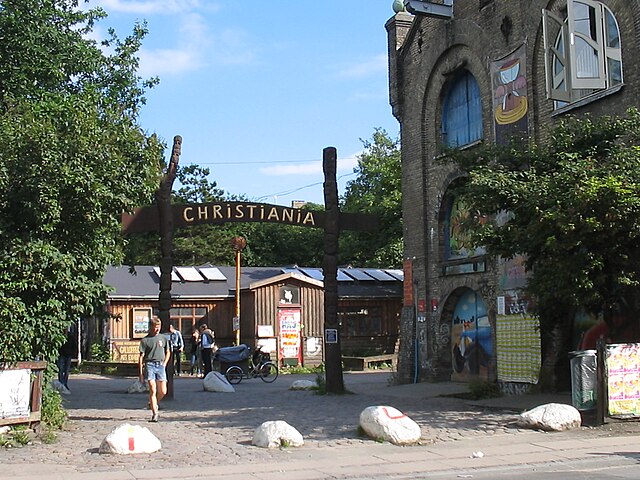
Perhaps it was in the last century, or perhaps at the beginning of this one, that I (Kung Chan) visited Copenhagen, the capital of Denmark. There is a place in this city called Fristaden Christiania, or Freetown Christiania. I wanted to take a look there, but many locals in Copenhagen strongly tried to dissuade me, mentioning that place was too chaotic and rather dangerous. At the time, I was young and fearless, and still wanted to see for myself just how “free” this “Freetown” really was.
When I arrived, I saw that this “Freetown” was in fact a low-lying area within the city. At the time, there were probably a few hundred people living there, along with some tourists wandering about. From what I observed then, most of the people were likely white, specifically those who had achieved little, yet wanted to live entirely as they pleased. This, perhaps, was what “freedom” looked like to them. They were in conflict with the police and the city, fundamentally at odds with the surrounding urban environment, and essentially maintained a state of lawlessness through confrontation. The existence of “Freetown” itself was formed through such confrontation. These individuals, through their resistance, had developed a sense of pride, though they were originally a group of people who failed to achieve other things, such confrontations somehow gave them a feeling of remarkable success.
When I finally walked into the place known as “Freetown”, what I saw was graffiti everywhere, along with makeshift shacks and small storefronts scattered in disorder. On display were badges, CDs, and all kinds of miscellaneous pamphlets and books. The people there seemed to believe in every religion and political figure in the world, whether it was Che Guevara or anyone else. There were also followers of all kinds of idols, with slogans and symbols painted everywhere, rainbow LGBT flags flying throughout, and the air thick with the pungent smell of marijuana. I remember that while I was there, I even bought a red souvenir badge with a symbol on it. The man with shoulder-length hair who sold it thought I was like him and started talking enthusiastically, though unfortunately, I couldn’t understand a word of it. In any case, these were people who see themselves as cool, who had no proper jobs and look down on conventional work, who favored freedom and indulgence and drifted from place to place; such people were everywhere in that “Freetown”. This was their base, their place of refuge.
My purpose in visiting “Freetown” back then was to study urban governance, how such a “city within a city” could emerge. Yet now it appears that they have, to a large extent, turned the entire world into that kind of “Freetown”.
The so-called “Western left” in the Western world are, in reality, mostly individuals with unsuccessful lives who position themselves against the mainstream.
Many have studied left-wing movements and ideologies. Professors, scholars, and intellectuals have produced large numbers of articles, papers, and books, speaking with apparent authority, tracing origins, and attempting to find justification in history and philosophy in order to present and embellish such behavior. In my view, many of them have simply never been to Copenhagen’s “Freetown”. No matter how much one tries to refine the movement through historical materials, today’s Western left is not mysterious at all. Indeed, they are basically similar to the people of that “Freetown”. Today, they have spread across the world, filling Europe and the United States, occupying universities and city streets. In the past, they were confined to Copenhagen’s Fristaden Christiania; today, they are everywhere across the globe.
They have not really changed. Looking at the positions of today’s “Western left” and comparing them with Copenhagen’s “Freetown” of the past, there is virtually little difference. Why do they attract young people? It is essentially being “cool”, indulging themselves, choosing the easiest and most comfortable path in life, and going along with the crowd. These are the same old patterns of seeking a sense of existence through opposing the government. The difference is that when politics in Western countries loses its stance and becomes complicit, turning to political opportunism, the impact becomes enormous: marginal groups have been transformed into the mainstream of today.
In 1971, when “Freetown” was established, the Danish government at the time believed that there would always be a segment of society made up of marginal individuals like the hippies, social outliers, the far left, and others. These are those who could not integrate into the precise machinery of mainstream society. Rather than suppress them by force, it was considered better to designate an abandoned military barracks in the Christianshavn neighborhood of the Danish capital city, where they could carry out a so-called “social experiment”. What the Danish government did not anticipate was that, today, large numbers of directionless young people would flow into this trend, to the point that nearly the entire Western world has become a testing ground for this kind of social experiment.
By the 2020s, the Danish government had finally resolved to transform “Freetown” and launched a process of urban renewal. Pusher Street, the hub of illegal marijuana trade within “Freetown”, was officially dismantled in 2024. By 2026, streets once covered in graffiti and lined with makeshift stalls are being repaved. Local authorities and residents have even worked together to dig up the original cobblestones, symbolizing a complete break from a past associated with violent gangs. The Danish government has also decided to construct 10,000 square meters of public housing on the site for rental purposes, aiming to bring about a fundamental transformation of the area.
The problem is that while Denmark’s “Freetown” can disappear, the “Freetown phenomenon” will not vanish that easily. On the contrary, it continues to expand, and its influence today has even spread across the entire world. At the same time, however, mutations are taking place. There is a kind of rebound from left to right, and countercurrents inevitably emerge in response. The target of this backlash is precisely the group represented by “Freetown”. One example is Charlie Kirk, a right-wing student leader in the United States who was assassinated.
Today’s so-called “Western lefts” are, in fact, simple-minded figures. They live within their own world. This was true in the past, and it will remain so in the future. The real complexity lies with Western politicians, who, without regard for the consequences, exploit the “Western lefts” and intellectuals of the West, making society bear the cost.
Final analysis conclusion:
Denmark’s “Freetown Christiania” may disappear, but the “Freetown phenomenon” will not fade away easily. On the contrary, it continues to expand, and its influence today has already spread across the world. The figures associated with contemporary left-wing thought are, in fact, quite simple people. They live within their own world, both in the past and will remain so in the future. The real complexity lies with Western politicians, who, without regard for the consequences, make use of this group and leave society to bear the cost.


