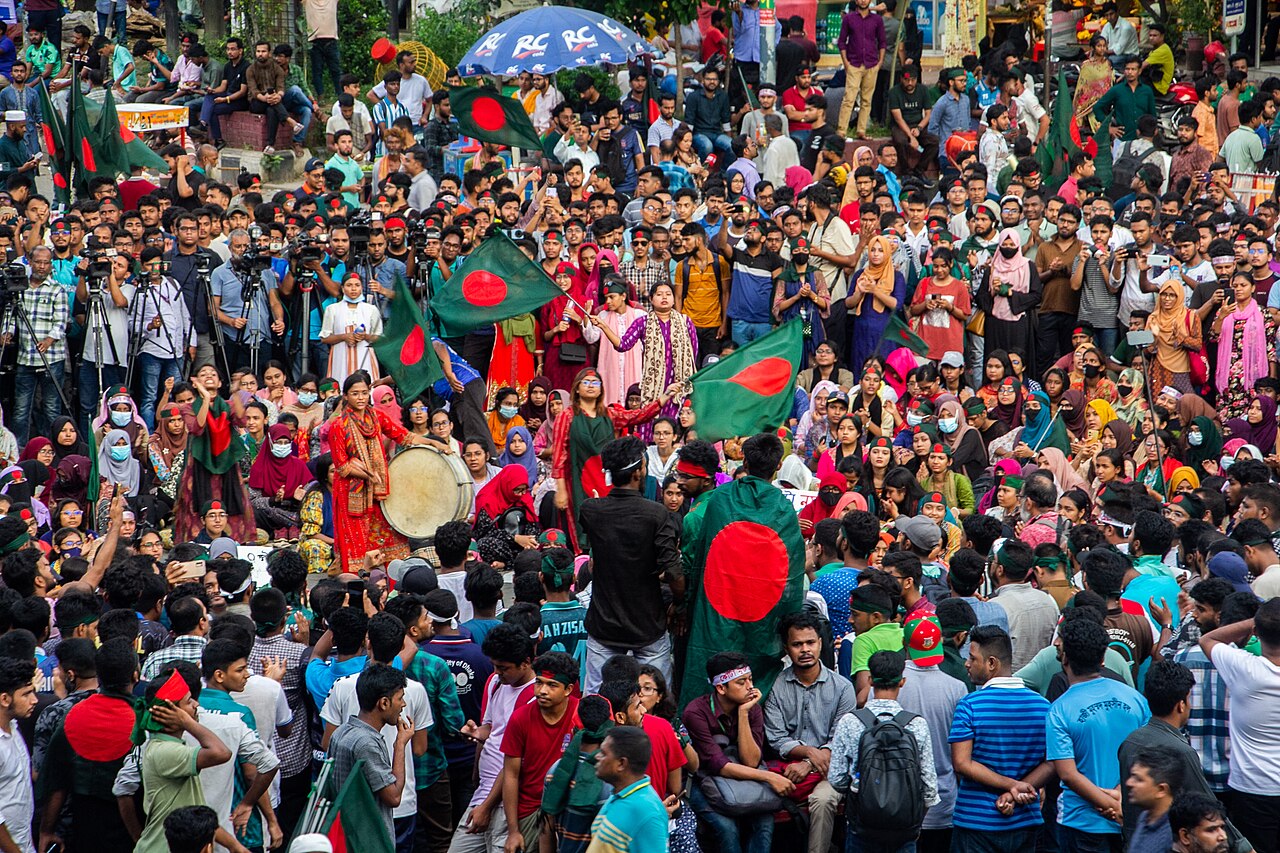
The
July Revolution, otherwise known as the Gen Z
Revolution, that took place in Bangladesh in 2024, began as a protest movement
led by Bangladeshi Generation Z students and ultimately escalated into a
nationwide uprising that brought down Prime Minister Sheikh Hasina, who had
been in power for 15 years. The immediate trigger was that on June 5, 2024,
Bangladesh's Supreme Court ruled to reinstate the public service quota system
that had been abolished in 2018. Under this system, 30% of government positions
were to be reserved for the descendants of veterans of the 1971 War of
Independence, which is widely regarded as a privileged class in Bangladeshi
society.
Large
numbers of students viewed the policy as deeply unfair to merit-based
employment. They launched class boycotts and peaceful demonstrations at major
universities, including the University of Dhaka, demanding reform of the quota
allocations. From July 16 to 17, armed student groups closely aligned with Chhatra
League the ruling party, along with the police, forcibly cracked down on the
protesters. Several students were killed, including student leader Abu Sayed.
These deaths sparked nationwide outrage, turning what had begun as a "minor
issue" into a full-blown national crisis.
To
prevent the situation from spiraling further, the Bangladeshi government
subsequently ordered the closure of schools nationwide, imposed curfews, and
cut off internet services. However, these familiar emergency control measures
proved ineffective. Sensing the gravity of the situation, Bangladesh's Supreme
Court ruled on July 21 to reduce the quota allocation from 56% to just 7%. By
then, however, the earlier bloodshed had fundamentally changed the nature of
public demands. The issue was no longer limited to quota reform; it had evolved
into calls for government accountability and resignation. As a result, unrest
escalated across the country. Clashes on August 4 alone left nearly 100 people
dead, making it the deadliest single day of the entire crisis.
On
August 5, tens of thousands of people broke through security cordons and
launched the "Long March on Dhaka". Protesters stormed the Prime Minister's
residence, and, faced with a situation she could no longer control, Prime
Minister Sheikh Hasina was forced to resign and fled to India by helicopter to
seek refuge. Bangladesh Army Chief Waker-Uz-Zaman delivered a nationwide
address, announcing that the military would "remain neutral" while assisting in
the formation of an interim government, and urging protesters to maintain
order.
At
this point, Bangladesh entered a period of power vacuum, raising the question
of who should steer the country's future. Once again, the solution came from
the Gen Z student movement. They invited in a major figure from abroad, the Bangladeshi
Nobel Peace Prize laureate Muhammad Yunus.
Throughout this process, a
decisive role was played by the student leaders of the Students Against
Discrimination Movement. These leaders made it clear that they would not accept
a government led by the Bangladeshi military and explicitly called on Muhammad
Yunus to step forward. Among the key Gen Z figures was Nahid Islam, a
26-year-old sociology student. In the early hours of August 6, 2024, he
formally announced via video that Bangladesh's student movement was proposing
Yunus as chief adviser of an interim government. Nahid later revealed that as
early as August 4, a day before Hasina's downfall, student leaders had already
reached out privately to Yunus, who was then in Paris, to ask whether he would
be willing to assume leadership at a moment of national crisis. It is reported
that after Hasina fled the country, Army Chief General Zaman played the role of
coordinator. He convened multi-party meetings and expressed support for the
Yunus proposal once it was put forward by the student leaders.
On August 8, at the urging
of student leaders, Yunus was sworn in as chief adviser of the interim
government, assuming leadership of the country's political and legal reforms.
Few had expected that he would end up doing such a remarkably good job in
Bangladesh.
According
to a survey released by the International Republican Institute (IRI) in
December 2025, around 70% of Bangladeshis expressed satisfaction with the
performance of the interim government led by Yunus. Drawing on his background
in economics, Yunus also delivered tangible results in stabilizing the national
economy, successfully averting a potential economic collapse. By December 2025,
inflation had fallen from double-digit levels at the time of Hasina's ouster to
8.49%, while foreign exchange reserves rebounded to USD 32.5 billion, enough to
cover three months of imports. Yunus also launched what has been described as
the toughest reform in Bangladesh's history of its corruption-ridden banking
sector, recovering hundreds of billions of taka in non-performing loans and
restructuring several banks on the brink of bankruptcy. In January 2026, under
Yunus's leadership, Bangladesh made significant progress in negotiations with
the United States on reducing textile tariffs, a move widely seen as an
important step toward strengthening trade and economic ties with the Trump
administration.
Gen
Z first stepped onto the world stage through social movements in Bangladesh.
How the world now views Gen Z, and the role they play in today's global
landscape, has become a major question of our time.
I
once believed that Gen Z is, in essence, a "Paper Generation, a generation
whose experiences and knowledge, including their understanding of the past, are
largely derived from books, written records, and imagination, one that we
perhaps can tentatively call the "Dream-Knowledge Generation". The word "paper"
here carries a dual meaning: on the one hand, it suggests something indirect
and superficial; on the other, it also conveys fearlessness, purity, and a
willingness to act boldly. Yet as time moves on, there is little doubt that the
future world will belong to Gen Z. They are the decisive generation of our era,
a generation with historic significance. At moments when the world stands at a
turning point, Gen Z will inevitably render the preceding generations insignificant.
Major
events in today's world are now closely intertwined with Gen Z, but what
defining characteristics do they actually possess? Only by understanding them
can we truly grasp the present and the future of our world.
Gen
Z is generally defined as those born between 1997 and 2012. Sociological
research suggests that they are no longer merely trendsetters, but active
rewriters of cultural rules. In cultural and social terms, their defining
traits can be distilled into the following key characteristics:
1. A
Culture of "Authenticity Over Perfection": Gen Z is highly critical and
anti-trend in spirit. Young people of this generation strongly reject anything
overly filtered or excessively polished.
2. Anti-Social
Socializing: By 2026, they prefer platforms like the French social media app
BeReal, which emphasizes immediacy, unedited content, and even removes likes
and follower counts. They enjoy posting "ugly" or unretouched photos,
celebrating raw, authentic moments over curated perfection.
3. Highly Populist with a Strong Iconoclast Tendency: Compared to
untouchable celebrities, Gen Z is more drawn to content creators who openly
show vulnerability, sharing their failures or mental health struggles.
4. A Generation of "Woke
Culture" and Social Justice: Gen Z is widely regarded as the most socially
conscious generation, integrating their values into everyday life. Take, for
example, the countless female students involved in the Bangladesh protests,
whose messages often read: "If I don't come back today, please tell my mother I
died like a hero".
5. A
Strong Sense of Boundaries: Gen Z rejects "hustle culture" and has popularized
the idea of "quiet quitting". They emphasize that work is only one part of
life, not its entirety.
6. Skeptical
of Authority: They do not follow authority blindly. In organizations and social
structures, they prefer flat, decentralized communication and value individual
contributions over hierarchy or seniority. They are a generation that questions
authority by default. Unsurprisingly, the authority often disappoints them.
7. The
Loneliest Generation: Gen Z is often called the "loneliest generation".
Fatigued by large, algorithm-driven public platforms, they turn instead to
Discord channels or private digital interest groups. They crave "vertical
socializing" built around deep, shared passions.
8. Retro
Revival: By 2026, Gen Z's fascination with physical objects like film cameras,
vinyl records, and the like has reached new heights. This is their way of
seeking tangible experiences and a sense of historical connection in an
otherwise purely digital world. Gen Z is, in many ways, a generation that looks
back.
Overall,
culturally, Gen Z represents a blend of pragmatism and idealism. On one hand,
they harness cutting-edge AI and digital technologies to reshape society. On
the other hand, they actively work to repair a real world that has been
overdeveloped and alienated. Starting with the student protests in Bangladesh,
the door to Gen Z's influence has already been opened.
No one knows exactly where Gen Z will take
the world, but it is clear that the world belongs to them. They are a decisive
generation, a historic generation, and they have already ushered in an entirely
new ideological era.


