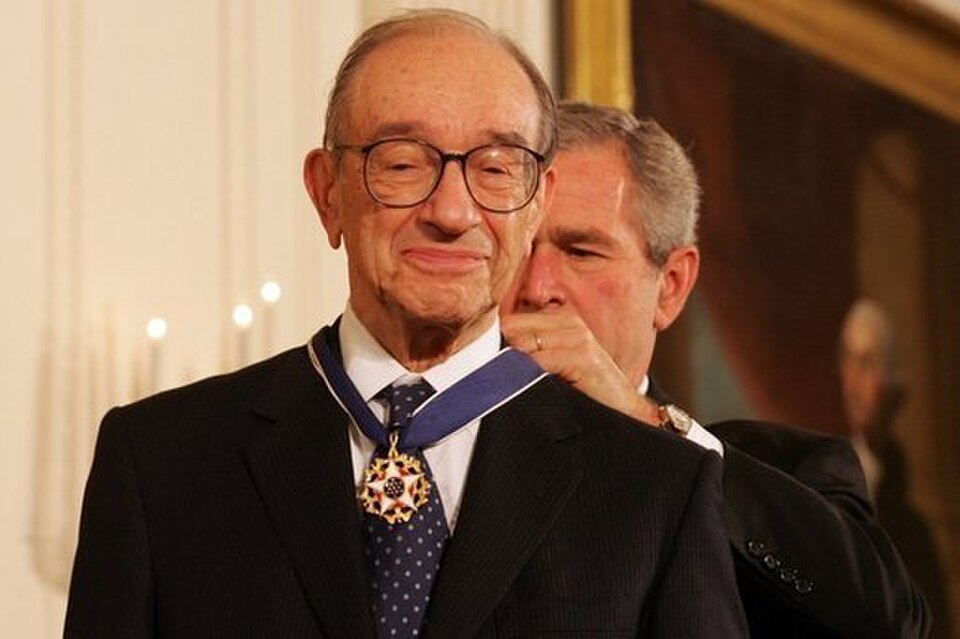
On June 22, former Federal Reserve Chair Alan Greenspan passed away at his home from complications of Parkinson's disease at the age of 100. Assessments of his legacy quickly split into two camps. One highlights his tenure at the Fed as an era of prolonged economic expansion, low inflation, low unemployment, and booming financial markets. The other notes his role in deregulating finance and tolerating asset bubbles, arguing he laid the basis for the 2007–2008 global financial crisis. The commentaries published by Bloomberg and The New York Times following his death largely stuck to these two narratives. Bloomberg discussed the growth, bubbles, and the "Greenspan put" of his era, while The New York Times focused on his post-crisis admission that his faith in the self-correcting power of free markets was flawed. These perspectives are certainly not without merit, yet they miss what truly makes Greenspan worth re-evaluating today.
A senior researcher at ANBOUND pointed out that Greenspan’s most significant identity was neither merely a monetary policymaker nor a free-market disciple, but rather a quintessential figure of political finance. Standing at the intersection of money, power, and politics, he played a unique role in American financial history.
Greenspan led a remarkable life. Born in New York in 1926, he initially studied music at the Juilliard School and played saxophone and clarinet in a jazz band. He later turned to economics, earning his bachelor's and master's degrees from New York University. He pursued a doctorate at Columbia University but left academia before graduating to co-found an economic consulting firm. From there, he entered the American political-economic establishment, serving as a campaign advisor to Richard Nixon and chairman of the Council of Economic Advisers under Gerald Ford, before Ronald Reagan appointed him Fed chairman. In addition, he eventually received his PhD in economics from NYU in 1977. In his later years, his marriage to NBC Washington correspondent Andrea Mitchell placed him squarely at the center of Washington's political and media elite.
Greenspan steered the Fed for nearly two decades (1987–2006), spanning four presidencies, i.e., Ronald Reagan, George H.W. Bush, Bill Clinton, and George W. Bush. His tenure witnessed the 1987 "Black Monday" crash, the long economic expansion of the 1990s, the dot-com bubble, the Long-Term Capital Management (LTCM) crisis, and the inflation of the housing bubble. He was perhaps most famous for using opaque language to guide market expectations. As he famously quipped, "If I seem unduly clear to you, you must have misunderstood what I said". Wall Street once scrutinized not just his words but even the thickness of his briefcase to guess whether the Fed would raise or cut rates. While Greenspan was not a straightforward public communicator and never sought the absolute transparency practiced by today's central bankers, he masterfully turned these apparent rhetorical shortcomings into a tool for expectations management. By forcing the market to search for signals within his ambiguity, he preserved maximum policy flexibility.
This style of communication contrasts with that of current central bankers like Jerome Powell. Today’s Fed relies heavily on transparency, economic modeling, forward guidance, and highly technical language, operating on the assumption that as long as the data is sufficiently detailed, the charts are clear, and the press conferences are thorough, the market will perfectly grasp its policy intentions. Yet reality often proves otherwise. The more detailed the explanation, the easier it is for the central bank to get dragged into public political crossfire.
What many fail to realize is that the Fed operates at the intersection of fiscal policy, finance, financial markets, and presidential politics. Interest rates are not merely economic variables, and adjusting them is never as simple as solving a formula based on inflation and employment. Rates directly dictate Treasury borrowing costs, fiscal deficits, stock market wealth effects, election cycles, corporate investment, and the credibility of the U.S. dollar. Consequently, a Fed chair cannot afford to be just an economist; the position is more akin to a master of political finance.
Greenspan’s genius lay in his keen awareness of his place within this political ecosystem. He never interpreted "independence" as a mandate to confront the U.S. President, nor did he try to turn the Fed into an adversarial center of political power. He understood that central bank independence is meant to shield monetary policy from direct, short-term political manipulation, not to turn the Fed chair into a public combatant against the White House. When independence is construed as a technocratic defiance of the political system, it not only fractures policy coordination but ultimately politicizes the Fed itself.
For this reason, he dedicated significant time to explaining financial policy to the Presidents, keeping communication channels open with the White House, and fostering cooperative relationships across party lines. In 1992, for instance, Greenspan, who is a lifelong Republican, flew to Little Rock to meet with President-elect Bill Clinton, a Democrat, quickly forging a bond of trust. During one of Clinton's State of the Union addresses, Greenspan sat right alongside First Lady Hillary Clinton. Such maneuvers put his extraordinary political-financial acumen on full display.
This is precisely where Greenspan’s legacy offers a lesson for today's Federal Reserve. The challenges currently facing the United States extend far beyond basic questions of inflation, employment, or interest rates. Indeed, they involve a complex web of fiscal deficits, Treasury financing, geopolitics, industrial reshoring, financial market stability, and coordination with the economic agendas of the President himself. The Fed can no longer pretend to be a purely technocratic institution. As ANBOUND previously noted when analyzing a potential Warsh-led Fed, the true challenge facing the central bank, beyond merely cutting rates or shrinking its balance sheet, is how to redefine its role amid the growing integration of fiscal and monetary policy.
In a sense, Kevin Warsh resembles a "Greenspan 2.0". He is neither a Powell-style technocrat nor a Bernanke-style crisis economist. Instead, he fits the mold of a political finance figure, combining a Wall Street background, deep Republican political ties, and Fed experience. He advocates for shrinking the balance sheet, opposes its permanent expansion, and wants the Fed to return to its core monetary mandate, all while coordinating effectively with President Donald Trump administration's economic policies. This dynamic means that a Warsh-led Fed could neither decouple from politics entirely nor simply become a pawn of the President. Its true task would be to strike a fresh balance between political realities and market discipline.
The Fed must understand that the core of independence is not about picking fights with the President, but about safeguarding the flexibility of its own policy judgment. It is not about standing above politics, but about maintaining the professional boundaries of monetary policy within the political architecture. In a system like that in the U.S., if the central bank entirely loses the support and understanding of the presidency and the Treasury, its so-called independence will ultimately morph into nothing but isolation.
Looking back at Greenspan's career today, the focus should not be just on the accuracy of his models or the success of his policies. Instead, what we should look at is how he transformed the role of Fed chair into a hub of political finance. He was deliberately keeping himself less noticeable, yet he made the markets hang on his every word. He kept a low profile, yet managed to serve four successive presidents. He came from an unconventional background and never viewed himself as a pure economic theorist. It was this very untraditional path that allowed him to see far more clearly than academic economists how money, debt, fear, and greed interact. This is why Greenspan truly deserves fresh study, not for how a central banker manipulates interest rates, but for how a figure at the center of power understands and navigates the political logic in the modern financial system.
Final analysis conclusion:
Greenspan was not a mere monetary policy expert but a quintessential figure of political finance. His brilliance lay in his accurate grasp of the Fed's institutional position between politics, fiscal policy, and the markets. For today's Federal Reserve, Greenspan's legacy shows that central bank independence does not mean fighting the president, but rather maintaining policy coordination within political realities. The Fed needs to return to its core duty of stabilizing interest rates and finance, rather than morphing into a new center of political power.
______________
Zhijiang Zhao is a Research Fellow for Geopolitical Strategy programme at ANBOUND, an independent think tank.


