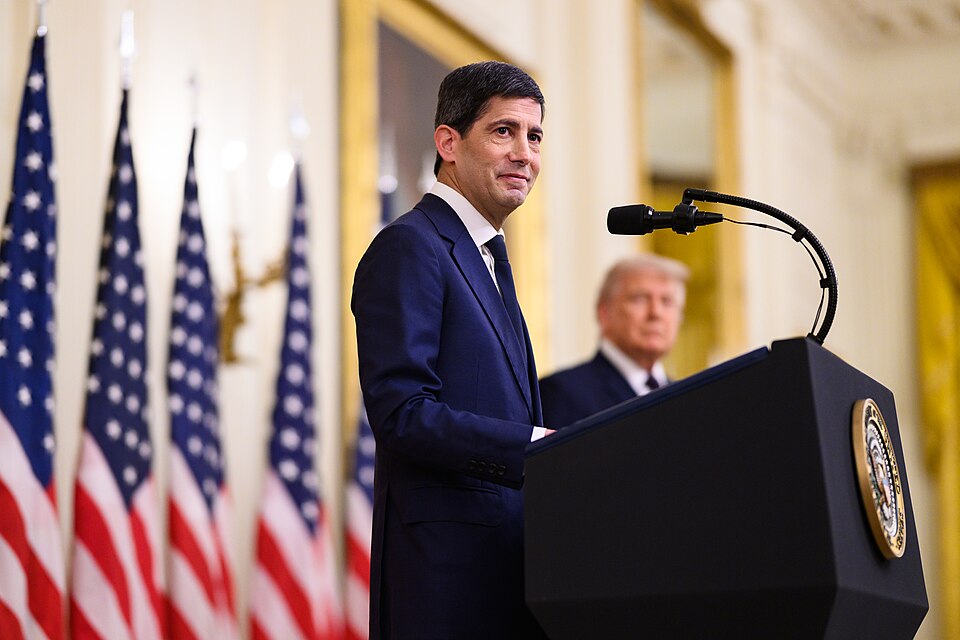
As the newly appointed Federal Reserve Chair Kevin Warsh prepares for his inaugural monetary policy meeting, U.S. capital markets have faced a turbulent Friday. At the close of trading on June 5, local time, the Dow Jones Industrial Average dropped 1.35%, marking its sharpest single-day decline since March 27 of this year. The Nasdaq Composite fell even more precipitously by 4.18%, its worst single-day performance since April 10, 2025, while the S&P 500 shed 2.64%, registering its largest one-day drop since October 10, 2025. Although this "summer chill" has temporarily abated, Goldman Sachs has warned investors against dismissing the volatility as a mere one-off anomaly. The U.S. equity market continues to exhibit a "K-shaped" divergence, driven by geopolitical risks and sustained investment in artificial intelligence. However, the trajectory of the Fed’s policy remains a paramount variable governing market direction.
The immediate catalyst for this sell-off was the latest batch of U.S. labor market data. Released on the evening of June 5, nonfarm payrolls for May surged by 172,000, far exceeding the consensus market forecast of 85,000, while the unemployment rate held steady at 4.3%. Furthermore, nonfarm payroll figures for March and April were revised upward by a combined 93,000, propelling employment growth over the past three months to its strongest performance in more than two years. This robust labor market performance directly contradicts the stagflationary outlook previously anticipated due to Middle East conflicts. Consequently, markets have begun pricing in the probability that the Fed will be forced to raise interest rates this year to combat mounting inflationary pressures. Following the report's release, the CME FedWatch Tool showed that the implied probability of a rate hike by year-end spiked from 48% to over 60%, while the 10-year U.S. Treasury yield jumped above 4.5%. Subsequent Consumer Price Index (CPI) data for May further exacerbated concerns of an overheating economy. The May CPI rose 4.2% year-on-year, marking a three-year high and registering its third consecutive month of sharp increases. Crucially, the stellar employment data implies that the underlying economy remains fundamentally healthy.
Given that sticky inflation suggests near-term pressures will not quickly dissipate, the market consensus overwhelmingly expects the Fed to hold interest rates steady at its upcoming policy meeting. This shift further diminishes the likelihood of the rate cuts that President Trump has persistently advocated, undoubtedly presenting the newly installed Fed Chair with an immediate challenge. Market observers warn that if Warsh were to push for a rate cut at his maiden FOMC meeting, it would run completely counter to the available empirical evidence. Moreover, should employment growth sustain its May pace, interest rate hikes will realistically be back on the agenda this year.
Researchers at ANBOUND maintain that a resurgence in inflation does not imply that Warsh will embark on immediate rate hikes. While the employment situation is more optimistic than expected, the stable unemployment rate suggests the U.S. economy is not exhibiting definitive signs of overheating. The moderate uptick in inflation appears to be more of a reflection of short-term volatility induced by geopolitical risks. Along with this, interest rate hikes remain a bitter pill for the Trump administration to swallow, especially given that monetary tightening was the core point of contention between Trump and former Fed Chair Jerome Powell. A rate hike would not only invalidate Trump’s advocacy for lower rates but would also signal a failure in his inflation-management strategy, forcing him to bear the political fallout in the upcoming midterm elections. Reports indicate that President Trump has reiterated that the employment figures are "fantastic". He complained that the market focuses excessively on the potential for Fed rate hikes rather than the dividends of economic growth, arguing that when economic data is strong, growth actually dampens inflation, and the stock market should rally. Trump stated that while he desires lower interest rates, the ultimate decision rests with Fed Chair Warsh. Although Trump's demands for rate cuts are notably less urgent than before, they leave Warsh with very limited policy maneuvering room. Concurrently, new developments arising from the conflict in the Middle East suggest that Warsh’s prior arguments for cutting rates must now be deferred for deeper, long-term consideration.
For Warsh, beyond mere interest rate adjustments, the Fed’s institutional reform remains a viable complementary toolkit for monetary policy. ANBOUND has previously analyzed Warsh's policy framework of combining rate cuts with balance sheet reduction. Now, as the prospects for rate cuts or hikes become increasingly remote, the likelihood is growing that Warsh will push for Fed reforms alongside quantitative tightening (QT).
Before assuming the position as the Fed’s Chair, and while explaining his policy stance to the public, Warsh repeatedly addressed the issue of balance sheet reduction. He has long been a vocal critic of the Fed's current balance sheet, which stands at approximately USD 6.6 trillion down from a peak of USD 8.97 trillion. Indeed, during his first term as a Fed Governor, he resigned partly over this issue. Warsh contends that previous rounds of quantitative easing caused an excessive expansion of the central bank's balance sheet, distorting market signals. In his view, active central bank intervention should be curtailed to avoid market imbalances caused by the normalization of balance sheet tools. Therefore, with rate-cutting options constrained, balance sheet reduction is expected to become the signature initiative of the Warsh era that is capable of delivering immediate results.
Previously, Fed Governor Stephen Miran, alongside three Federal Reserve economists, published a working paper titled A User’s Guide to Reducing the Fed’s Balance Sheet, which outlined the strategic logic and potential pathways for QT. As of March 22, 2026, the Fed’s total assets stood at approximately USD 6.646 trillion. On the liability side, bank reserves accounted for roughly USD 3.073 trillion, currency in circulation stood at USD 2.390 trillion, the Treasury General Account (TGA) held about USD 806 billion, and the foreign official reverse repo pool hovered around USD 325 billion. Currently, the Fed's balance sheet represents about 21% of US GDP. Past Fed reforms were designed to encourage commercial banks to hoard reserves to mitigate financial risks. However, the Fed must now pay interest on more than USD 3 trillion in excess reserves, a practice non-existent before the 2008 financial crisis. This has led to a sense of complacency among commercial banks, which prefer to reap risk-free returns on reserves rather than extend credit to the real economy. According to the median estimates in the working paper, a successful rollout of these reforms could see the balance sheet contract to a relative size of around 18% of GDP, aligning it with levels seen in 2012 or 2019. This analysis will clearly serve as the blueprint and operational roadmap for balance sheet reduction under Warsh’s leadership. Nevertheless, as Warsh himself has acknowledged, winding down the balance sheet cannot happen overnight. Miran similarly noted that once preparatory work for the reforms begins, the typical timeline dictated by the Administrative Procedure Act (APA) means it could easily take over a year, or even several years, to implement. He pointed to the Supplementary Leverage Ratio (SLR) reforms as a benchmark, which took nearly six years to transition from temporary relief to formalized regulation.
Based on current disclosures, Warsh’s approach to balance sheet reduction, i.e., primarily on draining bank reserves, may yield structurally different policy outcomes compared to the Powell-era QT, which centered on passive asset runoffs. Powell’s QT aimed to tighten aggregate liquidity, though the process was halted late last year to allow for flexible liquidity adjustments. In contrast, the balance sheet reduction envisioned by Warsh and Miran is more likely aimed at reducing compliance-driven capital locks on commercial banks. This would unlock and release more liquidity to commercial banks and financial institutions, thereby supporting the real economy and capital markets. Treasury Secretary Scott Bessent recently emphasized that balance sheet adjustments depend entirely on the Fed's own volition. He noted that a pivot toward an ample reserves framework actually needs maintaining a sizable balance sheet. Bessent anticipates that the Fed will likely take a step back and spend at least a year deliberating on the intended course of action. This suggests that the Treasury does not favor a continuation of aggressive, traditional quantitative tightening, which is an indication of the complex, protracted nature of the reform decisions facing the central bank.
Inevitably, the ultimate outcome of this balance sheet reduction remains fraught with uncertainty. On the one hand, the painful lessons of the global financial crisis remain fresh. While drawing down reserves can lower financing costs for financial institutions and free up capital capacity, higher leverage inherently magnifies systemic risk. If the economic cycle reverses, banks' capacity to weather shocks will be compromised, potentially reviving the specter of financial crisis. On the other hand, aggressive balance sheet contraction carries the risk of triggering unanchored inflation. An estimate by Goldman Sachs indicates that abruptly eliminating the interest on reserves and forcing a liquidation of the entire USD 3 trillion reserve pool could drive the U.S. core PCE inflation rate up by 1.2 to 1.5 percentage points.
Although balance sheet reduction presents its own set of dilemmas, market institutions and Miran's paper have nonetheless charted a technical path forward for reform. Analysts at BNP Paribas estimate that by amending banking liquidity regulations such as allowing discount window borrowing to count toward liquidity coverage requirements or optimizing clearing mechanisms in the repo market, the banking sector's reserve demand could be reduced by approximately USD 700 billion without inducing severe market dislocations. Miran's paper further demonstrates that reserve demand itself can be shaped by policy. Through a series of regulatory and operational framework adjustments, it is entirely feasible for the Fed to achieve a significant downsizing of its balance sheet while still preserving an ample reserves framework. Ultimately, however, the tension lies in the politicization of the Fed. The central bank under Warsh must find the institutional space and policy trajectory to align with Trump’s economic agenda, a task that remains exceedingly difficult in the current American political landscape.
Final analysis conclusion:
The "rate cut + balance sheet reduction" monetary policy framework proposed by the new Federal Reserve Chair Kevin Warsh has evolved into a double dilemma under prevailing economic conditions. Amid rising inflation and a robust labor market, the justification for Fed rate cuts is tenuous at best. While a contraction of the balance sheet remains technically feasible, the central bank will need to calibrate its pace and intensity with extreme precision.
______________
Dr. Wei Hongxu is a Senior Economist of China Macro-Economy Research Center at ANBOUND, an independent think tank.


