
China is facing a population upheaval that could reshape its future. In 2022, China's population shrank for the first time since the famine of the Great Leap Forward (1959–1961). China has one of the world's lowest fertility rates, and its population decline is accelerating. By 2050, China's population could lose 250 million people from its 1.4 billion (as of 2026)—nearly three-quarters of the United States' 2026 population (see Figure 1).
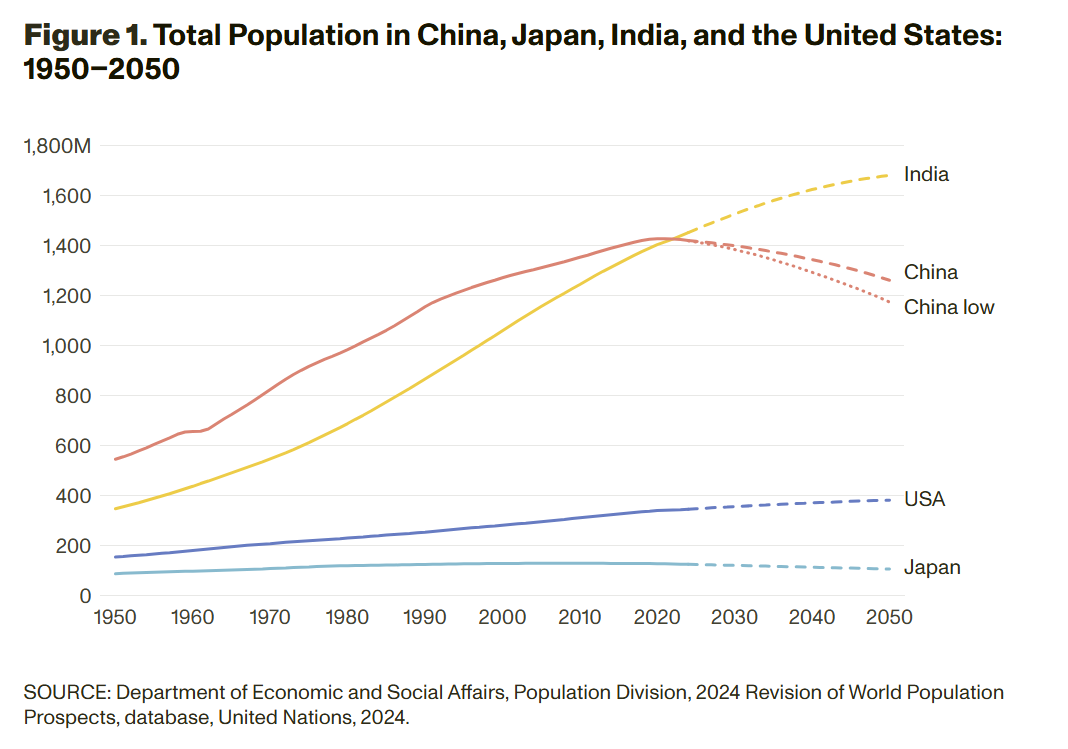
The real problem does not stop at fewer people. Falling birth rates and rising life expectancy mean that China's population is also aging fast.[1] The number of working-age people peaked in 2015 and has been decreasing ever since. By 2050, there will be fewer than two working-age adults for every person ages 65 and older, compared with more than two and a half working-age adults per older adult projected for the United States. This trend threatens to upend China's ability to grow its economy, strain its pension and health care systems, and threaten its national security. In the first RAND report on this topic, the authors consider the significance of rapid population aging on China's national security.
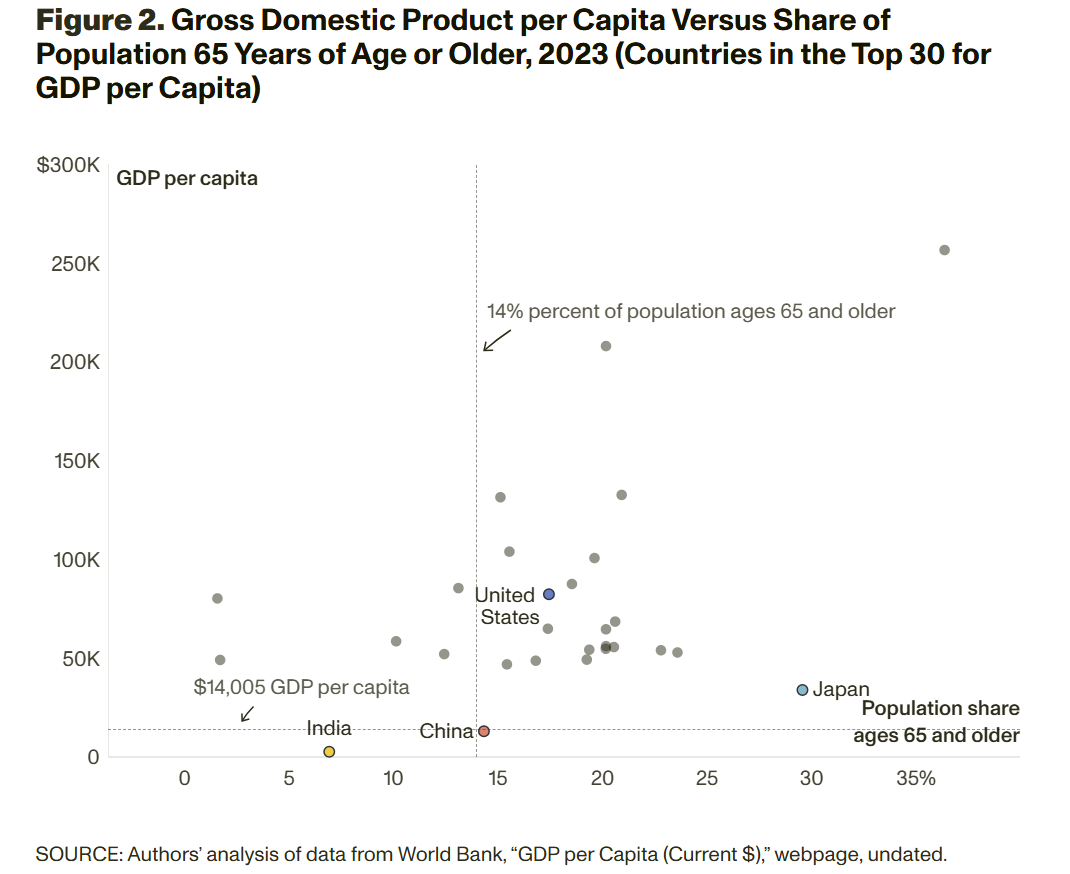
Compounding the aging challenge, China is yet to become a high-income nation.[2] Often, countries undergoing fertility decline benefit from a demographic dividend—a time of economic growth driven by a large working-age population compared with smaller numbers of dependents ages 65 and older and younger than 15. Beginning in the 1980s, China experienced unprecedented economic growth during its dividend period, but because it started later than its neighbors (such as Japan and Singapore) and its speed of fertility decline has been faster than others, it has exited this demographic dividend era with relatively low income per capita, leaving it with fewer resources to address the pressures of an aging population. For example, the United States and Japan both have higher shares of people ages 65 and older than China, but both countries also have substantially higher average economic output per person (gross domestic product [GDP] per capita), providing a higher standard of living and economic well-being for their residents, and more economic resources to support their aged populations. The United States and Japan got rich before they got old, but China got old before it got rich, which will pose challenges in the future (Figure 1). India, which has a population that is just starting to age, is not yet rich or old but may still be able to capitalize on the window of opportunity offered by its demographic dividend (see Figure 2).
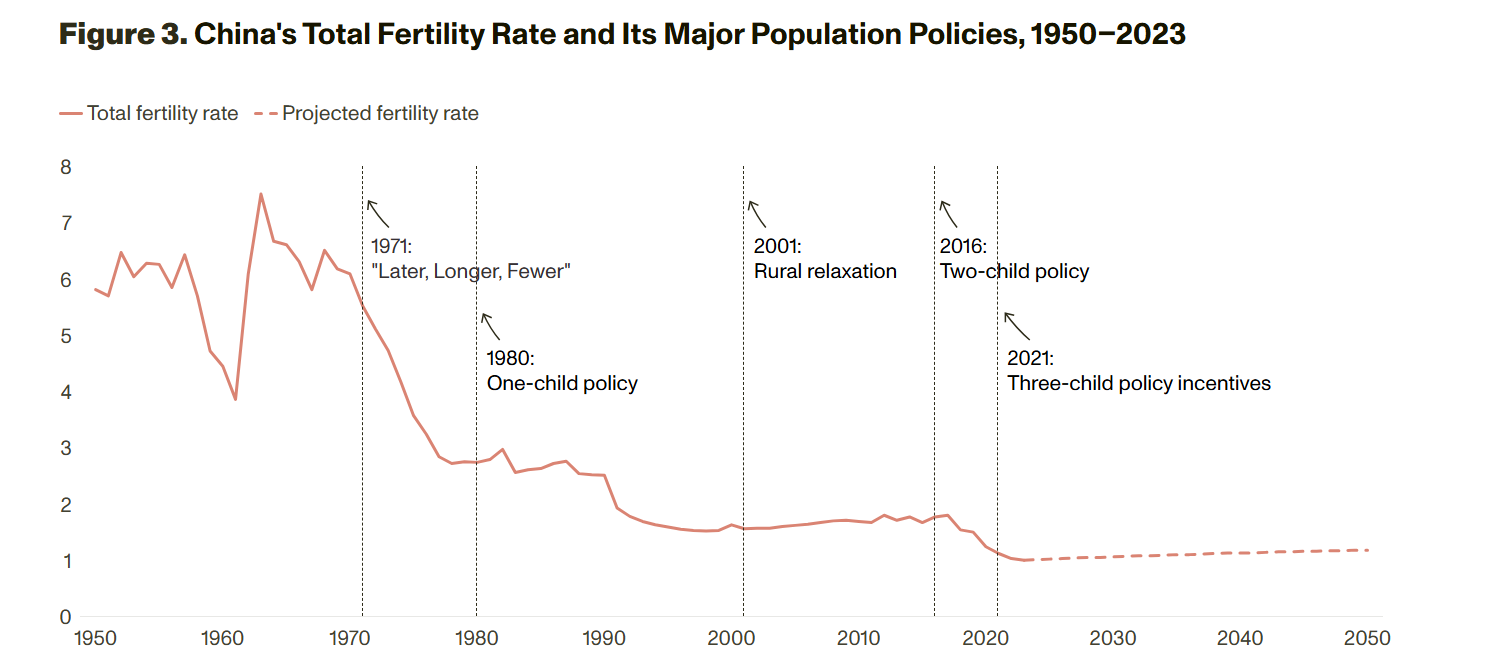
China's declining fertility rate dates to the 1960s (well before the one-child policy was instituted in 1980),[3] when women gave birth to around six children each. Since 1990, the total fertility rate has consistently been below the rate needed to sustain the population.
Even after China ended the one-child policy and moved to two- and three-child policies, the fertility rate has declined or stagnated (Figure 3).
Adding to the challenges faced by the Chinese Communist Party (CCP), youth unemployment in China is high and growing numbers of young people are opting for lower-paying, less stressful careers outside China's highly competitive work culture. Finding solutions to tend to the needs of older adults while encouraging the career hopes of younger people will test how much public trust and support the CCP has.
The culmination of these trends is that the proportion of the population that is 65 years and older is rapidly increasing. Figure 4 presents the age distribution of China's population, broken down by age and sex in 2020 and as projected for 2050.
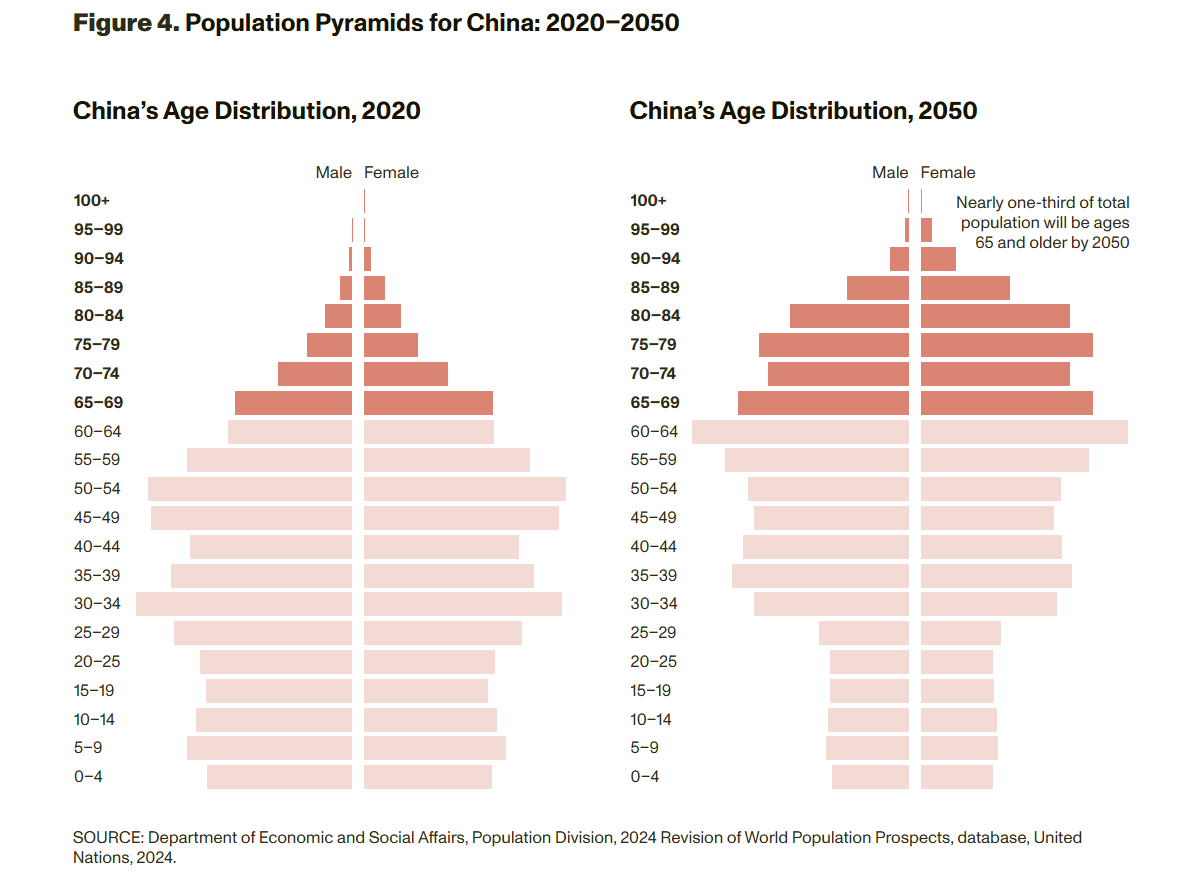
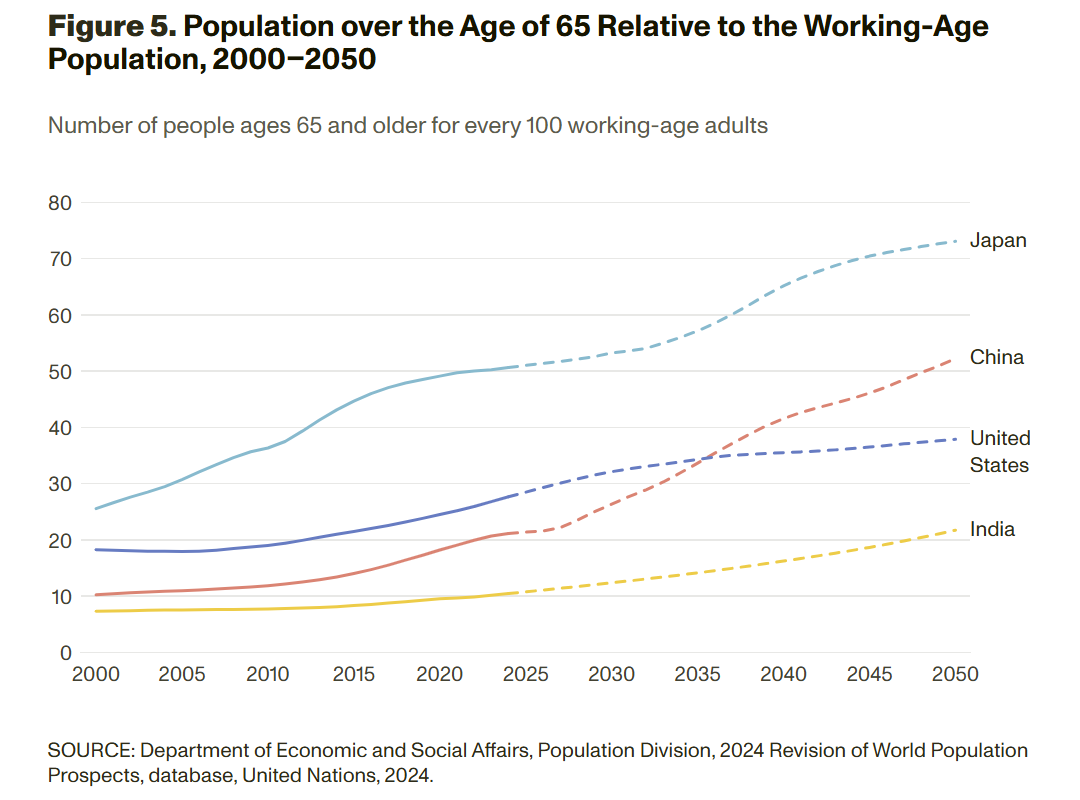
Comparing China's population age and sex structures from 2020 with those of 2050 shows how changes in the fertility rate over time have led to a steadily increasing dependency ratio (the number of people ages 65 and older compared with the number of younger working adults). In China, the proportion of seniors is rapidly catching up to Japan's (which has the world's oldest population) and will pass the the U.S. proportion of seniors in about a decade. Right now, for every person age 65 and older in China, there are about five working-age adults. By 2050, there will be fewer than two for every person age 65 and older, and people ages 65 and older could represent nearly one third of the population (see Figure 5).
Aging countries often see declines in global influence and in economic and military power, but outcomes depend on how the state responds. An aging population poses three kinds of security issues for China.
Aging societies face concerns over military security because with a shrinking younger population, the pool of potential military recruits is shrinking and the military must compete for funding with other priorities (possibly in a contracting economy). [4] States can partially address a smaller recruitment pool through technology, strong alliances, and improved military efficiency. China likely has time before military security becomes a major problem. Key implications of population trends are:
Structural security will also present challenges.[5] As China's population ages, it will become harder for the government and economy to support seniors. The population having fewer workers paying into pension plans means that there will be less generous benefits for retirees.
How the government responds will shape the impact, and funding for the military and social programs does not have to be a zero-sum game. China will face tough challenges but has chances to adapt. Some key implications of population trends for structural security are:
Regime security is another concern for China. [6] Typically, regime security is a relatively minor problem for many aging societies because such societies are often peaceful and democratic. Aging societies may be unwilling or unable to risk casualties in wars and their governments may strengthen partnerships with other countries to compensate, thus strengthening regional ties. China, however, faces the structural security challenges detailed previously, which may subsequently threaten regime security. Some key implications of population trends for regime security include:
China has several options to consider to address its population problems.
While boosting the birth rate may seem like an obvious fix, history shows that this is not enough. Of the 75 countries with populations of more than 2 million people that had their fertility rate fall below replacement after 1950, only Kazakhstan and Mongolia have total fertility rates greater than 2.1.[7] Even aggressive pro-birth policies may nudge only the timing and not the number of births.
Because the costs of raising a child in China are among the world's highest, the CCP is rolling out a suite of new supports. A directive from the General Office of China's State Council in 2024 introduced 13 targeted interventions addressing childbirth support, child care, and housing, employment, and education. In addition to financial supports, the CCP is working to change norms around family size, such as adding two new children to a long-standing sculpture in Wuhan that originally depicted a family with one child (Figure 6).

NOTE: Reproduced from Shanghai Daily, 2024.
Large-scale immigration is not a realistic fix for China. Its population is too large for immigration to make a meaningful impact, and the country's immigration policies are restrictive. Since the 1970s, more people have left China than have moved to China, and net migration out of China has fluctuated between 100,000 to 700,000 people per year since 2000. Although large-scale immigration is unlikely, the country could allow more international workers in the future for certain jobs, such as domestic workers (such as from the Philippines) and caregivers.
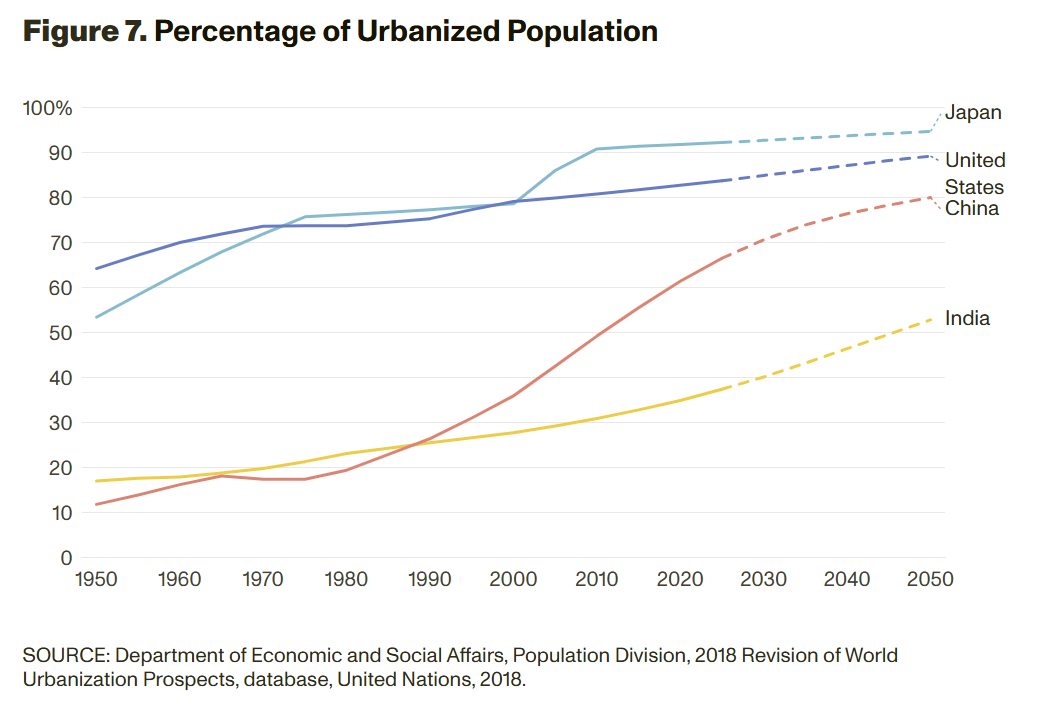
One lever to maintain economic growth is to entice more of the rural population to move to cities. Higher urbanization could be expected to boost economic growth and has been one of the main engines of China's economic boom through infrastructure development, economies of scale, innovation, and entrepreneurship. China's rate of urbanization, about 65 percent, lags that of most other industrialized countries, leaving substantial room yet to grow. However, nighttime light satellite imagery suggests that urbanization in China is already largely complete or at least well above the United Nations Population Division's 2025 estimate, and China's census data show that rural residents are much older than those living in cities, making it harder to achieve gains (see Figure 7).
Furthermore, China's hukou (household registration system) restricts the freedom to migrate within the country. In place since 1958, hukou ties people's access to jobs, health care, housing, and schools to their assigned district. This assignment is inherited and locks migrants out of public services and property ownership, even if they move, which reinforces social divides. Relaxing this system, which was hinted at in Beijing's 2025 policy shift, could unlock economic and other benefits, regardless of urbanization trends.
A shrinking population of young people may diminish military capabilities, but this outcome is not inevitable. Modern warfare does not rely on only manpower and force size but also technological superiority. Technology and robotic systems can replace some manpower needs, potentially more cheaply.
Moreover, considering existing unemployment trends and the progress being made in automation and technological innovation, expanding the workforce may be less essential in the long run. Instead, a smaller and more–highly skilled workforce that is supported by investment in emerging technologies could address labor shortages and boost economic growth.
Until 2025, China had the world's lowest retirement age—60 for men and 55 for women. China is now slowly raising its retirement age to 63 for men and 58 for women by 2040. Although this move is unpopular, it could contain the growing cost of providing pensions and reduce the burden on the working-age population by expanding that population. However, meaningful pension reform will require a comprehensive approach beyond adjusting retirement ages, including a reassessment of benefit formulas, contribution rates, and eligibility requirements. Such changes as these could also be unpopular, lowering the public's support for the government's policies.
In Table 1, the authors highlight key considerations for the policy options described in this brief.
| Policy Lever | Viability | Positive Considerations | Negative Considerations |
|---|---|---|---|
| Pro-birth policies | Unlikely sufficient | The CCP might have more social and structural power to exert on fertility than other governments do. |
This policy may affect the timing of childbirth, but such policies are unlikely to increase the total number of children. The cost of raising a child in China is second highest in world. |
| Immigration | Not viable | Such a policy could be used in specific sectors or geographical areas. |
There is a long history of net out-migration in China. The population is too large for immigration to significantly affect working-age population size. |
| Addressing the rural-urban divide | Possible impact |
Rural residents could move to cities. Revising the hukou system could ease access to urban cores and services. |
The urbanization of the working-age population may be largely complete. |
| Reliance on technology | Possible impact |
Modern warfare is not necessarily reliant on force size but on technological superiority. Technology and robotic systems can replace some labor manpower needs. |
Such a policy would likely cause a short-term increase in unemployment because rapid automation outpaces new job creation. |
| Increasing retirement age | Possible impact | Increasing the retirement age (the world's lowest until 2025) extends the viability of the pension system and reduces the dependency ratio. |
Such a policy may exacerbate the youth unemployment crisis. This would be unpopular among the near-retirement population. |
China faces a unique challenge: Its society is getting old fast but has not become rich. Most countries age after reaching high-income status, but the rapid drop in China's birth rate and longer lifespans for its population mean that it is dealing with these issues sooner. How China handles its population crisis will shape not only its own future but also the stability of the region and the global economy. China's policy choices—from encouraging families to have more kids to using new technology—will also be an example for other middle-income countries facing similar problems. As China's workforce shrinks and financial pressures grow, the impact will be felt worldwide, changing the global security environment, economic relationships, and international alliances.
Sourced from https://www.rand.org/pubs/research_briefs/RBA3372-1.html


