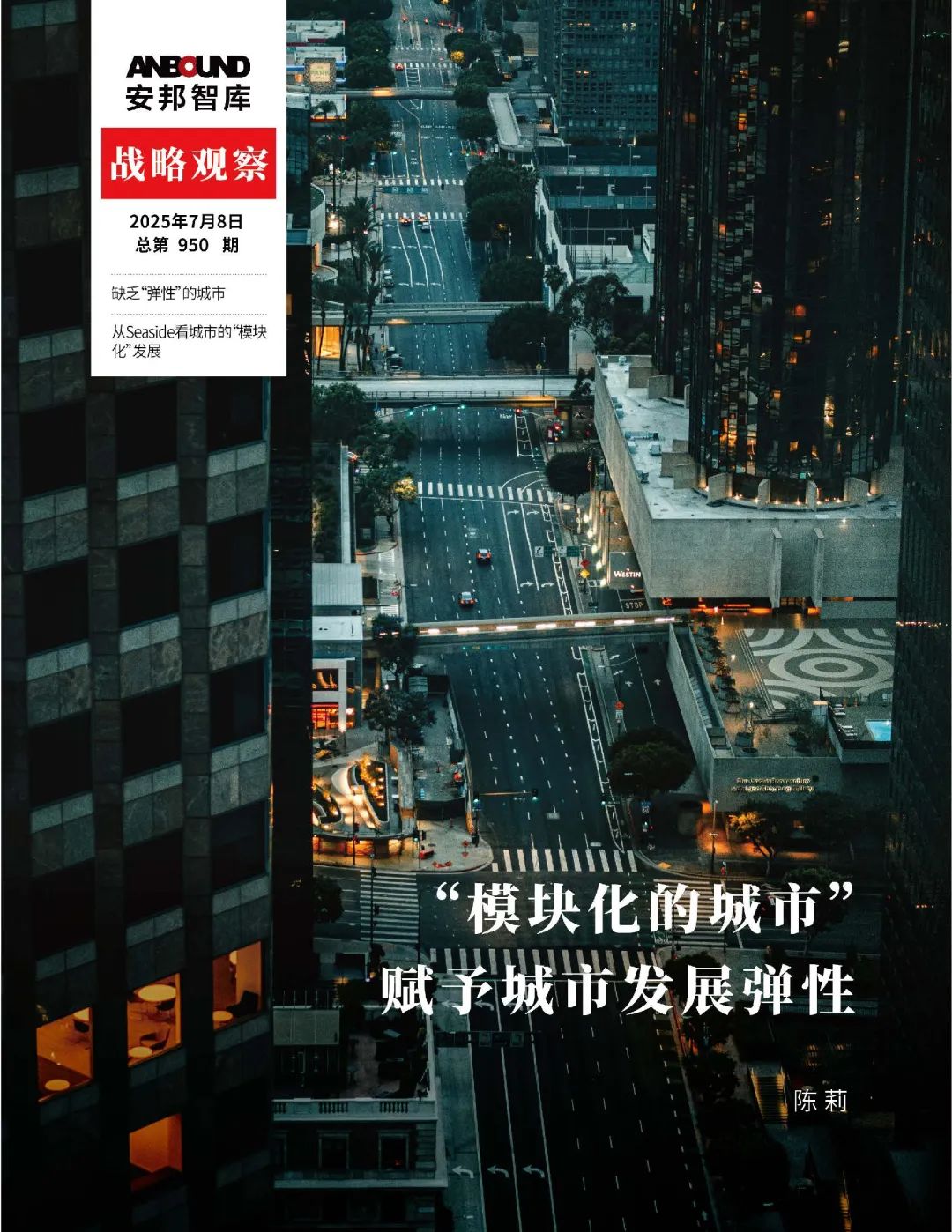
ANBOUND Strategic Research Report | Contemporary Modular Cities and Resilient Development
By Chen Li (Economic Research Fellow at ANBOUND)
Driven by more than four decades of rapid urbanization, Chinese cities have experienced astonishing growth in both scale and density. Yet, deep-seated problems have emerged, including rigid spatial structures, fragmented functional zones, excessively long commuting distances, and sluggish administrative responses. All of these issues point to a core deficiency: insufficient capacity for self-adjustment and rapid recovery in the face of change and shocks. The centralized, functionally zoned planning model that currently dominates urban development is increasingly unable to meet the demands of high-quality urban growth.
Against this backdrop, the theory of the “modular city” proposed ANBOUND’s founder Kung Chan offers a systematic pathway for breaking through the current impasse. This theory advocates restructuring cities into multiple functionally complete, independently operating urban modules. Each module contains relatively self-sufficient residential, commercial, educational, and recreational elements, organized around a core space to achieve both autonomous operation and flexible expansion. Such a structure not only reduces the radius of administration but also enhances urban resilience and improves residents’ quality of life.
The town of Seaside in Florida, United States, serves as a concrete real-world example of such a module. With its compact urban form, pedestrian-friendly design, and mixed-use functions, Seaside has created a livable and sustainable community unit. Its success demonstrates that even modules at a small scale can achieve strong spatial resilience when they are well organized. When integrated with China’s specific national conditions, the theory of the “modular city” can form a replicable and practicable paradigm for urban renewal. This paradigm provides a clear pathway for addressing contemporary urban issues and for guiding cities in the transition from structural rigidity to “systemic resilience.
Click here for more information about ANBOUND's report on this issue (in Chinese).


