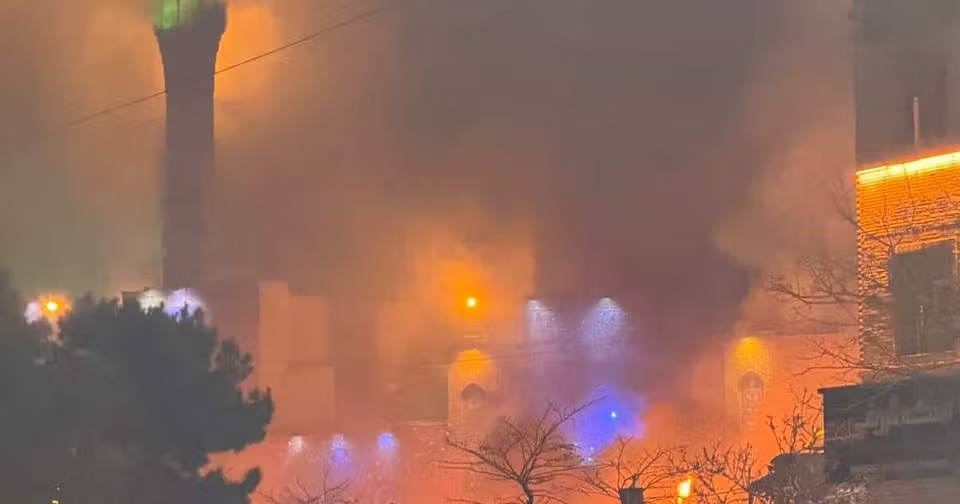
Despite harsh crackdowns, large-scale protests still erupt across multiple regions of Iran. Available information indicates that recent demonstrations have spread to all 31 provinces and more than 180 cities nationwide. Beyond major metropolitan centers such as Tehran, large gatherings have also appeared in Kurdish areas and in provinces traditionally regarded as politically conservative.
From the available information, this wave of protests was initially triggered by Iran’s livelihood crisis, where high inflation has caused a sharp depreciation of the Iranian rial, while the costs of basic necessities like water, electricity, and food have risen rapidly. Within a very short period, the demonstrations quickly evolved into open resistance against Iran’s theocratic government and Islamic rule itself, extending further to challenge the very essence of Islamic authority.
Both Iranian state media and opposition outlets reported that during clashes on the night of January 9, as many as twenty mosques in Tehran were set ablaze or severely damaged, with related footage spreading rapidly on social media. Almost simultaneously, an Iranian expatriate living in California posted a deliberately provocative and satirical statement on social media, suggesting that Iranians are willing to donate the tomb of Islamic Revolution leader Ayatollah Ruhollah Khomeini to the U.S. President for redevelopment into a hotel and casino. Iranian authorities swiftly condemned the remark as a blasphemous provocation against the revolution.
In Rasht, a major city in northern Iran, local opposition groups and human rights organizations claimed that after several students were killed during security force crackdowns, enraged protesters carried out coordinated attacks on religious buildings across the city. Meanwhile, a video widely shared on Iranian social media became one of the most iconic visual symbols of the protests and inspired widespread imitation, where a young Iranian woman, with a cold and contemptuous expression, and without wearing a hijab, lit a cigarette in her mouth with a burning portrait of Supreme Leader Ali Khamenei.
From street protests to the destruction of symbols in the spiritual realm, it is evident that what Iran is experiencing is no longer merely a social movement opposing a specific policy or government. Rather, it has become a movement centered on opposition to religious rule itself, rapidly spilling over into society at large as a process of de-Islamization. It must be emphasized that this trend is not a spontaneous emotional outburst, but one closely linked to structural changes within Iranian society, particularly the ideological shift of the new generation.
To understand this transformation, one cannot look solely at Iran’s current economic hardships and street confrontations. The broader context must be considered, which requires revisiting the historical evolution of Iran’s politico-religious system.
In 1979, the Islamic Revolution overthrew the Pahlavi monarchy, and revolutionary leader Khomeini swiftly established the framework of the Islamic Republic. A nationwide referendum in March 1979 approved a new constitution with a 98% majority, institutionalizing a highly centralized system of clerical rule in which Shiite Sharia became the ultimate source of political legitimacy. In its early years, the new regime displayed relative stability, integrating various revolutionary factions, including Islamists, leftists, and nationalists, and strengthening internal cohesion by exporting revolutionary ideas such as pan-Islamism and Third World anti-Americanism.
Over time, however, Iranian society underwent a pronounced generational ideological shift. The revolutionary generation, deeply influenced by Khomeinism, demonstrated remarkable resilience during mobilization for the Iran–Iraq War in the 1980s. Under conditions of war and sanctions, religious authority retained considerable moral capital. From the 1990s onward, however, driven by education, globalization, and internal governance crises, Iran’s younger generations increasingly gravitated toward pragmatic nationalism, secularism, and universal liberal values. From the nationwide protests sparked by the death of Mahsa Amini in 2022 to the most recent demonstrations, the main driving force has been Iran’s Gen Z, who are mostly highly educated, possess strong critical thinking skills, and exhibit a pronounced rebellious streak.
The emergence of de-Islamization is closely tied to two key factors. First, the rapid corruption of the clerical system that fused religion and state has, paradoxically, pushed it toward irreversible secularization. Second, Iran has one of the largest populations of highly educated yet deeply dissatisfied Gen Z in the Islamic world.
Following the revolution, the Iranian government massively expanded its higher education system to sustain state operations and technical capacity. The number of universities grew from just over 20 in 1979 to approximately 2,500 today. According to the 2026 Times Higher Education World University Rankings, 101 Iranian universities were listed, up from 85 in 2025, marking a historic high. World Bank data show that Iran’s gross enrollment ratio in higher education rose from around 3% in 1979 to approximately 59% in 2022, rather outstanding within the Islamic world.
Progress among Iranian women has been particularly striking. Since the 1979 revolution, female literacy has surged from 35% to over 96%. Women have consistently accounted for a majority of university students, comprising 58% to 60% of total enrollment, surpassing men. In academic performance, Iranian female students often outperform their male counterparts. It is therefore unsurprising that women have frequently taken the lead in Iran’s social movements.
This education system has inadvertently produced a generation of highly modernized social actors. Shaped by the internet and media globalization, they are familiar with scientific rationality, individual rights, and globalized lifestyles, and they approach authority with greater skepticism and pragmatism. At the same time, economic sanctions, inflation, and corruption have intensified generational divides, catalyzing the awakening of Gen Z. They view economic hardship as a symbol of regime failure, driving a shift from economic protest to demands for comprehensive political change.
Most importantly, the ideological profile of this younger generation differs sharply from that of the revolutionary generation. Religion is seen as a matter of private belief rather than a source of public authority; modern lifestyles and modern civilization are regarded as irreversible basic rights, not privileges requiring religious approval. Yet during the same period, institutions such as the morality police, dress codes for women, and religious intrusion into private life have not relaxed. In fact, they have often been reinforced in enforcement. This trajectory has gradually produced structural tension between public consciousness and institutional frameworks, laying the groundwork for conflict.
Actions seen in current protests should be understood as a rejection by Iran’s younger generation of the politicization of religion and compulsory social Islamization, rather than a simplistic denial of religious faith itself. Politically, religion is retreating from its central role in the state’s legitimacy. Socially, the sacredness of religion is being steadily eroded, and authority no longer enjoys unquestioned status. In this sense, “de-Islamization” points to the secularization of power structures.
Iran was once the heart of the Islamic Revolution and the most institutionally complete model of Islamic political rule. Today, however, scenes are unfolding that the revolution’s leaders could scarcely have imagined. De-Islamization is no longer a hidden social undercurrent; through street actions and cultural symbols, it has become a surging social wave. In a broader sense, this constitutes a classic confrontation between modernity and Islamic political order from within. Whether this ultimately signifies the “victory” of modernity over Islam remains a question for history.
What can be stated with certainty is that Iran’s final trajectory remains unclear, but de-Islamization has already become an established trend. Unless an entire generation of young people can be eliminated through extreme means, the resentment toward compulsory Islamization caused by death, anger, and long-term repression cannot simply be reversed.
The fusion of religion and state formed the foundation of the rise of Islamic movements, enabling them to mobilize and control vast social resources. Yet that same fusion ultimately undermines them, as power and corruption generate widespread social discontent. As things stand, conflicts surrounding religion, authority, and modern lifestyles have now become an unavoidable core issue in Iranian society, with potential spillover effects across the broader Islamic world. As for Gen Z, in many ways, they simply happens to have encountered, and must confront, this turbulent era.
Final analysis conclusion:
The ongoing protests in Iran are driven by profound
dissatisfaction with Islamic theocratic governance and a fundamental pursuit of
freedom. A new generation of Iranians, led by a highly educated Gen Z, is
reshaping the social foundations of state legitimacy by openly desacralizing
religious authority, a process that already constitutes a de facto trend of
de-Islamization. Although Iran’s ultimate political direction remains highly
uncertain, given generational turnover and a fundamental shift in cognitive structures,
the likelihood that this trend can be reversed solely through coercive
repression is steadily diminishing.
______________
Chen Li is an Economic Research Fellow at ANBOUND, an independent think tank.


