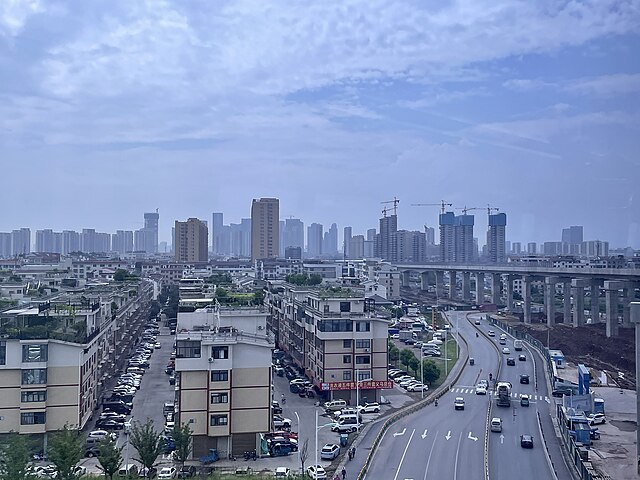
In 2025, amid an increasingly volatile and complex global environment, China's economy has continued to press forward under pressure and is expected to achieve growth of around 5% for the year, showing a certain degree of its resilience and vitality. Guided by high-quality development, new growth drivers such as artificial intelligence and green industries are gathering momentum at an accelerated pace. However, beneath the improving macroeconomic indicators, local governments are undergoing profound transitional pains. In particular, mounting fiscal pressures at the local level, adjustments in the real estate sector, and continued reliance on legacy growth models are becoming intertwined, posing severe challenges to regional development. The difficulties currently confronting local economies are reflected not only in a slowdown in growth, but also in the pains of structural adjustment and the time lag between the weakening of traditional growth engines and the cultivation of new ones.
How, then, should the current state of China's local economies be assessed, and how should these challenges be addressed? ANBOUND's founder Kung Chan has noted that China has entered a post-industrial, post-modern stage of development. As the share of the tertiary sector in GDP and employment has continued to rise and now exceeds 50%, China's economy has taken on clear post-industrial traits. This transformation signifies not only a fundamental shift in the drivers of economic growth, but also a profound change in the logic of regional development. Against this backdrop, the basic contours of the local economic landscape have largely taken shape.
Taking Yiwu as an example, ANBOUND has described it as a real-world version of a "global trade center city". Other provinces and cities may also hope to leverage their own resources to build similar hubs and pursue comparable urban transformations, and this is not entirely unrealistic. However, once Yiwu has reached its current scale and settled into a stable form, it becomes very difficult for other places to compete with it. This is because, in the post-industrial era, economic activity relies increasingly on historically formed industrial ecosystems, factor agglomeration, and locational advantages; these are all inherently difficult to replicate. The way most localities in the country have developed in the past, i.e., their characteristics, urban form, and economic scale and mass, has now largely become fixed. The transformation of township industries in the Yangtze River Delta is a case in point, where it is only through drawing on decades of accumulated industrial foundations and locational advantages that the region has been able to form a constellation-like industrial ecosystem, something that other regions cannot easily copy.
Yet, this fixation of local development patterns is not absolute. Unless a locality succeeds in securing major, centrally driven initiatives, such as a national-level pilot free trade zone or a comprehensive reform pilot to achieve a dramatic transformation through the injection of substantial capital and policy resources, it would be difficult for the fundamental development pattern to change. Under current economic conditions, local governments in China should avoid an excessive pursuit of dramatic overhauls or the replication of "model templates", and instead focus on local development. This means there should be a shift from expansion in scale to improvements in quality and the cultivation of their distinctive strengths. Foshan, a city in Guangdong Province in southeast China, is an example of this, where rather than blindly pursuing a full-scale rollout of emerging industries, the city has focused on two main priorities, namely upgrading traditional industries and fostering emerging ones to seek breakthroughs rooted in its existing manufacturing base.
When it comes to local economic development and governance, Kung Chan believes that attention should be focused on two key tasks.
First, local officials should assume primary responsibility for risk mitigation. Whether mayors, governors, or officials at other levels, they need the capacity to identify and prevent risks. This is particularly crucial during periods of economic transformation, when multiple and overlapping tensions tend to emerge. They should proactively identify and defuse hidden dangers in areas such as debt, employment pressures, and environmental governance, while establishing robust systems for risk monitoring, early warning, and emergency response.
Second, priority should be given to cultivating distinctive local economies. In the post-industrial era, competition among localities is no longer about homogeneous expansion of scale, but about differentiated, quality-oriented competition rooted in local distinctiveness. Such distinctive economies should be built on local resource endowments, existing industrial foundations, and cultural traditions, while avoiding blind imitation and low-level, repetitive development. This will be a central task of local economic development for the country.
Carrying out these tasks places higher demands on the cultural literacy of local officials. Many development opportunities are not immediately apparent; they must be proactively discovered, identified, and activated. This involves not only the integration of tangible resources but also a nuanced understanding of soft factors such as cultural traditions, ecological value, and an atmosphere of innovation. Without a solid cultural foundation and strategic vision, and if actions are driven merely by imitation, it is difficult to do this work well. For example, many companies in Germany choose to remain and grow in rural areas precisely because of their deep understanding of, and respect for, local cultural traditions and rural ways of life.
The transformation of local economies is closely linked to cultural factors. Culture and other forms of soft power have become critical to enhancing regional competitiveness, shaping local innovation capacity, brand image, and residents' sense of identity. In the past, the role of local economies emphasized wealth accumulation and growth, and now it is shifting to a development model with richer cultural substance. This shift implies that localities must place greater emphasis on realizing multiple values simultaneously, including cultural heritage preservation and innovation, ecological protection, public services, and governance.
From a higher-level perspective, this is also an inherent requirement of advancing civic and cultural development. From the Fourth Plenary Session of the 19th CPC Central Committee to recent central economic work conferences, such a development has been repeatedly emphasized, as it is a key factor in enhancing local soft power and attracting high-end talent. Post-industrial societies place greater emphasis on people's all-round development and improvements in quality of life, highlighting individual value and social responsibility.
The "gentrification" of localities and local economies in China has gradually evolved into a practical task. In terms of social governance, this is reflected in efforts to revitalize communities, build new forms of "acquaintance-based society", promote harmonious coexistence among diverse social groups, and improve the quality of public services. It is both a proactive direction of transformation and, potentially, an objective outcome of social development. For example, the model proposed by Zhejiang Province, where think tanks function as advisers, the market as the main actor, villagers and village collectives as owners, and the government as a service provider, embodies the post-industrial era's emphasis on multi-actor participation and cultural values.
Yet, this does not mean rigidity or stagnation. Rather, it signifies a development path that relies more heavily on uncovering and strengthening a locality's internal foundations and distinctive advantages. In essence, this reflects a fundamental shift in regional competition, from homogeneous expansion of scale to differentiated, quality-based competition. Against this backdrop, the cultural substance and distinctive local economies embodied in the "gentrified" transformation under modern civic and cultural development have become key to enabling localities to break out of entrenched patterns and cultivate enduring competitiveness. This requires local governance to move beyond a short-term GDP-driven approach and toward the long-term cultivation of innovation ecosystems, a sound business environment, and a high quality of life, thereby achieving genuine, resilient growth through deep structural transformation.
Final analysis conclusion:
In the post-industrial era China, the development of local economies essentially marks a departure from the "standardized" stage of scale-driven expansion, moving instead toward deep competition grounded in local endowments, cultural substance, and distinctive economic strengths. The core of local governance is no longer the pursuit of dramatic, visible change. Rather, it aims to mitigate risks, cultivate local resources, and transform cultural soft power into differentiated competitiveness, thereby achieving the evolution from "nouveau riche" growth to the "gentry-oriented" model of modern civic and cultural development.
______________
Yang Xite is a Research Fellow at ANBOUND, an independent think tank.


