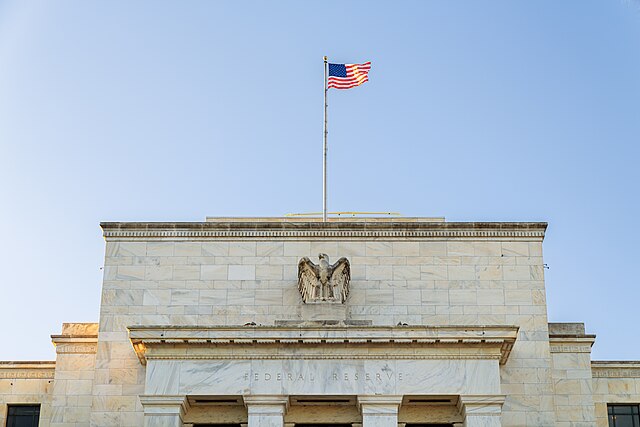
Following its monetary policy meeting, the Federal Reserve announced a 25-basis-point cut in the target range for the federal funds rate, bringing it down to 3.5–3.75 percent. This move is something that has already been widely anticipated. Ahead of the meeting, market pricing implied nearly a 90% probability of a rate cut. At the same time, after having halted balance-sheet reduction, the Fed decided to resume purchases of short-term U.S. Treasury securities at a pace of USD 40 billion per month starting December 12. At the previous meeting, the Fed had stated that balance-sheet runoff would cease on December 1; yet only days later it effectively restarted balance-sheet expansion—a step that, in substance, carries an even stronger easing signal.
Earlier, some institutions had estimated that if the Fed increased its Treasury holdings by USD 35 billion per month, roughly equivalent to the cap on its monthly reduction of MBS holdings, it could absorb around 20% of net Treasury issuance in a given fiscal year, significantly alleviating issuance pressures. In practice, the pace of balance-sheet expansion has been even faster. On the one hand, this helps ease the strains that have emerged in U.S. money markets in recent months; on the other, it provides funding support for the continued expansion of U.S. sovereign debt. Moreover, by directing balance-sheet expansion toward short-dated Treasuries, the Fed puts downward pressure on short-term interest rates and steepens the yield curve, moving toward the goal of a structural rate cut as articulated by Treasury Secretary Scott Bessent.
This coordination between fiscal and monetary policy reveals a close underlying alignment between the U.S. government and the Fed amid the appearance of tension in their public relationship. Although disputes over the Fed’s independence have subjected it to sustained criticism and pressure from President Donald Trump, the Fed has not adopted a confrontational stance. Instead, consistent with its mandate to safeguard economic and financial stability, it has continued to work constructively with fiscal authorities. This relationship of apparent distance but substantive alignment may create misperceptions and misjudgments in the market. More importantly, it places the Fed, a staunch defender of its independence, in an increasingly awkward position. It now faces persistent criticism on the one hand, while on the other, it must accommodate fiscal policy needs, diluting the effectiveness of its monetary policy and adding to the uncertainty surrounding the future policy path.
Additionally, there is the growing perception of a gap between the Fed’s rhetoric and its actions. Ahead of this meeting, several Fed officials, including Chair Jerome Powell, had delivered relatively hawkish messages in an effort to guide market expectations. As a result, market-implied probabilities in October for a rate cut in December declined sharply, at one point falling to around 60%. However, the meeting outcome told a different story: nine of the twelve voting members supported a 25-basis-point rate cut, forming a clear majority. The hawkish tone evident in earlier public statements was not reflected in the actual vote, a discrepancy that has understandably left market participants puzzled.
The inconsistency among these officials has not only put the Fed in an awkward position, but has also exacerbated internal divisions within the institution. Although a majority of participants ultimately agreed on the policy decision at this meeting, the number of dissenting votes was higher than in the past, and the degree of disagreement appears to be widening. Two members favored keeping interest rates unchanged, while one member, most likely Stephen Miran, the Fed Governor nominated by President Trump, argued for a more substantial rate cut. Such pronounced policy divergence has been uncommon in previous Fed meetings and signals a growing lack of consensus within the Committee.
Looking back at the Fed’s decision in October, a similar pattern was already evident. When announcing the rate cut, Chair Jerome Powell cautioned about heightened uncertainty ahead, which at the time led markets to scale back expectations for further easing. This form of “hawkish easing” may, for a considerable period, represent the policy outcome the Fed seeks to achieve through a deliberate mismatch between its words and its actions. According to the latest dot plot, even after factoring in a 25-basis-point cut in December, Fed officials’ projections for additional easing in 2026 have narrowed markedly, with most anticipating only a single rate cut that year. This is likely to add to market confusion. Given evolving economic conditions and the likelihood that President Trump will exert greater influence over Fed decision-making following Powell’s departure, a more accommodative policy stance next year may be more plausible than current Fed projections suggest. In the view of researchers at ANBOUND, this prevailing approach of “hawkish easing” reflects, on the one hand, the Fed’s own internal ambivalence and lack of clarity in decision-making, and on the other, a form of “soft resistance” under pressure from Trump. Confronted with an increasingly complex environment, the Fed appears to have limited confidence in its own policy judgments, which are seeking to promote easing while simultaneously fearing a resurgence of inflation and the attendant loss of credibility. Against this backdrop, preventing misinterpretation or overheating in market sentiment may well represent the cautious intent of Powell and other Fed officials.
With regard to employment and inflation, the Fed’s statement from this meeting noted that U.S. economic activity continues to expand at a moderate pace, but job growth has slowed, the unemployment rate rose in September, and inflation remains elevated to some extent. The economic outlook is still subject to a high degree of uncertainty, and downside risks to the labor market have increased in recent months. At the press conference following the rate decision, Powell stated that the current policy adjustment would help stabilize a labor market that is showing signs of weakening, while maintaining sufficiently restrictive conditions to contain inflation. He noted that as the effects of tariffs gradually fade, this further step toward policy normalization should support employment and allow inflation to move back toward the 2% target. On inflation, Powell emphasized that the current level of inflation above the Fed’s 2% objective is largely attributable to the Trump administration’s increases in import tariffs. He reiterated that the inflationary impact of tariffs is likely to be “a one-time price increase”.
Although the Fed has revised up its forecast for U.S. economic growth this year, inflation remains sticky, and the cooling trend in the labor market has become increasingly evident. This divergence further narrows the room for monetary policy maneuver and blurs the outlook for future policy direction. This is likely the fundamental source of the Fed’s current divisions and awkward positioning.
While the Trump administration has insisted on downplaying inflation, its measures, such as increasing subsidies for farmers and lowering tariffs on certain food products, suggest that it has, in fact, taken steps to address rising prices. This implicitly underscores the seriousness of the inflation problem and the substantial political pressure it poses for Trump ahead of the midterm elections. On December 8, Kevin Hassett, Director of the White House National Economic Council and a leading candidate to become the next Fed chair, stated that it would be “irresponsible” for the Federal Reserve to pre-commit to a specific interest-rate path for the next six months, emphasizing that policy decisions must be driven by economic data. Hassett remarked, “I think that Chairman Powell agrees with me on this one, that we should probably continue to get the rate down some, and do so prudently with an eye on the data”.
This is an indication that officials within the Trump administration also hold a cautious view toward rate cuts, reflecting concerns about inflation, albeit concerns rooted primarily in political considerations. Although headline inflation continues to trend downward overall, structural price increases, particularly in food, have had a greater impact on U.S. households even as energy prices have declined. These pressures reflect both the effects of Trump-era tariffs and the lingering aftereffects of multiple rounds of policy-driven liquidity expansion. As concerns over inflation intensify, Trump himself appears to have become less “obsessive” about rate cuts.
The divergence between employment and inflation trends is at the heart of the conflict between Trump and the Federal Reserve. What makes the situation particularly challenging for both the market and the Fed is that inflation performance is not aligning with economic performance. Data on employment and other indicators suggest that the U.S. economic outlook is less than optimistic. Inflation is more likely to weaken in tandem with a slowdown in U.S. economic demand, placing both the Fed and the Trump administration in an awkward position where they cannot have the best of both worlds. Whether it is Trump’s criticism of the Fed or the Fed’s inconsistency, it often seems like an attempt to shift blame.
Considering the global context, the policy differences between central banks around the world and the Fed have become increasingly apparent. Looking at the European Central Bank (ECB) and the Bank of Japan (BoJ), both of which have already begun or are set to begin raising interest rates, alongside countries like Canada, Australia, and Switzerland, which have recently kept rates unchanged, it is clear that inflation is a global issue. Regardless of economic performance, central banks worldwide are forced to take corresponding measures.
As a result, the interest rate differentials between major economies and the U.S. are narrowing, which is contributing to the depreciation of the U.S. dollar. This intensifies the challenge the Federal Reserve faces in managing inflation, and it also means that its scope and pace for rate cuts will be more limited. Perhaps a change in leadership at the Fed next year could be a way to avoid further divisions and awkwardness. However, regardless of leadership changes, it will likely be increasingly difficult to effectively address the growing internal and external contradictions facing the U.S. economy.
Final analysis conclusion:
The Federal Reserve’s decision to cut interest rates was not
unexpected, and with the changing economic conditions in the U.S., the
rate-cutting cycle is likely to continue. However, the internal divisions
revealed in the December policy meeting and the inconsistency from policy
officials reflect the growing split between employment and inflation trends,
highlighting the Fed’s policy dilemma. Whether through an “aggressive” or
“gradual” approach to rate cuts, neither seems capable of resolving the
underlying contradictions facing the U.S. economy.
______________
Dr. Wei Hongxu is a Senior Economist of China Macro-Economy Research Center at ANBOUND, an independent think tank.


