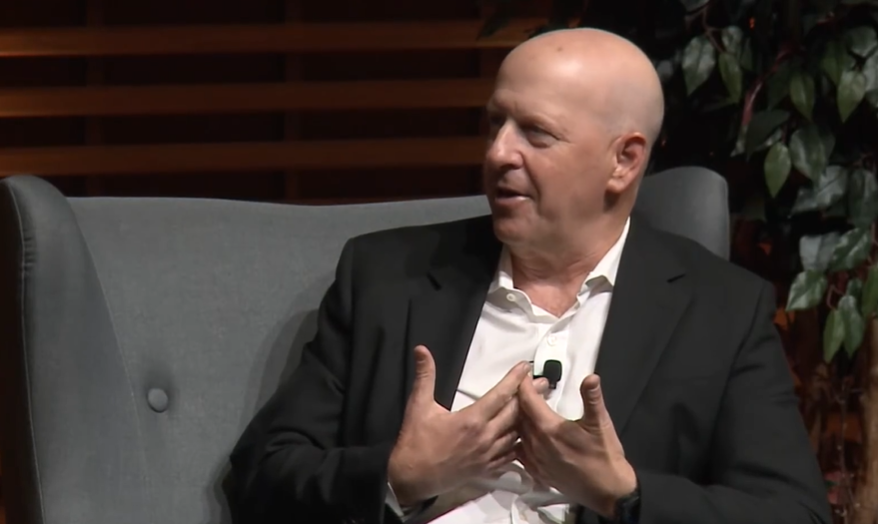
Goldman Sachs’ economist Hui Shan has unexpectedly put forward an optimistic view on the Chinese economy. Citing the commitment made at the country’s Fourth Plenary Session to achieve the annual socio-economic development targets and the recent acceleration in government spending, Goldman Sachs has revised its forecast for real GDP growth from 4.9% to 5.0%. Notably, Goldman Sachs appears to be almost the only major Western investment bank taking such an optimistic stance. The bank’s remarkable flexibility and adaptability in navigating China’s investment environment inevitably draw greater attention to its strategies. This shift largely reflects Goldman Sachs’ and CEO David Solomon’s keen sense of direction.
In the traditional Wall Street context, the image of a top investment bank CEO is often closely associated with rigor, conservatism, and insular networks. Yet, David Solomon completely overturns this perception. His career began in the 1980s at Salomon Brothers, followed by many years at Bear Stearns, and he ultimately joined Goldman Sachs in 1999. Solomon is not a banker in the conventional sense. He lacks the Ivy League pedigree, having graduated from Hamilton College with a degree in political science, and he was also a college football player, a part-time bartender, and a well-known electronic music DJ. By day, he steers one of the most powerful banks on Wall Street; by night, he transforms into DJ D-Sol, spinning tracks at electronic music festivals and clubs across New York.
It is precisely this unconventional and diverse background that has shaped his unique innovation DNA as a cross-boundary thinker. Investment need not be constrained by rigid frameworks, and the combination of cross-industry vision, ecosystem-oriented strategy, and human-centric insights can carve out unique paths in complex markets. Since taking office in 2018, he has delivered a highly compelling track record. Goldman Sachs’ stock price and market value have both grown by about 300%, revenue has surged from over USD 30 billion to nearly USD 60 billion, and assets under management have exceeded USD 3.45 trillion, making it the firm with the largest net profit growth among the five major Wall Street banks. How did he manage to achieve all these?
First, he injects sensitivity insight into a rational framework, deconstructing risks and opportunities. Investment decisions on Wall Street have traditionally centered on data modeling and macroeconomic analysis, but Solomon’s uniqueness lies in integrating the entertainment-oriented thinking from his DJ background into his investment philosophy, creating a dual logic of “rational foundation, sensitivity empowerment”.
As a DJ with over 400,000 monthly listeners on Spotify, Solomon has a deep understanding of the dynamics of “trend cycles” and “emotional resonance”, which gives him a clarity beyond his peers when navigating tech fads. Faced with the frenzy around AI investments, most institutions either blindly chase valuations or shy away entirely out of fear of a bubble. Solomon, however, uses the metaphor of a “musical wave” to offer a more nuanced perspective that the rise of new technologies is like the evolution of electronic music genres, where although many emerge, only a few will become classics. This judgment stems from emotional insights into the “peak of a trend”, much like a DJ must precisely feel the rhythm of a track. As a result, Goldman Sachs has focused on infrastructure areas such as chips and computing power, achieving an 18% return on related portfolios in Q1 2025, well above the industry average of 9.7%.
Solomon also broke the traditional negotiation model of investment banks. During Goldman Sachs' landmark 2016 negotiation to acquire a stake in Uber, faced with 12 competing bidders and the resistance of founder Travis Kalanick, Solomon discarded lengthy lists of terms and used a “anchoring-blank space” approach. This negotiation technique, akin to a DJ’s “beat-matching” control of a crowd, demonstrated professional confidence while avoiding confrontational emotions, ultimately securing the deal. For Solomon, investment negotiations are like DJ-ing, where emotional consensus often plays a bigger role than the specifics of the terms in determining success or failure. As a result, Goldman Sachs’ success rate in tech company investments has risen to 83%, far exceeding the industry average of 41%.
Secondly, he excels at using ecosystem-based strategies to deeply reconstruct business boundaries. Traditional investment banks often operate with a demarcated individual operation model, but after Solomon took charge, he implemented a “Global Banking and Markets” ecosystem strategy, building a system where resources are interconnected, customers share, and risks are jointly borne.
His ecosystem reform was not a simple business merger, but a deep restructuring based on the full lifecycle needs of clients. He integrated investment banking, fixed income, currencies, commodities, and equity franchises into a unified business unit, abandoning the old school departmental performance evaluation system in favor of a core metric focused on comprehensive client value creation. This reform sparked intense debate within Goldman Sachs’ partnership culture. Among the 420 partners, many were accustomed to the independent operation model, but Solomon explained the logic of the reform using a “DJ remix” metaphor: individual businesses are like separate notes, only through collaborative mixing can they create a truly powerful melody. Over the past five years, Goldman Sachs’ market share in trading has increased by 380 basis points, and in Q3 2025, core business revenue reached USD 10.12 billion, accounting for 66.6% of total revenue.
Another breakthrough in his ecological thinking is the decisive choice regarding non-core businesses. Unlike other investment banks' idea that diversification must be comprehensive, Solomon showed the courage to advance and retreat in consumer business. In 2019, he facilitated the cooperation between Goldman Sachs and Apple to launch the Apple Card, and in 2023, he acquired the consumer lending platform GreenSky. However, when it was discovered that the business had insufficient synergy with the core ecosystem and had accumulated billions of dollars in losses, he decisively initiated a strategic contraction, refocusing on the core areas of investment banking and asset management. This cycle of "expansion-trial and error-focus" is precisely the core characteristic of the ecosystem strategy. In 2024, the strategically focused Goldman Sachs achieved revenue of USD 53.512 billion, a year-on-year increase of 15.7%, and a net profit of USD 14.276 billion, a significant year-on-year increase of 67.6%.
Finally, with humanized insights, he balances short-term volatility with long-term value. Wall Street's investment philosophy is often filled with cold rationality, treating maximizing returns as the sole objective, while Solomon's unique quality lies in injecting an understanding of human nature and a reverence for long-term value while adhering to the bottom line of risk control.
On one hand, he adopts empathetic judgment of market cycles, not pursuing short-term precise timing, but rather guiding clients through volatility. Having experienced multiple market turbulences, Solomon deeply understands the emotional weaknesses of ordinary investors during cyclical fluctuations, so his investment advice consistently carries humanized warmth. Unlike other investment bank CEOs who frequently give precise point predictions, he prefers to use historical patterns and common language to guide rational decision-making. At the 2025 International Financial Leaders Investment Summit, he warned that the stock market might see a 10%-20% correction in the next 12-24 months, but immediately added that the market experiences an average of 3.4 corrections of 5%-10% and 1.1 corrections of 10%-20% every year. His advice to individual investors was simple and practical: to stay invested, regularly assess their portfolio allocation, and avoid letting short-term volatility influence their long-term decisions. This communication style has increased Goldman Sachs' client loyalty by 19% during periods of market fluctuation.
On the other hand, Solomon maintains a steadfast balance when it comes to policy and ethics, refusing to compromise long-term reputation for short-term gains. As a leader in the financial industry, he consistently emphasizes on the importance of central bank independence, asserting that monetary policy should be guided by economic data, not political influence. In 2025, a Goldman Sachs research report concluded that American consumers would bear most of the costs of tariffs, an analysis that ran counter to the prevailing political narrative and drew sharp criticism, with U.S. President Donald Trump even angrily suggesting Solomon should "just focus on being a DJ". Yet Solomon stood his ground, responding with a combination of humility and resolve, unwilling to adjust his professional judgment under political pressure.
This commitment to professionalism reflects his deep belief in the long-term trust value of financial institutions. He understands that the true assets of an investment bank are not short-term profits but, rather, the lasting trust it builds with clients and the market. This principled stance extends to the digital finance space, where he is a firm advocate for blockchain technology. He views tokenization and stablecoins as innovative tools to enhance financial infrastructure, but remains resolutely opposed to treating crypto assets like Bitcoin as speculative instruments. Instead, he categorizes them as "stores of value" rather than speculative assets. This cautious yet forward-thinking approach that embraces technology but rejects speculation has allowed Goldman Sachs to both capitalize on emerging opportunities and minimize the risks associated with the digital finance wave.
All in all, what sets Solomon apart is the diverse perspectives he gained from his multidisciplinary career, which enabled him to break free from conventional thinking in the finance industry. This unique blend of pragmatism and romance, rigor and rebellion gives him a distinctive personality that sharply contrasts with other CEOs who have followed a more traditional, finance-focused path.
During his tenure as CEO of Goldman Sachs, he demonstrated through practice that investment philosophy does not need to follow a fixed paradigm. His boundary-breaking philosophy not only adheres to the core principle of steady value growth in finance but also breaks free from conventional thinking, offering new solutions to global economic challenges.
As deglobalization deepens and markets continue to evolve, the key takeaway from Solomon's investment philosophy is that successful investing requires not only expert knowledge and sharp judgment but also diverse perspectives and a sense of humanity. Only by breaking through mental boundaries can one remain resilient and victorious in the ever-changing tides of the market.
Final analysis conclusion:
In the traditional context of Wall Street, the image of a top investment bank CEO is often closely associated with rigor, conservatism, and an insular elite culture. However, Goldman Sachs CEO David Solomon has completely disrupted this perception. As a banker in a non-traditional sense, Solomon's diverse background has shaped an innovative mindset unique to cross-disciplinary thinkers, and that investment need not be confined to rigid frameworks. The combination of cross-industry vision, ecosystem strategies, and insights into human nature allows him to navigate complex markets, deconstruct risks and opportunities, redefine business boundaries, and balance short-term volatility with long-term value.
______________
Xia Ri is an Industry Researcher at ANBOUND, an independent think tank.


