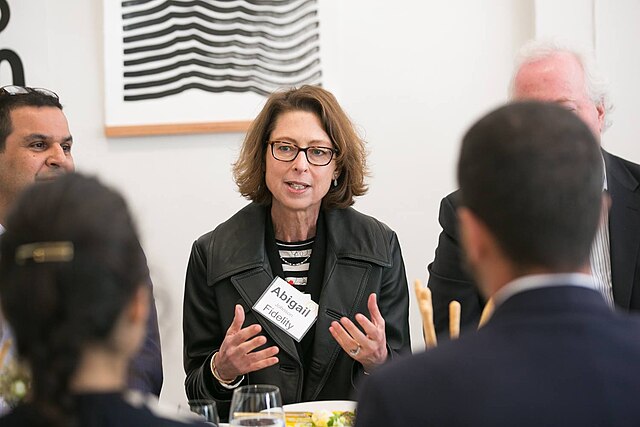
In the male-dominated, fast-paced world of Wall Street, Abigail Johnson stands out as a unique figure. Unlike some CEOs who seek the spotlight in financial media or attract attention with provocative statements, Johnson has focused her efforts on the core operations of her company. Since taking the reins at Fidelity Investments in 2014, one of the world’s largest asset management firms, she has dedicated herself to improving internal operations and refining product offerings. Under her leadership, the firm has experienced impressive growth. By 2024, Fidelity’s assets under management grew from USD 4.9 trillion to USD 5.9 trillion, a 20% increase year-over-year, while revenues rose 16%, reaching a record USD 32.7 billion.
This success is deeply rooted in Johnson’s "client-first" philosophy. While many Wall Street firms claim to prioritize clients, Johnson has truly ingrained this approach into the company’s DNA. She has been willing to transform the company from within, prioritizing long-term client interests over short-term profits. Through comprehensive reforms in fees, technology, and products, she has completely reshaped the client experience.
First, she initiated a self-revolution in the area of fees, placing client costs under the spotlight. She astutely recognized that, in an era of high information transparency, high fees are an "invisible enemy" that erodes clients' long-term compound returns.
In 2018, under Johnson’s leadership, Fidelity launched two index funds with no management fees, namely FZROX (Fidelity ZERO Total Market Index Fund) and FZILX (Fidelity ZERO International Index Fund). This move caused a major shock in the industry. In a market dominated by Vanguard and BlackRock's low-cost index funds, Fidelity, as a late entrant, chose not to follow but to disrupt, using the strategy to attract customers and enhance product value. According to Fidelity’s financial reports, since the launch of its zero-fee funds, both the number of retail customer accounts and the total assets under management have seen significant growth, successfully capturing market share from competitors.
Johnson was equally decisive when it came to Fidelity's cornerstone active management funds. She led multiple rounds of fee reductions. According to Morningstar, since she took over as CEO in 2014, the average fees for Fidelity’s actively managed funds have dropped by over 30%. She required each fund manager to provide a rigorous justification for the fee structure of their products, incorporating "cost-effectiveness analysis" into the core of the investment process. For funds with consistently mediocre performance but high fees, she took decisive actions, including mergers or liquidations.
In 2019, in response to the challenge posed by zero-commission brokers like Robinhood, she made another bold decision. She slashed online trading commissions for U.S. stocks, ETFs, and options to zero across the board. This move instantly rocked the industry, forcing traditional giants like Charles Schwab to urgently follow suit within days. Although Fidelity sacrificed hundreds of millions of dollars in annual revenue, Abigail Johnson believed it was a necessary step to ensure fairness for retail investors and maintain Fidelity's competitiveness in the market.
Meanwhile, she leveraged her strong background in quantitative science and technology to empower the firm with tech and reshape the client experience. Drawing on her expertise in applied mathematics and technology, she has transformed Fidelity from a traditional asset management company into a modern, technology-driven financial services platform.
Under her leadership, Fidelity has invested billions of dollars in the overhaul of its digital platforms. The company’s website and mobile apps have undergone a comprehensive user experience transformation, featuring a clearer and more intuitive interface and a greatly simplified trading process. For example, Fidelity’s mobile app integrates features such as fingerprint and facial recognition login, voice-command search, and personalized dashboards, enabling clients to manage their assets easily and conveniently.
To drive internal financial innovation, Fidelity established a dedicated lab. This team focuses on rapidly developing and testing solutions around clients’ needs. Their products include Spire and a retirement planning visualization tool. Among them, Spire is an app that analyzes clients’ spending habits and provides personalized savings and investment goals. The core purpose of these tools is not to directly sell products, but to strengthen client engagement and trust by addressing real problems.
Johnson’s vision is to make Fidelity a one-stop financial companion for its clients. As a result, Fidelity has greatly expanded the scope of its services beyond investing. Clients can access a range of offerings on Fidelity’s platform, including free financial planning tools such as college cost calculators and retirement income planners, as well as comprehensive financial education content, from basic investment knowledge to sophisticated market analysis, delivered through articles, videos, and other formats at no cost. This ecosystem-oriented approach has elevated the relationship between Fidelity and its clients.
Finally, she has actively embraced emerging fields such as cryptocurrencies and blockchain, opening doors to the future for clients. Among all traditional financial giants, Fidelity stands out for the early and deep investment it has made in these areas. The driving force and key decision-maker behind this push is Abigail Johnson herself.
On one hand, in 2018, under her strong leadership, Fidelity launched a dedicated cryptocurrency custody and trading platform for institutional investors: Fidelity Digital Assets. This opened the door for top-tier investment institutions that wanted to allocate to cryptocurrencies but lacked secure infrastructure. Fidelity invested heavily in building institutional-grade hot and cold wallet storage systems and cybersecurity protocols, bringing Wall Street–level risk management into the digital asset world.
On the other hand, in 2022, Fidelity made another bold move by announcing that plan sponsors could include Bitcoin investment options in their 401(k) menus. Although this decision drew explicit warnings from the U.S. Department of Labor, Fidelity maintained that it was intended to meet clients’ demand for diversified assets, particularly among younger generations. However, Fidelity set strict allocation limits, up to 20%, and provided detailed risk disclosures. The core logic was to return the decision-making power to clients while ensuring that risks remained manageable, rather than making paternalistic choices on their behalf.
Additionally, Johnson leads by example. She is not only a driver at the company level but also an active participant herself. As early as 2014, she began personally investing in Bitcoin and blockchain startups and even encouraged Fidelity employees to pay with Bitcoin in the company cafeteria. This approach greatly strengthened internal confidence in this emerging technology.
With her unique leadership style, Johnson has reshaped Fidelity and redefined the “client-first” philosophy on Wall Street. In her view, this is no longer a passive service mindset but an active, even aggressive, business strategy. Through launching a fee revolution, she has reclaimed valuable returns for clients. By driving a transformation of the client experience, she has made investing more democratic and human-centered, and by venturing into new fields, she has ensured that clients are not left behind.
Under her leadership, Fidelity’s “client-first” approach has successfully transformed the company from a traditional fund firm into a trusted lifelong partner, deeply intertwined with the financial lives of tens of millions of clients.
Final analysis conclusion:
Since Abigail Johnson took over as CEO in 2014, she has driven significant growth at Fidelity. This success is rooted in her unique leadership style, which has redefined the "client-first" philosophy. For her, it is not just a passive service attitude, but an active and aggressive business strategy. Through her fee revolution, she has reclaimed valuable returns for clients. By reshaping the client experience, she has humanized investing. Through expanding into new fields, she has ensured that clients are not left behind in a rapidly changing world.
______________
Xia Ri is an Industry Researcher at ANBOUND, an independent think tank.


