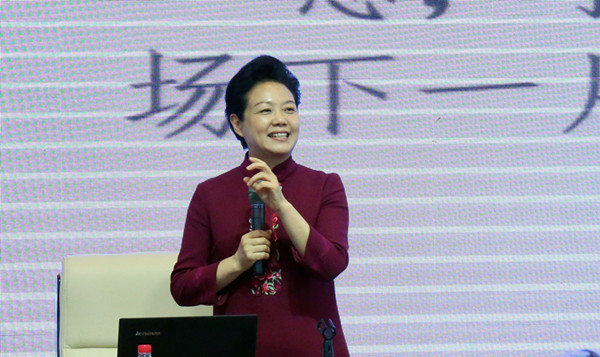
As an educator with 40 years of experience, she believes education in China has undergone a dramatic transformation from which the conventional approaches overwhelmed by a test-driven evaluation are being phased out.
According to Wang, beyond scores there are numerous qualities, such as, social responsibility, independent thinking and learning, creativity and compassion towards disadvantaged groups, which are more important in evaluating pupil growth.
In her quick reaction to the changes of time, Wang and her teammates worked out a curriculum that is quite different from the traditional textbook-based requirement. In such lessons, students are encouraged to provide community-level services, run businesses and promote philanthropic undertakings.
Over the past few years, her students have rolled out many programs, such as, giving big hugs to delivery persons and street cleaners and distributing their self-made brochures on how to behave appropriately abroad for those to depart from the Beijing Capital International Airport for overseas trips.
While learning knowledge, students are often organized to visit museums where guides and teachers will show them basic information and cultural backgrounds behind collections. However, apart from the illustrations, several open questions are left for students to think about at home. In doing so, Wang said, students can have a good command of a broad range of knowledge with deep understanding.
In her three-hour lecture, Wang also highlighted the important role parents should play in educating their children.
"A strong family bond between parents and their children is of paramount importance to the growth of youngsters. Without the care and love from their parents, children are less empowered and motivated."
"In my childhood, parental education was absent due to a social concept that treated teaching as totally a school responsibility. However, those born after China's reform and opening up which began in 1979 have become parents," Wang explained.
According to her, because many young parents grew up in single-child families, they hold totally different opinions while rearing their own young.
Wang said, their approaches are creative and unique and often inspiring to an old educator like herself; however, there are still problems to be figured out.
According to her, a big one of that because of young parents' educational precepts based on their own experiences, is that they impose too many extra-curricular academic activities on their children which take up too much spare time and lead to unnecessary stress for them.
"There is nothing wrong in helping your children develop some hobbies that they are immensely interested in. However, you should not let them believe they can excel in every skill by simply attending classes. Actually, learning requires great perseverance and a hard-working spirit throughout one's life if it is to be really worthwhile."


