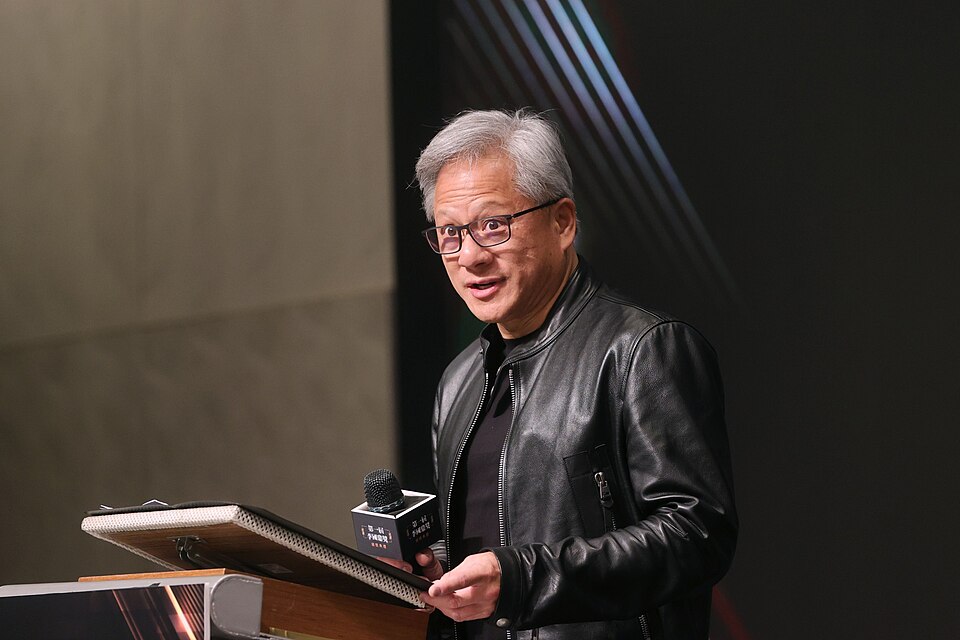
Nvidia co-founder Jensen Huang has finally announced his departure from the company he founded. On November 12, Nvidia announced that its co-founder Jensen Huang had resigned as president, chief executive officer, and director, with Chief Financial Officer Colette Kress temporarily taking over and director Harvey Jones becoming chairman. Following the announcement, Nvidia shares fell by more than 10% at one point, dragging down U.S. stocks related to artificial intelligence (AI) as well.
In 33 years, Huang transformed Nvidia from a graphics card company into a core supplier to the global artificial intelligence industry. Yet now, he has suddenly left within the space of just a few days. This is certainly no trivial matter. An American economics professor once conducted a quantitative study of the contributions that company founders and executives make to corporate performance. The findings showed that founders accounted for more than 98% of performance, while executives contributed less than 2%. A clear example is what happened to Apple after Steve Jobs's passing. Judging by the usual metrics, Apple itself did nothing wrong, but it never again achieved the kind of breakthroughs it had under Jobs. Jensen Huang is the soul of Nvidia, and Nvidia, in turn, is the soul of America's AI industry.
If this incident is viewed merely as a personal scandal involving a corporate executive, our understanding of it will be reduced to the level of gossip.
The incident began when U.S. media reported that Huang had been having an extramarital affair with a woman suspected of having ties to Chinese intelligence. Reports subsequently emerged about his private relationships with a female executive within Nvidia. Both stories originated from media outlets with close ties to the U.S. Democratic Party, one of which was The New York Times. Nvidia's board then launched what it called an "independent investigation". The allegations have not yet been conclusively substantiated, yet Huang has already announced his departure.
At this stage, by piecing together the fragments of information, it is possible to assemble an objective picture of what has happened.
On Nvidia's board, the discussion regarding CEO Jensen Huang's position is being driven primarily by a group of outside directors. This group includes members with backgrounds at Goldman Sachs. Another independent director has a background in the restaurant industry, having built a career through food service enterprises such as the TACO restaurant chain. Additionally, another director has experience from PepsiCo, a major multinational food and beverage corporation. The board also includes an academic member.
Such developments surrounding prominent tech figures and administration associates, such as Elon Musk and Jensen Huang, are viewed by some members of the Democratic Party as a significant political focus. In its coverage of these incidents, The Wall Street Journal reported that Democratic Senator Elizabeth Warren called on the Trump administration to preserve all government records relating to Nvidia's chip exports to China and the alleged relationship between CEO Jensen Huang and a suspected Chinese intelligence operative. The newspaper characterized this call as "the latest indication that lawmakers are gearing up for detailed investigations of the saga".
Musk was among the first to understand what was happening. He bluntly described Huang's "affair" as a "personal lapse" and said that Nvidia and AI could not do without Huang's contributions. Upon seeing the news of Huang's resignation, Musk immediately made a public statement on social media that it would be "an honor" to hire Huang.
Trump, by contrast, appears completely out of touch with the situation. He has failed to recognize that this is an intense conflict between the two major U.S. political parties, with the aim of fighting over the lucrative Nvidia business and seizing control of the AI narrative. Instead, he has offered what he apparently considers a clever suggestion that Tim Cook, the former chairman of Apple, could succeed Huang. If this is taken as a signal, it could be interpreted as meaning that the outcome of the midterm elections has already defeated Trump.
The situation on the Republican side is equally revealing. The Republican Party and the industrial forces associated with it do indeed want to stabilize Nvidia, but Huang has nevertheless left. More interestingly, Republicans have yet to reach a unified position internally. Following Huang's departure, House Speaker Mike Johnson said only that Congress was developing a consensus on restricting chip exports to China. In other words, within the Republican Party, some want to protect Nvidia, while others are more concerned with using the situation to tighten technological restrictions on China. Each faction has its own calculations, making coordinated action difficult.
For Nvidia, the cost of losing Huang is almost unimaginable.
The outside directors on Nvidia's board are, after all, "outsiders". The company's internal technical personnel, many of whom have followed Huang through years of challenges and ventures, cannot possibly remain unaffected. As Nvidia's co-founder, Huang's role extends far beyond managing the company. He understands technology and the market, can coordinate the global semiconductor supply chain, and knows how to deal with governments around the world and major technology companies. Nvidia's current market position was built to a considerable extent under his leadership. More importantly, the financial fortunes of its core technical personnel are deeply tied to Nvidia's share price. This is particularly significant now, when the AI industry has attracted such enormous investment, the market has begun questioning whether data center investments can generate returns, and Democrats are doing their utmost to attack data center construction for driving up prices. At such a time, Nvidia needs someone even more urgently to hold the entire industry chain together. The company's board may believe that replacing Huang will put an end to the controversy, but matters may not be that simple.
Nvidia's share price has now fallen to around USD 150, down from a peak of more than USD 200. ANBOUND's founder Kung Chan believes that Huang's departure will not merely fail to halt the decline in Nvidia's share price, instead it could inflict damage from which the company may find it impossible to recover.
There is another aspect of the situation that China should consider. While some may view a major crisis at Nvidia and its potential impact on the U.S. AI industry as an advantage for China, the implications may not be so straightforward. In fact, the consequences could prove more complex than expected.
Huang has long advocated retaining access to the Chinese market, arguing that completely cutting off chip supplies to China would only force the country to accelerate the development of its own technology. He has also consistently lobbied the U.S. government to ease restrictions on certain chip exports. In January this year, the U.S. Department of Commerce changed the export licensing arrangements for Nvidia chips such as the H200, making exports to China subject to case-by-case review once the conditions were met. Although restrictions remained strict, some room for commercial and policy coordination was still available.
Now that Huang has left, China's access to AI chips could shrink even further. The Democratic Party could use national security concerns to further tighten export controls. Combined with hardliners in the Republican Party who also support tougher restrictions on China, this could effectively halt U.S.-China AI chip trade, making it increasingly difficult for China to obtain AI chips. In the past, China could at least rely on Huang's efforts to persuade the U.S. Department of Commerce to approve exports of certain chips. Yet, with the change in leadership, that possibility may well disappear altogether.
As a result, the Huang affair could produce an unexpected outcome that Kung Chan describes as losses for four parties.
The U.S. itself could suffer losses. Major upheaval at Nvidia is bound to affect the stable development of the American AI industry and could even undermine the country's hard technological capabilities. Neither the Republican Party nor Trump has gained anything. They have not only lost an important industrial ally but have also exposed their political vulnerability. The entire AI industry is affected as well. Nvidia's crisis, combined with political resistance to data center construction, could disrupt the industry's existing investment plans. As for China, problems facing U.S. technology companies do not necessarily mean China will benefit. On the contrary, China could face even tighter restrictions on chip exports.
Who, then, might gain politically from this? According to Kung Chan's assessment, the Democratic political forces could emerge as the beneficiaries. They can capitalize on voters' dissatisfaction with data center construction, use national security concerns to put pressure on the Trump administration, and influence Nvidia's future business operations and policy environment through congressional investigations. Thus, the AI technology sector, the Republican Party, Nvidia, and China are all set to lose ground in the Huang affair, while the Democrats stand to gain.
Throughout this controversy, the U.S. "intelligence community" has been the source of the greatest number of disclosures. This suggests that the Trump administration's own departments are riddled with leaks and that Trump has failed to establish effective control over the US government. Perhaps he himself believes that he is already out of hope. As for Nvidia, this is only the beginning. The major troubles are far from over. Whether Huang himself will stage a comeback in some form, as Steve Jobs did back in the day, remains to be seen.
Final analysis conclusion:
The Jensen Huang affair has already gone far beyond a personal scandal
involving a corporate executive. It has become a major controversy entangled in
U.S. partisan politics and technological competition with China. Kung Chan
believes that the Democrats may use the incident to gain the political
initiative, while the Republican Party and Trump are left on the defensive. The
incident could result in a situation in which Nvidia, the Republican Party, the
artificial intelligence industry and China all suffer losses.
______________
Yang Xite is a Research Fellow at ANBOUND, an independent think tank.


