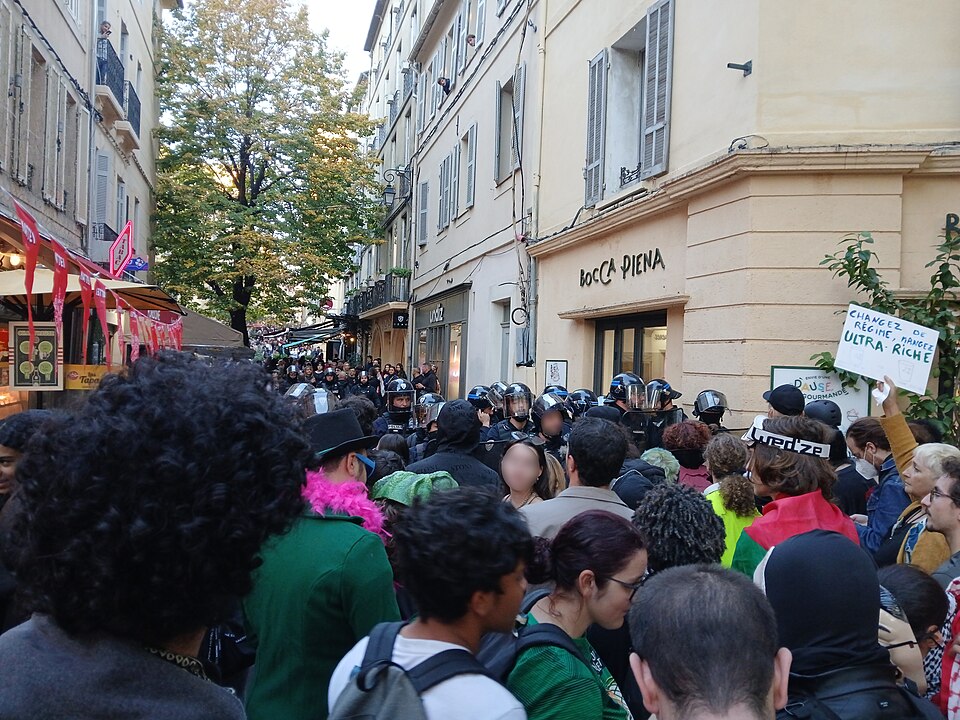
The protests that have persisted in France for over a month have evolved into a severe political and social crisis.
In mid-September, protests broke out in several high schools in the Paris suburbs due to teacher shortages and deteriorating teaching conditions, and subsequently spread rapidly across the country. A 17-year-old student in Saint-Denis complained to journalists that the school was infested with cockroaches and rats. Initially, the students merely demanded improved educational conditions, but as teachers and unions joined in, the protests extended to social issues such as the cost of living. On October 17, severe violence occurred during nationwide demonstrations in France, with arson and looting breaking out in multiple cities. The government reinforced police deployment, while left-wing parties accused the police of excessive use of force, and the right demanded tough measures to restore order. On October 26, the French government announced increased investment in education and proposed adjustments to the university admissions system, yet student organizations stated they would still continue the protests. Although the French government has attempted to ease tensions through policy concessions, the accumulated social dissatisfaction has already exceeded educational issues alone.
The social conflicts in France have also triggered political clashes across the Atlantic. On October 19, at a rally in Kansas, U.S. President Donald Trump blamed the riots in France on immigrants, the radical left, and Islamists, stating that France was suffering severe destruction and calling on Macron to close the borders. On October 21, Macron publicly refuted these remarks, accusing certain foreign leaders of exploiting the situation in France for political gain, and calling comments that immigration was driving the riots "stupid” and “unacceptable". The differing interpretations of the same event by both sides reflect divisions between American and European political philosophies and social governance approaches.
ANBOUND’s founder Kung Chan pointed out that a political divergence based on continental plates is emerging in the Western world, whereby the expanding influence of American right-wing conservatism forms a confrontation with Europe's deeply rooted left-wing political tradition, potentially developing into a new "continental politics". The clash between Trump and Macron over the French riots can be viewed as a concrete manifestation of this political divergence. In fact, Europe has also continued to shift to the right in recent years. The Brothers of Italy, led by Italian Prime Minister Giorgia Meloni, has already seized power, while the French National Rally and the Alternative for Germany (AfD) are also continuously expanding their political influence. However, electoral breakthroughs by the right have not caused a fundamental transformation of Europe's established political and economic systems. Compared with the United States, Europe still retains a deeper social democratic tradition, and its institutional influence has long since surpassed changes in government.
This political landscape has deep historical roots. From the French Revolution, 19th-century socialism and the labor movement, to post-World War II welfare state building, left-wing forces have deeply participated in shaping Europe's modern political and economic systems. Public healthcare, pensions, and labor protection have gradually become universally accepted basic guarantees in society, and many center-right parties likewise recognize these institutional arrangements. According to data from the Organization for Economic Co-operation and Development (OECD), France's public social expenditure accounted for approximately 30.6% of GDP in 2024, compared with about 19.8% in the United States. The European welfare system has thus formed a broad social interest base and deeply embedded left-wing political ideas into public policy and residents' lives.
Europe's political system has further reinforced this path dependency. While the U.S. presidential system and two-party competition allow executive power and political course to undergo significant adjustments with changes of president, many European countries adopt proportional representation and coalition government mechanisms, meaning that even if the radical right wins a high number of votes, it usually needs to negotiate with other political forces. Research released in September 2026 by the Swedish Institute for European Policy Studies (SIEPS) shows that although the European Parliament has shifted markedly to the right, the center-right European People's Party still cooperates primarily with the Socialists and Democrats group, the Liberals, and the Greens. According to 5,282 roll-call votes from July 2024 to June 2026, the voting coincidence rate between the European People's Party and the Socialists and Democrats group reached 80%. The European centrist political coalition still maintains considerable institutional influence. It can be seen that although the European right is growing continuously, the institutional arrangements shaped by the left over the long term, as well as the cross-party consensus formed around these institutions, still possess strong stability.
However, the deep institutional foundation of the European left is encountering increasingly severe economic realities. ANBOUND pointed out in previous research that the external security, cheap energy, globalized division of labor, and demographic dividend that supported Europe's post-war prosperity are gradually disappearing. In the past, Europe was able to build a high-welfare society by relying on sustained economic growth and strong industrial competitiveness. Left-wing politics places high value on social equity and the distribution of benefits, and is able to use fiscal expansion to improve public services and coordinate the interests of different groups. Today, as the dividends vanish and economic growth lacks new impetus, governments have fewer and fewer resources available to expand distribution, yet welfare commitments must still be fulfilled.
France is a typical example of this structural dilemma. Recent protests have already shown signs of political radicalization.
As the student movement expanded, the radical left-wing party La France Unsoumise (France Unbowed, LFI) actively participated in political mobilization, and the government and the party traded accusations over the violent incidents. On October 20, inside the French National Assembly, the government and LFI engaged in a fierce clash, debating the protest violence and law enforcement responsibilities. The interest conflict originally centered on educational resources gradually extended to political stances, state authority, and the legitimacy of law enforcement. The intervention of certain radical forces and the escalation of political confrontation are increasing the difficulty of negotiation.
The problem is that the radicalization of left-wing politics may in turn stimulate the radicalization of the right. For ordinary residents, transport disruptions and arson and looting inflict tangible harm on their lives and livelihoods. Even if they identify with the original protest demands, it is difficult for them to endure social disorder for long. A survey released on October 21 by the French polling agency Elabe showed that 93% of French people endorsed the protesters' demands regarding purchasing power and the cost of living, and 82% endorsed the students' demands, but 91% simultaneously condemned the violence during the demonstrations. A survey released on October 22 by Odoxa showed that 60% of respondents felt the police response measures were not tough enough.
This shift in public sentiment has already begun to reshape France’s political landscape. Marine Le Pen and Jordan Bardella, leaders of the National Rally (RN), a party widely regarded as far-right, have linked social disorder to the radical left and the government’s failure to govern effectively, seeking to broaden their support by emphasizing law and order, public security, and state authority.
Political confrontation has also extended from the parliament and public opinion arena to the streets. On October 24, the French city of Orleans was divided into two political camps by the Loire River. The south bank hosted an RN party congress, while the north bank gathered trade unions and anti-far-right demonstrators. To prevent clashes, police blocked bridges, traffic in the city center was restricted, and some shops were ordered to close. According to on-the-scene reporting by Le Monde, a left-wing union activist openly defended violent actions, while another radical activist called for direct action. During the same period, direct confrontations between far-right groups and far-left activists also occurred in Nice and Montpellier.
It is evident that France's social conflicts are providing new activity space for extremist political forces.
ANBOUND previously proposed that the alternation of left- and right-wing social trends possesses a certain corrective function, with the left focusing on social equity and distribution and the right emphasizing production, efficiency, and order, thereby driving social adjustment through competition. When both sides increasingly rely on fierce confrontation to consolidate political support, the left and the right move toward polarization. Taking current France as an example, certain left-wing forces expand their influence through radical mobilization, provoking strong demands from the right for order and state authority while creating greater activity space for the right to mobilize social forces. As the right further adopts hardline political positions, it reinforces the left's fears that social rights are being suppressed, stimulating a new round of mobilization. In this process, political competition increasingly involves social identity and political legitimacy, making it difficult for the two sides to reach a compromise through routine policy adjustments. Political opponents begin to be viewed as threats to their own values and interests, and the political competition between the left and the right shifts from mutual correction to mutual reinforcement, ultimately leading to the polarization of the political spectrum. This is essentially a "reaction-counterreaction" process.
France’s political tensions have their own distinctive characteristics, but the conditions underlying them are by no means unique to the country. Many other European nations face similar challenges, including ageing populations, rigid welfare expenditure, and persistently sluggish economic growth. As existing institutions struggle to adapt while social interests require continuous redistribution, fertile ground is created for the rise of radical political forces. European politics may therefore face an increasingly complex situation in the years ahead. The right continues to gain strength but struggles to fundamentally transform existing institutions, while the left retains a substantial social base but finds it increasingly difficult to address public discontent through traditional redistributive policies. Political competition between the two sides is likely to intensify, placing traditional centrist political forces under growing pressure.
Final analysis conclusion:
The continued rise of right-wing forces in Europe is contrasted by the enduring stability of the institutions, interest structures, and political culture long shaped by the left. As the European economy declines, the traditional distributive governance model will face increasingly intense resource constraints, leading to a gradual decrease in the left's capacity to coordinate social conflicts. This, in turn, will give certain radical forces greater room for mobilization. Recent conflicts in France indicate that left-wing radicalization and social disorder are stimulating the right to adopt harder-line political positions, with signs of direct street-level confrontation between the two sides. Consequently, the relationship between Europe's left and right has shifted from past mutual checks and mutual correction to mutual stimulation and continuous reinforcement, further weakening the self-repair capacity long formed by European society.
______________
Chen Li is an Economic Research Fellow at ANBOUND, an independent think tank.


