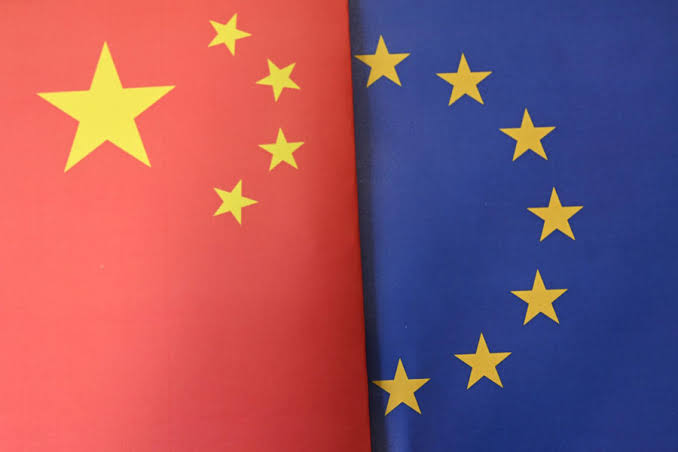
The global economy is a vast system where multiple forces interconnect and interact, and individual actions cannot be detached from their relationship with the surrounding space. By knowing how to utilize the expansiveness and diversity of space, and working on the synergies between one another to provide mutual support, any single point can withstand multiplied pressure.
China-Europe economic and trade relations are showing features increasingly similar to those between China and the United States, with trade imbalances, rising friction, and escalating competition, while differences between the two sides become progressively evident. Long-term expectations among many academic and business communities remain pessimistic. Should economic and market-related issues between China and Europe become increasingly politicized, a new "trade war" could erupt on a full scale. This emerging trend is a cause for concern.
In March this year during the Two Sessions, Chinese Foreign Minister Wang Yi stated when discussing Chinese foreign policy and external relations that the essence of China-Europe economic and trade relations is complementary advantages, and dynamic balance can entirely be achieved in the development process. On June 29, Chinese Minister of Commerce Wang Wentao and European Trade Commissioner Maroš Šefčovič jointly co-chaired the first meeting of the China-Europe trade and investment consultation mechanism in Brussels. Both sides pointed out that challenges affecting bilateral economic and trade relations should be properly handled, and agreed to seek practical and viable solutions. At the negotiating table, the attitudes of both sides were quite restrained, indicating that neither party wants to mess up the relationship. If countermeasure tools are expanded to suppress each other, nobody will have an easy time. Every measure in macroeconomic policy ultimately turns into the living costs borne by ordinary people. When U.S. Secretary of State Marco Rubio visited India, he candidly acknowledged in a media interview in Mumbai on October 20 that a U.S.-China trade war would have been "devastating to the global economy".
Maintaining open and effective channels of communication between Brussels and Beijing is crucial to managing China-Europe relations. Through enhanced dialogue and communication, both sides can gain a deeper understanding of each other, improve their understanding of each other's regulatory requirements, avoid misinterpretations of respective policies, and work together to enhance the overall effectiveness of policy implementation.
Continuous high-level dialogue and consultations between China and Europe have seen positive progress recently. The two sides held in-depth discussions in Beijing in early October regarding hybrid and electric vehicle trade issues and reached specific arrangements. Subsequently, Chinese authorities announced that the value-added tax export rebate rate for new energy vehicles would be reduced from 13% to 9%, taking effect officially on April 1, 2027. Export tax rebates for Chinese photovoltaic products and batteries have been comprehensively canceled or successively reduced to zero. The intention behind these policy adjustments is to curb the domestic low-price competition model relying on volume, raise export thresholds to reshape the export order, and further optimize the industrial structure, which benefits the sustainable development of China's economy.
However, this can only be regarded as a temporary measure to ease tensions. Many issues remain unresolved, and differences over trade imbalances, industrial subsidies and market access have yet to be bridged, with both sides having their own arguments and perspectives. Furthermore, it remains uncertain whether markets, businesses, societies and the general public on both sides will be able to adapt to the changes brought about by any policy adjustments.
The timing of policy decisions requires careful and nuanced calculation. This is a factor that is easily and significantly underestimated, yet it places an even greater test on strategic maturity.
The situation in the Middle East, support for Ukraine, immigration issues and other challenges have heightened anxiety across Europe. In particular, rising living costs, increasing unemployment, deteriorating public services and shortages of educational resources have fueled widespread public dissatisfaction with the status quo. Protests and demonstrations continue to take place across several European countries. It is against such a backdrop that European leaders are negotiating with China while facing considerable domestic pressure.
The widening trade imbalance has become the key obstacle at present. China's major European trading partners can no longer afford to ignore the "elephant in the room". Last week, German President Frank-Walter Steinmeier visited China. As someone well-versed in China, he had the opportunity to gain first-hand insights into the latest changes in China's business environment, economic strength and industrial structure. He was accompanied by Katarina Barley, Vice-President of the European Parliament and a member of Germany's Social Democratic Party (SPD). In his speech at Peking University, President Steinmeier mentioned "Aus Win-Win darf kein Win-Lose werden" ("A win-win must not turn into a win-lose"). In other words, a win-win should mean mutual benefit, not one side gaining at the expense of the other.
With the changing geopolitical landscape, Beijing needs to assess more effectively the policy costs and their implications for the EU's interests, make strategic decisions based on China's own realities, and adjust the pace of negotiations accordingly. Boosting domestic demand, strengthening social welfare and security, fostering a fair and orderly market environment, and developing an innovative ecosystem are all areas that require China itself to make sustained, long-term investments.
I believe that the fundamental solution to finding a balance lies in the provision of high-quality institutions, including alignment of rules and standards, enforcement of contracts, market order, and openness. A self-sustaining market order stems from an entrepreneurial spirit and an innovation system that supports it. China and Europe need to take proactive steps to manage expectations, prioritize smaller, more manageable areas for steady progress, and seek to reach long-term commitments wherever possible. This could help lay the groundwork for broader cooperation and major breakthroughs.
1. Competition rules and institutional improvement: This is to protect the long-term interests of the EU through response measures consistent with the core principles of the World Trade Organization (WTO), while simultaneously moving toward China's propositions on upholding the authority of the multilateral trading system. It is evident that the WTO's current rules are somewhat outdated, containing quite a few gaps and gray areas, such as digital trade and the green transition. The expansion of executive power and "de-institutionalization" continuously squeeze out market space. China and EU members have the responsibility to jointly promote the continuous improvement of WTO rules through negotiation and consultation, ensuring that the multilateral system keeps pace with market and technological developments. Respecting order also requires designing better order.
In global trade and investment activities, the volume of cross-border data flows is growing very rapidly. When enterprises from both China and Europe engage in cross-border commerce, trade, and investment businesses, they also need to ensure international supply chain security and prevent compliance risks through data sharing. Therefore, in areas such as supply chain traceability, new energy, and carbon trading, it is necessary to build fact-based dialogue mechanisms, support international organizations in conducting independent evaluations of disputes between the two sides, and enhance the logic and objectivity of viewpoints in China-Europe negotiations.
2. Deepening Two-Way Industrial Engagement: When more Chinese enterprises choose to build factories, conduct R&D, or invest directly in Europe, employing European staff and paying taxes in Europe, this "European localization" will gradually transform into a binding of economic interests between China and Europe. Correspondingly, European companies hope to deeply cultivate the Chinese market, find new business, and increase local profits. The Chinese side should continue to create conditions enabling European enterprises to participate more in policy dialogue and legislative consultation procedures, engage in discussions on industry standards and rule-making, integrate into the reform practice of China's urban regeneration and further innovate business models to achieve a turnaround.
At the level of building global cooperation mechanisms, new opportunities are emerging in third-country markets, and China and the EU should work together to explore new approaches to cooperation. For example, China, Germany and India could step up cooperation in pharmaceutical R&D and investment in Africa. This would not only foster closer collaboration in areas such as biomaterials, exchanges of medical professionals and academic research, but also enable the three countries to jointly expand their presence in global pharmaceutical markets. By combining their respective strengths and leveraging their complementarities, the three countries could generate significant synergies, strengthen global pharmaceutical innovation capabilities and help traditional Chinese medicine (TCM) expand its international reach. Such cooperation could also facilitate the further alignment of China's domestic drug registration procedures, regulatory standards and quality certification systems with international standards.
3. Technological autonomy, openness, inclusion, and synergy: The new round of technological revolution brings unprecedented opportunities to the world and provides new momentum for solving many old problems, and no country wants to fall behind. Nevertheless, climate change, epidemics, and the accelerated development of artificial intelligence (AI) have also triggered common challenges, bringing new problems to global governance. Preserving the institutional channels for China-Europe knowledge exchange helps detect policy blind spots earlier, reduce policy mistakes and implementation resistance, and rebuild social trust. Both sides should expand multi-point connectivity and technical-level ties, allow stronger communication between foreign-funded enterprises and local universities and research institutions, and encourage joint research and data sharing.
This summer has been continuously hot and dry, with water levels in rivers across multiple European countries continuing to drop, threatening European economies and people's lives. In practical scenarios of enhancing climate change resilience, governments, enterprises, and all sectors of society in China and European countries should join forces to solve more problems. An example of this is expanding new spaces for China-Europe cooperation in the commercial aerospace field. Utilizing satellite remote sensing technology and space science research to promote global sustainable development, focusing on weather observation and analysis, environmental protection, agricultural monitoring, and disaster emergency response. The United Nations Space2030 agenda emphasizes that the peaceful use of space activities and space tools has become an important driving force for solving humanity's long-term sustainable development.
Public policy must remain relevant to the times and, objectively speaking, demonstrate the utmost respect for Lebenswelt (the lived realities of people's everyday lives). This requires policymakers to rethink their approaches, update their decision-making models, and adjust their policies and actions accordingly.
All in all, the optimal way forward for China-Europe relations lies in economic cooperation, with both sides needing to carefully balance their respective interests and understand each other's approaches and priorities. By offering solutions at multiple levels that accommodate the interests of both parties, there is reason to believe that sufficient room exists for the two sides to achieve a rebalancing of their relationship.
______________
Yi Wang is Head of Global Development Program and Senior Researcher at ANBOUND, an independent think tank.


