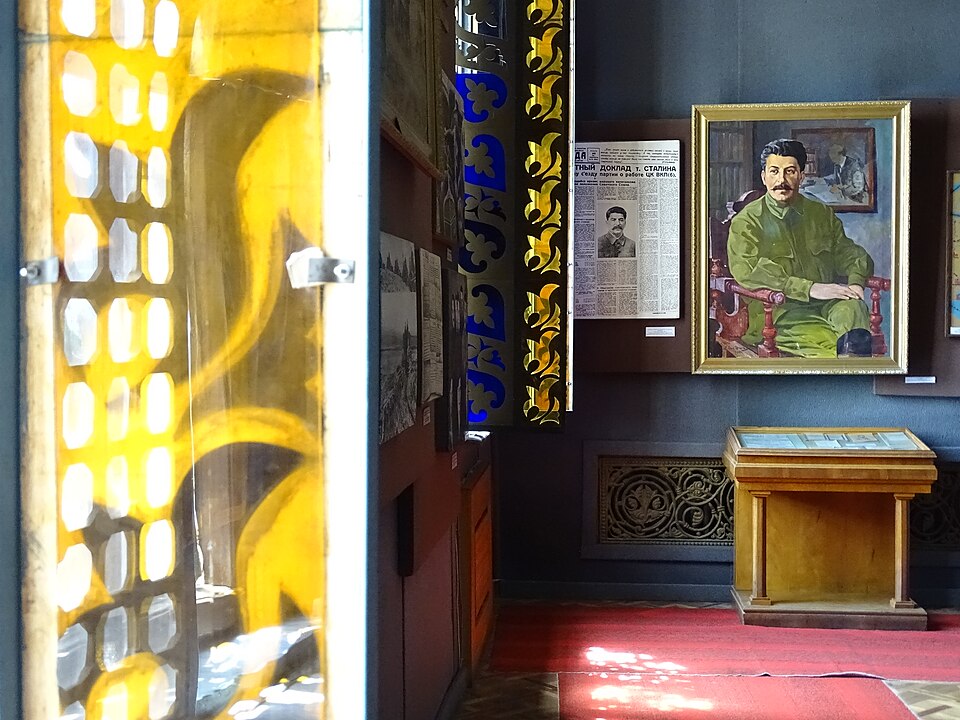
In the old town of Gori, Georgia, the birthplace of Stalin, stands a Stalin Museum. It is a source of income for this economically depressed region and a must-visit destination for many tourists, particularly Chinese visitors. On the ground floor of the museum, there is an informal exhibition containing an old photograph of a bespectacled man with a tall, slender build, dressed in a military uniform and holding an old-fashioned revolver, awkwardly practicing shooting and aiming. He is unmistakably an intellectual, yet also a feared member of the Cheka, the Red Army's security organization.
Intellectuals of that era were caught in the currents of their time, drifting along with the tide. That was an era when left-wing and right-wing social tides clashed fiercely. War, upheaval, conflict, casualties, and destruction brewed page after page of history, which we read today in various books. Yet those books often represent only one facet of these ideological clashes. Because authors typically carry their own standpoints and biases, reading them is like looking at the world through a designated window, rarely catching a full view. They frequently find themselves guided or led, often subconsciously, without ever quite realizing it.
Today, the left and the right continue to clash fiercely as social currents around the world. People have been astonished by the successive victories of Germany's right-wing Alternative for Germany (AfD) in regional parliamentary elections. The Christian Democratic Union (CDU), which had long been regarded as a representative of the established “German order”, has seen its support plummet, falling to the point where it is on the verge of being abandoned by voters. The situation in France is much the same. In the partial renewal of the French Senate in September 2026, the right-wing National Rally, led by Marine Le Pen, and its allies won a combined total of 14 seats, reaching for the first time the threshold required to form an independent parliamentary group in the French Senate. This means that the party has secured a more formal parliamentary standing in France's upper house. In addition, the French right-wing National Rally has directly won several mayoral positions in local governments. In fact, as early as 2024, in the European Parliament elections, Le Pen's National Rally had already secured 31.37% of the vote, far exceeding the 14.60% won by the center-left alliance affiliated with French President Emmanuel Macron. This made the National Rally one of the most influential political forces in French elections.
Brazil's presidential election between the left and the right is the latest example.
Brazilian presidential elections have long been a classic example of intense political confrontation between the left and the right. As early as 2022, the Brazilian presidential election went to a second-round runoff because the candidates' levels of support were so close. That year, the left-wing leader Luiz Inácio Lula da Silva, now Brazil's president, narrowly defeated the incumbent far-right president, Jair Bolsonaro, by just 50.9% to 49.1%. Now, the same left-right confrontation is playing out again in 2026. Lula, the left-wing president who had initially been expected to have the stronger chance of winning, has experienced a major reversal in the latest Brazilian presidential election. The first round of voting concluded on 4 October 2026. Rather than securing an outright victory, Lula unexpectedly fell behind his right-wing challenger in the first round. The outcome must therefore await the second-round runoff on 25 October, demonstrating just how intense the political struggle between the left and the right has become.
From the old photograph at the Stalin Museum in Georgia to the recurring cycles of social thought we see today, we can abstract the following trend model of social movements:
Intellectuals/literary figures -> Left-wing ideology -> Inclined towards contemplation/value prestige/adept at debate -> Focus on wealth disparity -> Political maneuvering centers on distribution (spending) -> Lack of funds leads to coercive action -> Typically dictatorship and high pressure -> Reliance on powerful organizational systems (such as the Cheka) -> Errors and failures begin to accumulate -> Suppression increases -> Wealth disparity ceases to be paramount -> Control capacity becomes increasingly crucial -> Wealth, environmental, and resource reserves near exhaustion -> The right begins to rise -> Emphasis on production and efficiency -> Return of conservatism -> Through reproduction -> Wealth re-creation -> Achievement of wealth accumulation -> Growing prosperity -> Wealth inequality issues resurface -> Renewed focus on wealth disparity -> Splitting of left and right once again.
Clearly, this is a cyclical model. The 1930s operated this way, and today's world does too, with social movements merely escalating and repeating themselves continuously.
This cyclical model of social movements takes on a form resembling a sine wave when plotted along a timeline. Although the amplitudes and frequencies vary, the overall pattern of its fluctuations is similar. If we distinguish between the waves representing the left and those representing the right, then shift them along the timeline, we can see that the amplitudes of the two waves can, to some extent, cancel each other out when superimposed. In effect, this is a process of social self-correction. The left identifies the shortcomings of the right, while the right, in turn, corrects the problems created by the left. Neither side may actually resolve the fundamental problems inherent in social movements, but their coexistence and recurrence maintain a relative balance within society.
This model of self-correction through social currents conveys an important lesson. The key point is not the existence of left-wing and right-wing thought, since countless books and articles have already discussed that. What really matters is where one is positioned on the curve. Social movements invariably follow this pattern, that left-wing and right-wing currents both emerge, yet we may simply drift with the tide, perpetually remaining in a position where others exercise control over us. Like the intellectual in the old photograph above, even if this person were alive today, he would still be unable to change anything.
Of course, numerous theoretical attempts to understand changes in social currents from a cyclical perspective already exist in the field of international politics. One example is the political pendulum theory, which holds that political forces may shift from the left to the right and then return to the left, producing a pendulum-like movement. The basic logic is that when the left remains in power for an extended period, society may gradually place greater emphasis on equality, welfare and government intervention. If these policies create fiscal burdens, economic inefficiencies or restrictions on freedom, some members of the public may once again turn to the right, which emphasizes markets, order and personal responsibility. If right-wing policies exacerbate wealth inequality and weaken social security, the public may again lend its support to the left. In essence, this theory is that of a feedback mechanism, which is basically that one side's policies and their consequences may create political opportunities for the other side. However, this does not mean that the left and the right must alternate in power. Policy outcomes, institutional structures, economic crises, and the performance of political leaders may all cause the pendulum to remain on one side or change direction abruptly.
There is also considerable political science research on this subject. For example, a 2016 paper by Brusco and Roy examined the relationship between changes in public political preferences over time and the stability of party systems, although its primary focus was on dynamic political models.
There is also the generational cycle theory proposed by American scholars William Strauss and Neil Howe, which suggests that American history experiences a major social cycle roughly every 80 to 100 years, encompassing stages of institutional stability, cultural conflict, institutional decay, and major crisis. The core premise is that social attitudes are not static, but fluctuate repeatedly alongside generational turnover and shared historical experiences. Naturally, this theory faces considerable controversy. Researchers have criticized its generational divisions for lacking sufficient empirical backing because its presupposed stances make it impossible to gather objective data for verification, rendering it prone to cherry-picking historical cases that fit the theory while failing to apply directly to all nations. Therefore, these theories are generally regarded as historical interpretive frameworks rather than reliable cyclical predictors.
Compared with these political science theories, the self-correcting model of left-wing and right-wing social currents is concerned with more than periodicity or viewing society through the lens of recurring, relatively regular movements. Its real focus is on identifying the relationship between social change and the people within society. That is the significance of this model. In other words, although society may undergo dramatic changes in form, its underlying structure remains unchanged for the people living within it. The status and class positions of most people are rarely altered in any real sense by the fluctuations of social movements.
Therefore, individual problems must still rely on individual effort, rather than being resolved through social movements or through the dramatic oscillations and shifts of left-wing and right-wing forces. For most people, this is the simple yet profound truth revealed to us by that vintage photograph in the Stalin Museum in Georgia.
Final analysis conclusion:
Abstracting a trend model of social movements from the cycle of ideological currents, we arrive at this: Intellectuals -> Left wing focuses on wealth disparity -> Political maneuvering centers on distribution -> Typically dictatorship and high pressure -> Errors and failures begin to accumulate -> Control capacity becomes increasingly crucial -> Wealth, environmental, and resource reserves near exhaustion -> The right begins to rise -> Emphasis on production and efficiency -> Return of conservatism -> Through reproduction, wealth re-creation, and accumulation -> Renewed focus on wealth inequality -> Splitting of left and right once again. The significance of this cyclical model lies in uncovering the relationship between social change and human beings.


