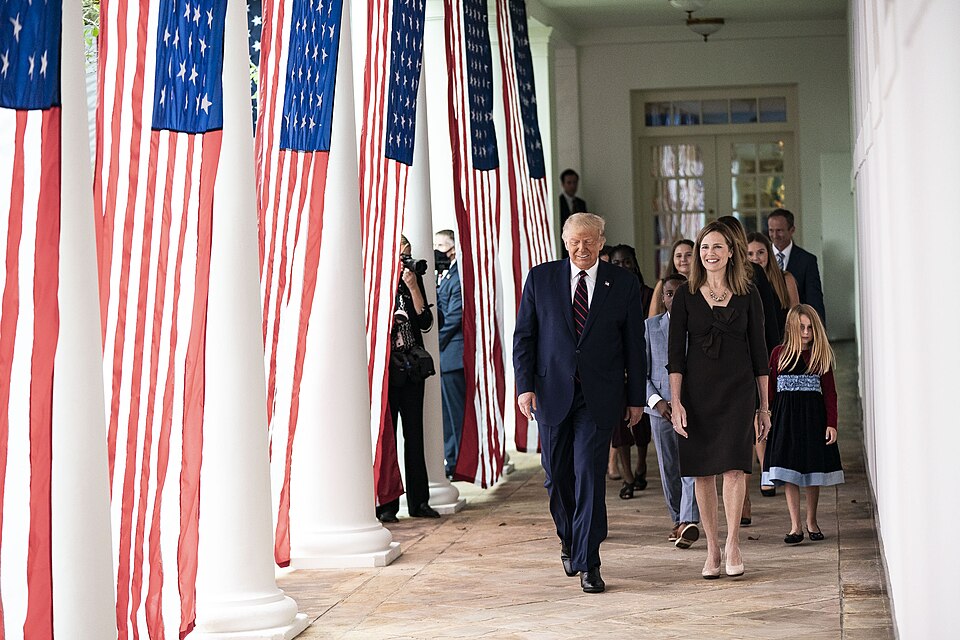
Not long ago, the United States Supreme Court delivered a highly controversial election law ruling that sent shockwaves through American politics. Centering on Mississippi's mail-in voting rules, the Supreme Court ruled by a narrow 5-4 majority that legally compliant mail-in ballots arriving after Election Day must still be counted in the final election results. The majority opinion was authored by Justice Amy Coney Barrett, a nominee of Donald Trump, directly striking down a lawsuit filed by the Republican National Committee attempting to ban the counting of post-Election Day mail-in ballots. This dealt a severe blow to the core electoral demands of Trump and his Make America Great Again (MAGA) faction.
This outcome not only shocked the American public but also left observers abroad baffled: How could a Supreme Court justice nominated by President Trump himself turn against him?
Around the same time, the Supreme Court rejected an executive order from Trump demanding changes to birthright citizenship. On this occasion, Chief Justice John Roberts authored the opinion for the majority, rebuking this "dramatically revisionist view" of the Fourteenth Amendment, with Barrett likewise joining the majority. ANBOUND’s founder Kung Chan believes that such an occurrence is actually unsurprising. The process surrounding Barrett's appointment as a justice back in 2020 already signaled this outcome, reflecting the long-standing factional rift between the Republican establishment and Trump's MAGA faction, and offering a true microcosm of American deep-circle politics within the framework of the separation of powers.
Tracing Barrett's political roots, her core political allegiance has never been to Trump's MAGA faction, but rather to the Republican establishment led by George W. Bush. Public resumes and historical records show that Barrett is fundamentally a Bush person. During her younger days, she worked for George W. Bush's legal team. At the critical juncture of the 2000 U.S. presidential election recount in Florida, she assisted Bush, the leader of the Republican establishment.
The sudden passing of Justice Ruth Bader Ginsburg in 2020 provided the Republican Party with an opportunity to quickly seize judicial control of the U.S. Supreme Court, but Barrett's nomination and appointment process was entirely guided and controlled by the Republican establishment, with Trump serving merely as the "nominal nominator". On the very night Ginsburg died, then-Senate Majority Leader and establishment stalwart Mitch McConnell placed an immediate phone call to Trump, forcefully demanding the nomination of Barrett as Supreme Court justice. Meanwhile, current Senate Majority Leader John Thune served as a key supporter of Barrett's ascension to the U.S. Supreme Court.
A crucial fact widely overlooked by the outside world is that rushing through Barrett's Supreme Court appointment eight days before the 2020 election was not a tactical election maneuver by the Trump team, but a preemptive move by the Republican establishment. According to post-election reviews by multiple mainstream U.S. media outlets at the time, the core circle of the Republican establishment had already used polling data and voter trends to predict that Trump would likely lose. Consequently, they positioned a judicial figure they could rely on ahead of time to firmly control the conservative majority on the Supreme Court, hedge against judicial reform risks under a future Democratic administration, and counterbalance the aggressive expansion of Trump's MAGA faction.
Barrett's alignment with the Republican establishment directly reflects the "small interests, big politics" characteristic of American political club culture, where various "small interests" run through and intertwine with networking ties. In 2021, Barrett secured a lucrative two-million-dollar book publishing contract, roughly equivalent to the payout for a presidential memoir, a reward widely viewed by the American political scene as a textbook political payback. Notably, the literary agency she signed with, Javelin, was co-founded by Matt Latimer, former chief speechwriter for George W. Bush, and Keith Urbahn, former chief of staff to Secretary of Defense Donald Rumsfeld, serving as an exclusive networking and interest-operation platform for the Republican establishment.
Furthermore, Barrett's family industrial background further cemented her ties with the Republican establishment figures such as the Bushes and Cheney. Public career records show that Barrett's father worked for Royal Dutch Shell for 29 years, specializing in core contracts for offshore drilling in the Gulf of Mexico. The core capital entities behind Gulf of Mexico offshore oil development were none other than Zapata Corporation, founded by the Bush family, and Halliburton, the energy services company controlled by former Vice President Dick Cheney. For decades, these two enterprises monopolized the U.S. Gulf of Mexico offshore drilling and supporting services market, forming a solid energy-interest community.
These connections have never been severed by Barrett's elevation to Supreme Court justice. The Republican establishment maintains regular contact with Supreme Court justices, just as Democrats undoubtedly do, with both major parties having their own representative figures on the high court.
The antagonism between the Republican establishment and Trump's MAGA faction has long permeated multiple dimensions, including congressional legislation and personnel appointments. As an establishment successor personally fostered by Bush and Cheney, John Thune now stands as a core figure in the anti-Trump MAGA camp. They are closely knit, frequently attending events and fundraisers together. Thune shares a deep personal friendship with Cheney and often goes hunting with him.
At the level of critical legislation, Thune has repeatedly taken the lead in blocking main bills advanced by Trump's MAGA faction, most notably the Safeguard American Voter Eligibility Act (SAVE Act). Designed to tighten election rules and strengthen presidential campaign authorities, the bill would clearly benefit the long-term governance of Trump's MAGA faction. Encountering universal opposition from the Democrats, the bill was also forcefully obstructed by the Republican establishment led by Thune and ultimately stalled in the Senate.
The factional standoff in the Senate is starkly clear. McConnell, who long controlled the Senate previously, is a crucial establishment figure, while newly empowered Thune is a steadfast anti-Trump establishment figure. Senate veteran and former Texas Senator John Cornyn has likewise repeatedly and publicly rejected Trump's core proposals, standing out as a well-known MAGA opponent within the Republican Party. Congressional voting records show that in the 118th and 119th Congresses, the proportion of votes cast by Republican establishment lawmakers that ran counter to Trump's stance consistently hovered above 35%, exceeding 50% in areas such as electoral rules, capital regulation, and energy policy. Therefore, the surface-level "separation of powers" actually conceals a four-way contest, one of which involves the Republican establishment.
For a long time, outsiders have widely misunderstood the operating logic of American politics. When deconstructing American politics, Kung Chan once noted that numerous political cases and institutional practices prove that American politics is fundamentally a circular culture. All these connections among Thune, Bush, and Cheney are merely superficial manifestations of this culture. While the Republican establishment and Democratic elites ostensibly belong to different parties, they actually stand together as forces blocking Trump's MAGA efforts. The Supreme Court's 5-4 mail-in ballot ruling serves as a perfect testament to this logic, directly undercutting the electoral voice of the MAGA faction while preserving the establishment-dominated flexible voting system.
From an institutional architecture perspective, the system of the "separation of powers" established by the U.S. Constitution appears to achieve a checks-and-balances framework among the legislative, executive, and judicial branches, constructing a structured equilibrium of power. In actual political operations, however, the separation of powers is merely a surface-level institutional framework. What truly dictates the direction of American politics is the various elite circle politics hidden beneath the surface of these institutions. Anyone who believes that Trump is genuinely leading the Republican Party is being overly naïve. Everything is a struggle, and it is a struggle fought among circles.
The anomalous ruling on mail-in ballots by the U.S. Supreme Court in 2026 is not an isolated judicial dispute, but rather an inevitable consequence of America's deep political structure. Barrett's appointment, her ruling stance, her interest ties, Thune's personnel arrangements and legislative obstruction, along with the deep penetration of the Bush-Cheney energy circle, progressively reveal the operational logic of American circle politics, i.e., political parties, factions, and institutions are all surface-level tools, while the preservation of interests across various elite circles remains the core objective.
Naturally, Trump and the MAGA faction will not sit idly by and will mount a counter-offensive, primarily leveraging House legislative procedures to try and force the Senate to pass resolutions favorable to themselves. This outcome remains to be seen.
Final analysis conclusion:
Not long ago, the U.S. Supreme Court ruled 5-4 that compliant mail-in ballots arriving after Election Day are valid. Justice Barrett, who authored the opinion, actually belongs to the Republican establishment and holds views contrary to the Trump MAGA faction, thoroughly exposing internal rifts within the Republican Party. Powered into her position by the establishment, Barrett serves establishment demands by relying on deep-seated interests and networking circles. The establishment, represented by Thune, has repeatedly blocked core MAGA legislation, and the antagonism between the two factions runs deep across multiple political domains. This reflects that beneath America's separation of powers structure, the political landscape is truly dominated by elite circle struggles.
______________
Xia Ri is an Industry Researcher at ANBOUND, an independent think tank.


