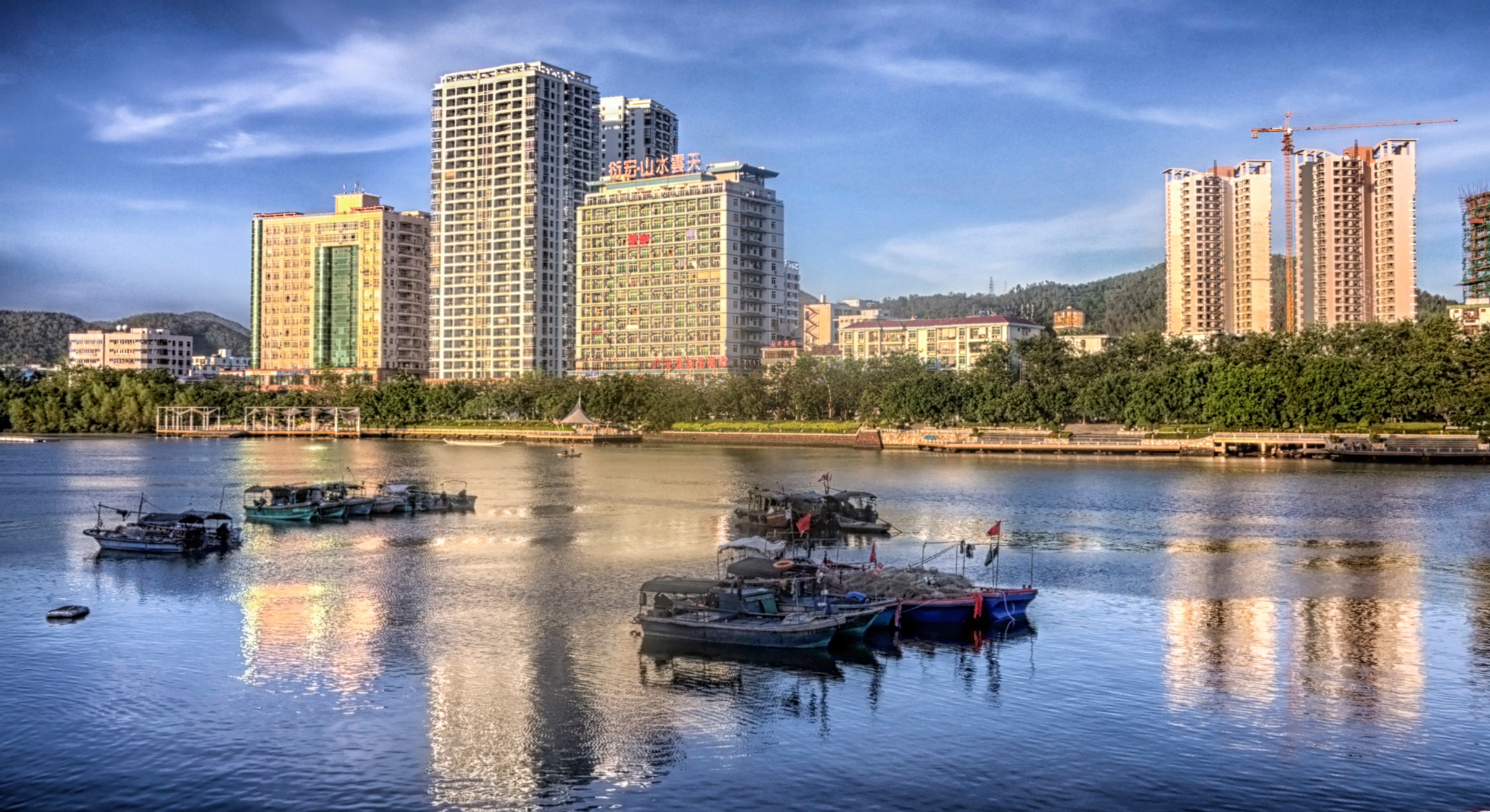
On July 22, the authorities of Hainan released the economic performance data for the first half of 2026. The province's gross domestic product reached RMB 381.345 billion, a year-on-year increase of 2.0 percent. This figure is significantly lower than the national growth rate of 4.7% and falls well short of the target of around 6% set at the beginning of the year. Broken down by sector, primary industry grew by 3.9%, secondary industry contracted by 2.4%, and tertiary industry expanded by a meager 2.5%. This time, it is unusual for Hainan to have its growth during the first half of the year driven primarily by the primary sector, while the industrial sector shrank and the services sector failed to exhibit the dynamism expected of a free trade port.
As a matter of fact, such an outcome deserves serious attention of the Chinese authorities.
In December 2025, the Hainan Free Trade Port officially commenced island-wide independent customs operations. Conventional wisdom held that these customs operations, combined with policies such as zero tariffs, low tax rates, and trade and investment facilitation, would serve as a powerful catalyst for a new wave of growth. Yet, half a year later, a striking gap has emerged between policy enthusiasm and economic momentum. This disparity indicates that Hainan is currently confronting more than just short-term cyclical fluctuations in economic growth. There is clearly a gap between policy input, policy expectations, and actual economic results. Consequently, it is worth pondering the reason why Hainan Free Trade Port policy failed to deliver the transformative impact originally anticipated.
The Overall Plan for the Construction of the Hainan Free Trade Port, released in 2020, expected that by 2025, Hainan would initially establish a policy and institutional framework centered on trade and investment freedom and facilitation, achieve a first-class business environment within China, see a massive surge in market entities, significantly enhance industrial competitiveness, and markedly improve the quality and efficiency of economic development. Looking back now, the institutional framework has indeed been established, and certain localized indicators are quite striking. Since the launch of independent customs operations through the end of May this year, offshore duty-free sales in Hainan exceeded RMB 20 billion, marking an increase of about 20% year-on-year. Meanwhile, the value of zero-tariff imported goods surged by 1.2 times, and container throughput in the first five months of the year rose by 53.9%.
While these indicators show that policies are beginning to take effect, they do not prove such policies have translated into island-wide productive forces. Duty-free sales, imported goods, and port throughput primarily reflect growth in trade flows, logistical channels, and policy-driven business. Without a stable local industrial chain that drives business investment, technological advancement, rising household incomes, and stronger market demand, it is difficult for it to become a sustainable pillar of the province's economy. Hainan's contracting secondary industry and sluggish tertiary sector in the first half of the year precisely illustrate that policy dividends remain confined to a few isolated areas and have yet to generate a broad multiplier effect. In other words, Hainan is neither starved of policies nor entirely devoid of policy efficacy. The genuine problem is that the localized flows generated by these policies have not smoothly translated into comprehensive productivity growth across the entire island.
In fact, at the very inception of the Hainan Free Trade Port policies, ANBOUND’s founder Kung Chan had already made a clear and definitive assessment of their likely impact. At the time, he argued that the influence of the Hainan Free Trade Zone policies on the local economy should not be viewed with undue optimism. This assessment ran counter to the widespread optimistic expectations at the time and even sparked considerable controversies. Re-evaluating this view today in light of Hainan's actual economic performance provides a phased, real-world benchmark for those initial divergent judgments.
It is worth noting that Kung Chan's initial assessment was not based on the belief that all free trade zone policies are ineffective, but rather that placing all hopes in a single free trade zone policy to transform a region's fortunes is fundamentally flawed. Policies never operate in a vacuum. A policy that worked in the past will not necessarily work today, and a policy that succeeds in one locale will not automatically yield the same results if simply transplanted elsewhere. Policy researchers must recognize that environments and backgrounds exert an immense influence, and all outcomes are conditional. Assessing the magnitude of a policy in isolation, detached from the specific economic environment, market demand, and industrial foundation, invariably leads to an overestimation of its actual impact.
In the past, China was in a phase of high-speed growth with robust demand, expanding markets, and the rapid advancement of industrialization, urbanization, and real estate development. Once a new district, development zone, or special policy area secured advantages in taxation, land, trade, and administrative approvals, capital, enterprises, and population naturally gravitated toward it. The policy merely needed to open a sluice gate, and subsequent market forces would rapidly amplify the effect. During that time, when such policies were deployed, they could indeed transform the landscape and deliver conspicuous results. This success was not solely attributable to the nature of the policies themselves, but rather to the fact that China's market was undergoing high-speed growth with high demand for investment, consumption, and development. Consequently, that was the era when policy signals were given, pre-existing market forces quickly fell into line.
Yet today’s economic conditions are completely different.
The Chinese economy has entered a phase of medium-to-low growth, marked by subdued domestic demand, a downward trend in the real estate sector, and constraints on both local government fiscal capacity and corporate investment. Regions across the country are fiercely competing for finite capital, projects, talent, and consumer spending. Hence, granting preferential policies to a single region often merely shifts existing business away from elsewhere, or simply reorganizes administrative registration, settlement, and trade routes. With no significant expansion in aggregate volume and no marked improvement in production efficiency, policy efficacy inevitably declines. In 2025, fixed-asset investment in Hainan fell by 16.5%; even though total retail sales of consumer goods grew by 5.0%, this failed to translate into more robust industrial expansion or sustained investment.
Consequently, Hainan's current challenges cannot be simply attributed to insufficient policy intensity, nor should policymakers continue to place all their hopes on adding a few more preferential policies, engineering new industrial parks, or importing another batch of registered enterprises. If the broader economic environment and market conditions remain unchanged, putting forward additional preferential policies may merely inflate registration counts, trade volumes, and signed project amounts, without necessarily enhancing Hainan's actual productive capacity. The ultimate test of a policy's efficacy remains whether it genuinely enhances productivity.
Furthermore, opening-up would encompass far more than tax exemptions on goods, the hosting of exhibitions, cross-border trade, or rising tourist arrivals. According to Kung Chan's framework, the more comprehensive the openness, the more conducive it is to unleashing productivity. The issue facing Hainan is not merely a question of whether it has opened up, but whether that openness is sufficiently thorough. A genuine free trade port requires the efficient movement of capital, technology, talent, data, logistics, and professional services in accordance with market laws. It also requires enterprises to compete in international markets, as well as aligning institutional frameworks with high-standard international economic and trade rules.
The Overall Plan explicitly lists trade, investment, cross-border capital, personnel, personnel transport, and data flows as its main components, setting 2035 as the target year for establishing a mature institutional system. This indicates that Hainan remains in a stage of institutional construction and open experimentation, still some distance away from fully releasing its production factors. The launch of independent customs operations is a vital institutional milestone, but it does not mean that true, comprehensive openness has been completed.
Hainan's development over the past few years has been concentrated primarily in tourism, duty-free retail, real estate, and a handful of policy-driven industries. While these sectors can generate localized prosperity, their counter-cyclical resilience and industrial pulling power remain limited. A surge in tourist arrivals does not necessarily mean a parallel rise in per capita spending or local incomes. Growth in duty-free sales may simply reflect a diversion of consumption from overseas or other parts of the Chinese mainland to Hainan. Similarly, if port throughput merely consists of cargo passing through Hainan, the value-added retained locally remains minimal. Hainan must look beyond the mere magnitude of trade and visitor flows to examine how much corporate profit, resident income, technological capability, and fiscal revenue remain behind after those flows pass through.
Viewed from this perspective, the sluggish growth recorded in the first half of 2026 is hardly surprising. Rather than representing an anomaly, it serves as a reality check on the early wave of optimism surrounding the free trade port. While free trade port policies can create opportunities, they cannot automatically generate industries or investment projects. Such policies may reduce transaction costs and improve the business environment, but they cannot substitute for entrepreneurs, technological capabilities, market demand, or well-developed industrial supply chains. The outcome is therefore far more consistent with ANBOUND's original assessment, that expecting a single regional policy initiative to fundamentally transform Hainan's development trajectory reflects a misunderstanding both of the broader macroeconomic environment and of the inherently conditional nature of public policy.
Kung Chan believes that the actual adjustment Hainan must make next lies in the direction in which its productive forces are released. Policy effectiveness depends on productivity gains, and productivity gains in turn depend on genuine openness. If bottlenecks emerge in the release of productive forces, the strategic direction must be adjusted promptly. How far Hainan's future can progress naturally depends on the extent of its openness, but it relies even more heavily on the proactive governance and execution of the local government in economic and industrial development.
Hainan's free trade port should also be assessed against a different set of metrics. The number of newly registered enterprises, the value of signed investment projects, tourist arrivals, and port throughput are all important. More crucial, however, are whether labor productivity has improved, private investment has increased, household incomes have risen, local industrial value chains have become more complete, and fiscal revenues can be sustained over time. Unless these fundamental indicators undergo meaningful improvement, however compelling the policy narrative surrounding Hainan may be, it will remain difficult to translate that narrative into tangible economic reality.
Final analysis conclusion:
Hainan's 2.0% growth in the first half of this year provides further evidence supporting ANBOUND's earlier assessment that expecting the free trade port policy alone could fundamentally transform the province is to overlook the changing macroeconomic environment and the evolving conditions. Policies that proved effective during periods of rapid growth may lose their effectiveness in an era of low to moderate growth. Hainan's future will depend not on the free trade port policy itself, but on its ability to pursue broader and more substantive opening-up, recalibrate the direction in which productive forces are unleashed, and actively advance both industrial upgrading and overall social development.
______________
Yang Xite is a Research Fellow at ANBOUND, an independent think tank.


