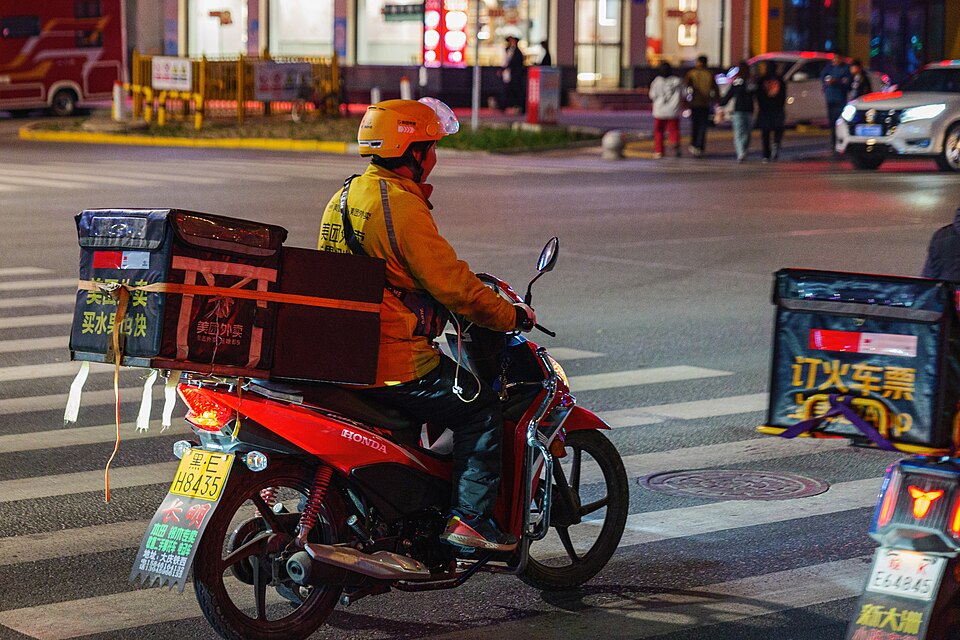
The standardized regulation of the platform economy has recently become a central focus of policy attention in China. Measures ranging from requiring platforms to pay social security contributions for food delivery riders, to promoting the signing of formal employment contracts between platform workers and platforms, to progressively improving the labor rights protection system, are undoubtedly correct from a long-term perspective. These steps imply a transition for China’s platform economy from extensive, unregulated growth toward maturity and standardization, while responding to long-standing calls for enhanced basic protections for flexible workers.
However, the implementation of any policy requires doing so at the right time. Under current downward economic pressures and severe employment headwinds, advancing such policies too quickly or forcefully risks producing adverse consequences.
From January to April 2026, the unemployment insurance fund registered consecutive monthly deficits, with current expenditures outpacing current revenues. Although the number of insured participants is growing, expenditures are expanding at a faster pace, indicating that the number of individuals receiving unemployment benefits is rising sharply, while per capita payouts are also increasing. All these translate to an increase in the real unemployment rate.
As of now, what is known as the flexible employment workforce in China has reached 320 million people. Within this 320 million, beyond traditional construction workers, manufacturing workers, and self-employed micro-vendors, the three major platform economy sectors, i.e., food delivery, express logistics, and ride-hailing, absorb the largest volume of employment, which is continuously expanding. According to incomplete statistics, food delivery riders alone exceed 15 million, while ride-hailing drivers also number in the tens of millions. The jobs provided by these platforms share widespread common traits, namely low entry barriers, flexible hours, and predictable income, making them a crucial employment buffer for vast numbers of low-skilled laborers, the temporarily unemployed, and young workers newly entering the labor market.
If policies regulating platform labor lead to a contraction among platform entities, when it comes to which other entity can absorb this continuously growing flexibly employed population, no alternative exists at present.
The current severity of employment pressure stems from the compounded impact of three forces.
The first is the ongoing economic downturn. Decelerating GDP growth, shrinking corporate orders, and narrowing profit margins have made layoffs and wage cuts widespread. When businesses cease hiring, employment naturally becomes difficult.
The second force involves the pangs of structural transformation. China’s economy is transitioning from labor-intensive to technology-intensive models, and from low-end to high-end manufacturing. While progressive at the macro level, this transformation means the disappearance of vast numbers of traditional jobs at the micro level. Employment in manufacturing continues to decline; meanwhile, emerging deep-tech industries such as artificial intelligence, semiconductors, and biomedicine, despite offering high pay and prestige, absorb a very limited absolute volume of labor.
The third force, which is the most fundamental cause, is that mainstream discourses often attribute employment pressure to "insufficient demand", i.e., sluggish consumption and weak domestic demand cause businesses to stop hiring. This assessment is not incorrect, but it sees only the surface. ANBOUND’s founder Kung Chan explained this issue through the concept of "supply-side depression".
Kung Chan pointed out that the core of the supply side is enterprises. Enterprises are the foundation of economic growth, the carriers of employment, and the baseline for the functioning of society as a whole. Apart from enterprises, there can be neither employment nor development. What appears on the surface as an employment problem is, in essence, a problem of corporate distress. The causes of distress among supply-side enterprises are manifold. This includes macroeconomic pressures that continuously penetrate to the micro level, plunging Chinese businesses into progressively deeper operational challenges. This, in turn, causes difficulties in securing financing, elevated costs, scarce orders, thin margins, and weak expectations. At the same time, the policy-related operational costs for enterprises continue to rise. In particular, labor protection costs are steadily expanding, accounting for a substantial proportion of fixed corporate expenses, which is a major reason for a large number of enterprises experiencing hardships.
The significance of the concept of "supply-side depression" lies in shifting the root cause of employment challenges beyond "insufficient demand" to the deeper level of the "distress of enterprises". This is the essence of "supply-side depression". It is not that the demand side lacks a desire for goods, but rather that supply-side enterprises have lost the capacity for sustained production and job creation. Hence, China is currently facing not merely a simple employment issue, but a "supply-side depression".
Precisely because of "supply-side depression" showing no immediate signs of easing, the "employment buffer" function of the platform economy becomes crucial. Platform enterprises are themselves enterprises. They bear the same immense pressure of "supply-side depression" like rising operating and policy-related costs, intense competition, and declining profit margins. Yet, precisely because they possess vast flexible employment networks, they can serve as an employment buffer for tens of millions of workers during an economic downturn. If this buffer is removed or its capacity diminished, the consequences will be unthinkable.
As it stands, the current business model of the platform economy is built on low-cost flexible labor. If platforms are forcibly mandated to convert millions of riders into formal employees and contribute to social insurance and housing provident fund, the cost of social security contributions alone could increase by tens of billions of RMB. With thin profit margins and fierce competition among platform companies, these costs will either be passed on to consumers via higher delivery fees, passed on to merchants through higher commission rates, or result in platforms scaling back operations substantially. Whichever outcome materializes, it will ultimately shrink employment capacity. Some platforms have already estimated that fully enforcing new social security regulations might require massive workforce reductions among riders, leaving millions without a source of income overnight.
Furthermore, the composition of the flexible workforce is extremely complex, and a considerable portion of these individuals do not wish to be "formalized". For instance, many riders work part-time, maintaining agricultural or seasonal work in their hometowns while delivering food in cities merely to supplement household income. Others might use it as a short-term transition while seeking more stable employment. Still others are retirees returning to work. Mandatory labor contracts and social security contributions for these groups could mean a loss of flexibility, thereby reducing their actual net gains.
This is not an argument against regulation, but rather an appeal for a phased, categorized, and well-paced approach. For example, pilot social security coverage could begin with full-time, long-term riders registered exclusively on a single platform, while retaining flexible options for part-time, multi-platform, or temporary riders. Concurrently, multi-party funding mechanisms could be explored, such as per-order social security deductions, government subsidies, and cost-sharing by platforms, rather than placing the entire financial burden on the platforms themselves. In short, while standardized management of the platform economy must move forward, it cannot be implemented through a one-size-fits-all mandate. At least during the present stage marked by heavy employment pressures, high unemployment, and a "supply-side depression", the employment buffering role of the platform economy remains indispensable.
Over the longer term, resolving employment challenges cannot rely on the platform economy. Rather, this requires fundamentally revitalizing enterprise dynamism on the supply side. Kung Chan's concept of "supply-side depression" points the way forward, that the focus of China’s future policy should shift from stimulating demand to repairing supply, thereby restoring vitality to the vast number of private small and medium-sized enterprises that serve as the main drivers of employment absorption. When enterprises regain their vitality and the supply side ceases to suffer from "depression", the employment market will improve at its source. At that point, the employment reservoir of the platform economy will no longer need to bear such enormous pressure, allowing regulatory and formalization reforms to proceed with greater composure.
Final analysis conclusion:
Under the compounded pressures of the current economic downturn, the pangs of structural transformation and "supply-side depression", the "employment buffer" function of online platforms in China’s economy is indispensable. If the authorities abruptly halt or adopt a one-size-fits-all approach in pursuit of regulatory compliance, this might lead to platform contraction and the loss of flexible employment jobs, in which tens of millions of workers could lose their employment safety net, rapidly transmitting unemployment pressures to social stability. Over the long run, the fundamental solution lies in repairing the supply side, which would enable enterprises to survive and thrive, and re-establish a solid foundation for the macroeconomy, after which employment pressures will naturally ease. Only then can the standardization of the platform economy and job security achieve a truly virtuous cycle.
______________
Xiaofeng Li is a Economist of China Macro-Economy Research Center at ANBOUND, an independent think tank.


