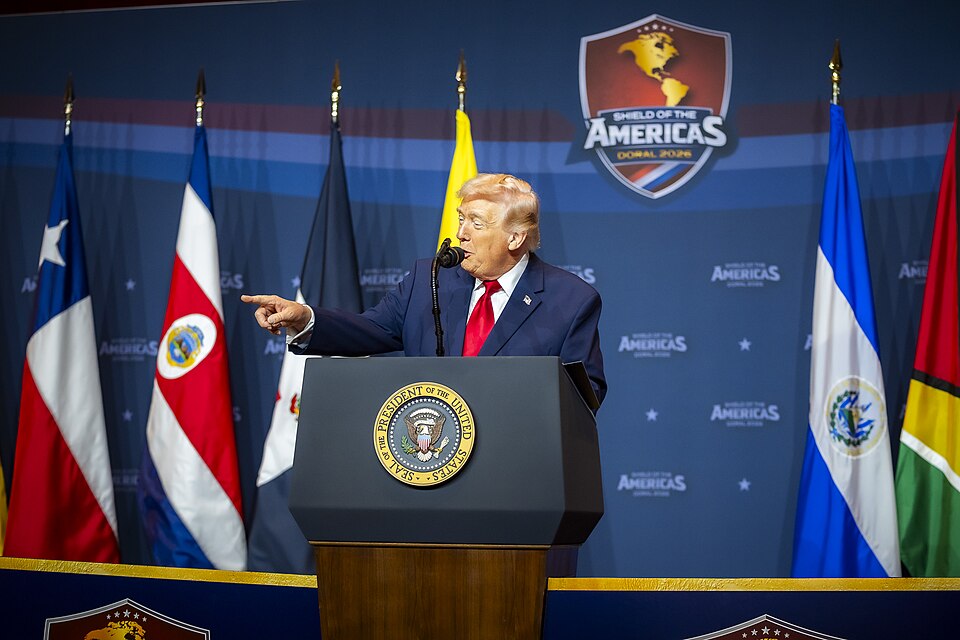
The international situation since March 2026 has seen rather interesting, symbolic parallel developments. While the U.S. and Israeli military strikes against Iran have created tensions in the Middle East, Washington simultaneously convened the "Shield of the Americas" summit in Doral, Florida, signaling a decisive return to the Western Hemisphere as a primary strategic theater. While the war in the Middle East appears to be monopolizing the world's attention, Washington is clearly not easing up on consolidating its regional backyard. On the contrary, it is using the pressures of the conflict to accelerate its strategic grip on the Americas, signaling a "dual-track" global strategy that balances military force in the Middle East with a sweeping geopolitical overhaul of the Western Hemisphere. Crucially, throughout the summit, the U.S. has maintained steady pressure on Latin American states regarding the control of Panamanian ports, Chilean undersea cables, and critical mineral resources. This was further shown in late April when the President Santiago Peña of Paraguay, South America's sole remaining country to maintain "diplomatic ties" with Taiwan, reaffirmed that relationship and announced plans to visit the island. While Paraguay's stance might not shift the regional deck on its own, it reflects a broader U.S. effort to force Latin American capitals into a closer alignment with its own position on China. It is becoming clear that beneath the headlines of the Middle East, the U.S. is aggressively re-engaging the Americas through the logic of securitization, bloc-building, and exclusion.
As things stand, this "Shield of the Americas" summit was neither a conventional pan-American multilateral gathering nor a routine safety meeting focused simply on drug interdiction, migration, or law enforcement cooperation. Judging by the high-level U.S. presence, including Donald Trump, Marco Rubio, Pete Hegseth, Howard Lutnick, and Jamieson Greer, this was actually a high-level strategic mobilization aimed at bundling security, trade, supply chains, and political integration with geopolitical competition. The attendance of leaders from over a dozen nations, such as Argentina, Chile, Ecuador, Panama, El Salvador, and Paraguay, contrasted sharply with the notable absence of regional powers like Brazil, Mexico, and Colombia. This clearly indicates that the summit was not an inclusive platform for all of Latin America, but rather a narrow coordination mechanism built around "like-minded allies". At the summit, Trump made a high-profile call for using military force against drug cartels and pushed for the creation of a coalition to combat drug cartels, while explicitly emphasizing the need to repel "hostile foreign influences" from outside the hemisphere. This rhetoric effectively merges "anti-drug", "anti-immigration", and "hemispheric security" with the "exclusion of external powers" into a single strategic narrative. Even more noteworthy is the timing: this summit took place just ahead of a potential meeting between Trump and the Chinese leadership in May. In this context, the "Shield of the Americas" is undoubtedly a move to consolidate the Western Hemisphere and sharpen U.S. leverage before engaging with Beijing. For China, the significance of this summit goes beyond a mere meeting in Latin America; it signals a concerted U.S. effort to reshape the entire continent into a primary strategic front for pressuring, containing, and competing with China.
First of all, the U.S. competitive posture toward China in Latin America appears to be shifting from economic rivalry toward sustained security-driven containment. After this summit, the pressure China faces across the Americas will manifest in a fundamental change in the regional environment. For a long time, while U.S.-China interactions in Latin America were certainly competitive, they were primarily defined by trade, investment, financing, and infrastructure cooperation, i.e., rivalry largely confined to projects, markets, and technical standards. However, this summit signals that Washington is rapidly escalating this competition into the security, military, and political spheres. Issues that previously fell under the umbrella of developmental cooperation are now being re-embedded into a narrative of "hemispheric security", "national sovereignty", and even a "civilizational defense".
Trump's public demand that Latin American nations deploy their militaries against drug cartels, coupled with his proposal to root out "cartel networks" much like the campaign against ISIS, indicates that Washington is using its most potent non-traditional security issue to rebuild a U.S.-led security system in the Western Hemisphere. Once this regional security framework is established, infrastructure such as ports, undersea cables, energy, minerals, logistics corridors, and digital networks are likely to be redefined as "security assets". Consequently, China's legitimate cooperation in these sectors will face systematic stigmatization.
In this sense, the challenge China faces in the Americas will no longer be standard market competition, but rather a "securitized competition". The recent controversy over the Panamanian port and the tightening scrutiny of Chinese projects in Argentina, Ecuador, and Bolivia already demonstrate that Washington is systematically reframing China's established presence in the region as a political and security threat. The danger of this shift lies in the fact that the U.S. does not need to fully replace China economically; it only needs to impose political hurdles, security reviews, and public pressure at a few strategic junctures to significantly drive up the costs of China-Latin America cooperation. In other words, the U.S. may not aim to "expel China" from Latin America entirely, yet it is fully capable of engineering "node-based containment" in critical sectors like ports, essential minerals, undersea cables, telecommunications, and energy corridors. By doing so, it can establish a regional security mechanism that exerts continuous, systemic pressure on China's broader cooperative network throughout the region.
This echoes and validates ANBOUND's previous assessment regarding the "Century of Americas". This assessment was not merely a general observation that the U.S. was turning its attention back to the Western Hemisphere; more importantly, it argued that amid global instability and a refocusing of strategic priorities, Washington would likely reshape the entire Americas into a U.S.-led core zone for the restructuring of its security, industrial, resource, and financial systems. This implies that Latin America is no longer just an external space for China's economic expansion, but is increasingly becoming a critical component of the United States' effort to rebuild strategic depth between its mainland and its near neighbors. Under these circumstances, the pressure China faces in the Americas is long-term, structural, and systemic in nature, rather than a series of isolated or short-term frictions.
Secondly, the U.S. is simultaneously building small-circle alliances and advancing a "de-Sinification" agenda in Latin America, which will subject China to much more intense political vetting. Another critical signal from this summit is that Washington's policy toolkit in the region is shifting from broad engagement toward small-circle integration, moving away from trying to "influence the entire region" in favor of "locking in pivot states" to a U.S.-led system. This suggests that the pressure China faces in the future will likely not be evenly distributed. Instead, it will manifest as concentrated friction points surrounding specific key countries, projects, and industries. Judging by the attendance list, the U.S. is prioritizing the integration of a cluster of nations that align more closely with the Trump administration's stance on security, migration governance, market policies, and general political posture toward Washington. The immediate effect of this arrangement is the creation of a policy network that is easier to coordinate and more submissive to U.S. intentions. For China, while such networks may not cover the entirety of Latin America, they are sufficient to generate significant chain-reaction pressure in localized areas, effectively establishing a strategic layout for "de-Sinification".
Recent developments in Panama and Chile already indicate this trend. Panama, among the first Latin American nations to join the Belt and Road Initiative (BRI), had seen substantial progress in its cooperation with China. Today, however, it has become a testing ground for Washington's policies on "port securitization" and "corridor sovereignty". Even as China reacted strongly and substantively, including by detaining Panamanian-flagged vessels, the situation remains complicated as the U.S. continues to intervene to back the Panamanian authorities. Similarly, Chile has seen a simultaneous contraction of cooperation with China across undersea cables, astronomical observatories, and lithium resources. This proves that U.S. pressure is not isolated to single incidents; rather, it is a coordinated attempt to sever Chinese influence across telecommunications, technology, and natural resources. Furthermore, subtle shifts in project access, vetting mechanisms, policy rhetoric, and the general media climate in several Latin American countries suggest that China is facing a process of "incremental de-Sinification". This may not always be high-profile "decoupling", but will instead involve a steady erosion of the foundations of China-Latin America cooperation through administrative delays, legal disputes, security reviews, smear campaigns, and the shifting tides of local party politics.
Crucially, this pressure is not entirely a result of external coercion; it is increasingly being channeled through the internal political structures of Latin American nations. The United States' advantage in the region lies not only in its markets, military power, and financial tools, but also in its enduring capacity to shape regional political elites, ideological networks, and public narratives. When certain right-wing or center-right governments in Latin America view alignment with Washington as a shortcut to securing security guarantees, capital support, and political endorsement, their China policy easily becomes a bargaining chip used to signal loyalty to the U.S. In this environment, the resistance China encounters in Latin America stems not only from direct U.S. pressure but from Washington's success in embedding that pressure into the domestic policy mechanisms and political preferences of these countries. This "internalized external pressure" is often far more difficult to counter than simple diplomatic friction. It allows certain states to maintain a nominal posture of cooperation with China while effectively raising barriers behind the scenes, leading to constant back-and-forth and the gradual exhaustion of project momentum.
Over the long-term period, this "small-circle" approach, framed by Washington under the pretext of anti-drug initiatives, will further deepen the internal divisions within Latin America. One group of nations will become more tightly integrated into U.S.-led security chains, serving as pivots for a "Neo-Monroe Doctrine" in the Western Hemisphere. Meanwhile, others will continue to vacillate, attempting to balance their security reliance on the U.S. with their economic dependence on China. This implies that China's position in the Americas will become increasingly uneven. While cooperation may remain resilient in certain countries and sectors, China will face escalating political risks and security costs in others. This asymmetrical pressure is set to become the new normal that China must face in its future engagement with Latin America.
Furthermore, the U.S. is leveraging long-term attrition to force China into a "high-cost presence" phase in the Americas. While the current U.S. push against China is aggressive, Washington does not yet possess the capacity to fully replace China across the entire region. China remains a vital trading partner, infrastructure financier, and resource collaborator for Latin America and the Caribbean. Many Latin American nations simply cannot sustain their development without the support of Chinese markets, capital, and manufacturing. These realities make it extremely difficult for the U.S. to construct a comprehensive economic alternative capable of supplanting China in the short term. Consequently, it is unlikely that Latin America will pivot toward the U.S. in a uniform or rapid fashion, and it is even less likely that the region can truly decouple from China economically.
However, the U.S. does not necessarily need to achieve total replacement to realize its strategic objectives. As long as it can secure policy compliance from key nations, establish "forbidden zones" in critical sectors, and continuously drive up the political and security costs of major projects, it can successfully force China into a state of "high-cost presence" in the Americas. In this "high-cost" scenario, China remains present, cooperation continues, and its influence does not necessarily collapse. However, every initiative becomes harder to advance than in the past. Cooperation becomes increasingly prone to disruption and requires significantly higher expenditures in terms of political, diplomatic, and risk-management capital. This situation is actually more complex than direct confrontation, as it represents a process of long-term attrition rather than a clean, one-time break.
This is exactly what makes the "Shield of the Americas" summit alarming to China. On one hand, Washington is using mechanisms like the coalition against cartels, border governance initiatives, and military training programs to bind Latin American nations more tightly to its own security framework. On the other, by taking a hardline stance on issues like Venezuela and Cuba, it is creating a regional atmosphere of deterrence, nudging smaller and mid-sized Latin American countries toward a policy of "risk-averse alignment" with the U.S. At the same time, by framing China alongside "hostile foreign forces outside the hemisphere", the U.S. is carving out the policy space needed to expand its crackdown in the future. If this trend persists, China will not just face localized challenges in the Americas, but an increasingly systematic and interconnected network of pressure.
Final analysis conclusion:
The true significance of the "Shield of the Americas" summit lies not in the immediate, actionable agreements reached on the ground, but in the fact that it marks the reintegration of the Western Hemisphere into the U.S. global strategy. It signals that Washington has begun to approach U.S.-China competition in the Americas through an explicit logic of security, alliances, and exclusion. For China, what is crucial is not the gain or loss of specific projects, but the reality that the entire Latin American region is shifting from a space of economic cooperation into a theater of strategic competition. This transformation demands China's highest vigilance. Consequently, Beijing must respond by restructuring its own long-term Latin American strategy; relying solely on the hope that local political cycles or changes in government will resolve these challenges is no longer realistic for it.
______________
Zhou Chao is a Research Fellow for Geopolitical Strategy programme at ANBOUND, an independent think tank.


