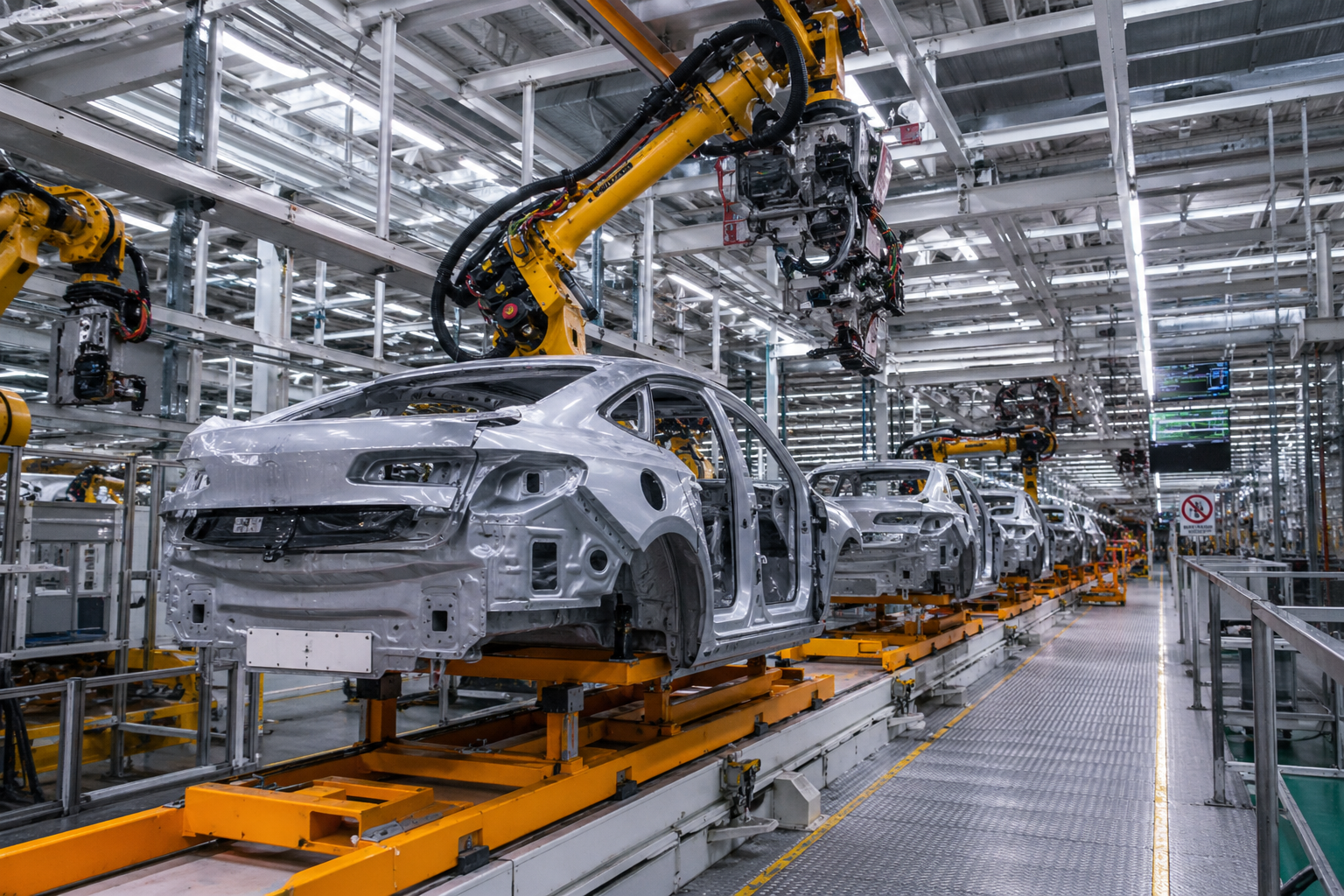
The United States once viewed the electric vehicle (EV) industry as a pivotal lever for both a manufacturing renaissance and a green transition. The Biden administration promoted it, where an intensive series of policies centered on the Inflation Reduction Act (IRA) were rolled out in an attempt to fulfill the dual political promises of energy transformation and industrial reshoring within a condensed timeframe. However, since the beginning of 2025, this highly anticipated industry has shown clear signs of cooling or even stagnation across multiple regions. Progress on several projects has been obstructed, the pace of investment has decelerated, and employment expectations have fallen short, effectively creating an "EV Rust Belt."
According to reporting from Reuters, on March 30, 2026, General Motors' Detroit-based electric vehicle plant Factory Zero announced an extension of its production halt until April 13, with the plant manager citing aligning with “market dynamics" and initiating temporary layoffs for approximately 1,300 workers. Furthermore, in December 2025, Ford Motor Company announced a USD 19.5 billion capital impairment charge related to its electric vehicle operations and cut roughly 1,600 jobs at its BlueOval SK battery plant in Kentucky. Ford simultaneously announced it would cease production of the all-electric F-150 Lightning and abandon its production plans for the next-generation T3 electric pickup and electric vans. Media reports also indicate that Magna’s factory in St. Clair, Michigan, a supplier of EV components to General Motors, now sits nearly vacant; as the automotive industry recalibrates its electric vehicle investments, the plant has suffered a significant blow and is essentially in a state of shutdown or large-scale dormancy.
What once was heralded as the "hope for revival" of the American automotive industry is now facing a rapid decline. This phenomenon of "high expectations followed by a low trajectory" raises a question worthy of deeper analysis: even with aggressive policy promotion and rapid capital deployment, how did the U.S. electric vehicle industry reach this state?
The American EV industrial policy originated under the Biden administration, and it was one of the most ambitious initiatives of the Democratic Party's political goals. The administration sought to combine green transition, blue-collar employment, and manufacturing reshoring through framing the EV policy model as being capable of simultaneously reducing emissions, building new factories, and creating unionized jobs. To achieve this, the Biden administration constructed a comprehensive policy toolkit.
First of all, there are demand-side incentives, with the primary mechanism being the Clean Vehicle Credit under IRA. This provides a tax credit of up to USD 7,500 for qualifying new EVs and USD 4,000 for used EVs, alongside specific incentives for leased and commercial vehicles. The objective was to bolster end-user demand during a transitional phase where EV prices remain higher than those of internal combustion engine vehicles. Then, there are supply-side incentives. The Advanced Manufacturing Production Credit (Section 45X) within the IRA provides direct subsidies based on output, significantly lowering the domestic production costs for EVs and their components. Simultaneously, the U.S. Department of Energy, through its Loan Programs Office, has provided low-cost financing for large-scale projects. Notably, the BlueOval SK venture, a partnership between Ford and the South Korean battery giant SK On, secured approximately USD 9.63 billion in loan support to construct three battery plants in Tennessee and Kentucky, with a combined design capacity exceeding 120 GWh. Finally, the strategy includes infrastructure support. Through the 2021 Bipartisan Infrastructure Law (IIJA), the National Electric Vehicle Infrastructure (NEVI) Formula Program was established. This program plans to allocate approximately USD 7.5 billion to states by 2026 to build a public fast-charging network along highway corridors and within communities, aiming to resolve the "range anxiety" stemming from a lack of charging stations.
This multifaceted policy suite had an immediate and profound stimulatory effect on both the private sector and local governments. Between 2021 and 2024, cumulative announced investments in the North American battery and electric vehicle supply chain surpassed USD 250 billion. According to data from Atlas Public Policy, as of September 2024, announced investments specifically related to EV and battery manufacturing reached approximately USD 208.8 billion, tied to commitments for roughly 240,000 manufacturing jobs. Under these policy signals, nearly all legacy automakers recalibrated their capital expenditure strategies. General Motors initially pledged USD 35.0 billion toward electric vehicles and autonomous driving through 2025, a figure it later revised upward. Similarly, Ford announced plans to invest over USD 50.0 billion in EVs by 2026, restructuring its product roadmap around the F-150 Lightning, Mustang Mach-E, and next-generation electric platforms. Meanwhile, battery and material companies rapidly established footprints across Michigan, Ohio, Tennessee, Kentucky, and Georgia, forming what has become known as the "Battery Belt". State and local governments responded with equal urgency. Competing to secure these projects, states offered aggressive packages including land grants, tax abatements, infrastructure support, and direct subsidies. Their objective was to leverage the EV industry to replicate the historical success of the traditional automotive sector in driving local employment and expanding the tax base.
However, this policy-driven path of industrial expansion is increasingly at odds with the market-oriented economic model of the United States. Consequently, the Biden administration's EV industrial policy quickly encountered multiple structural constraints in practice, the most immediate of which stemmed from the demand side.
The actual penetration rate of EVs in the U.S. market has fallen significantly short of policy and capital expectations, with pricing emerging as a primary constraint. Because battery costs have not declined as rapidly as early projections suggested, compounded by fluctuations in raw material prices, it has been difficult for vehicle costs to reduce. A case in point is the Ford F-150 Lightning; the manufacturer's suggested retail price (MSRP) for the entry-level "Pro" model rose from approximately USD 40,000 at its 2022 launch to USD 54,995 by early 2024. The mid-range XLT model saw an even steeper increase of USD 10,000, bringing its starting price to USD 64,995. With high interest rates and volatile consumer confidence, American EV adoption has become heavily dependent on subsidies. Any perceived policy uncertainty or marginal weakening of incentives triggers immediate and significant demand volatility. Data indicates that while U.S. EV sales reached between 1.3 million and 1.7 million units in 2024, the growth rate plummeted from approximately 40%–50% in 2023 to just 7%–10%. By 2025, this growth turned negative, with sales contracting 2%–4% year-over-year.
The lagging development of charging infrastructure has further suppressed consumer demand for electric vehicles. Although the Biden administration prioritized the expansion of the charging network, actual progress has fallen significantly behind schedule. Public records indicate that by the end of 2024, the number of charging stations effectively operational under the federal program remained remarkably low. Some assessments even suggest that the number of stations fully completed and opened to the public was only in the single or double digits, a fraction of the original targets. This structural misalignment where vehicle production outpaces infrastructure deployment has left consumers facing significant inconveniences, thereby undermining the overall user experience and weakening the incentive to purchase.
While weak demand initially constrained the growth of the American EV sector, the 180-degree turn in policy following Trump’s inauguration has proven to be the final straw for the industry’s development. Upon taking office, Trump pursued an America First energy agenda, utilizing executive orders and legislative reviews to aggressively dismantle the EV support system established during the Biden era. On his first day in office, Trump signed the Unleashing American Energy executive order, which suspended all fund disbursements originating from the IRA and the Bipartisan Infrastructure Law (BIL). By January 2026, the Department of Energy announced it had restructured, modified, or rescinded over USD 83 billion in Biden-era loans and conditional commitments. The policy reversal extended to the regulatory front as well. In June 2025, Trump signed a congressional resolution revoking the Clean Air Act waiver previously granted to California by the EPA, effectively nullifying the state’s target to ban the sale of internal combustion engine vehicles by 2035. Furthermore, in September 2025, the federal government formally terminated consumer tax credits for EV purchases. This move led to an immediate crisis in the market, with total U.S. EV sales in the fourth quarter plummeting by 36% year-over-year.
This policy shift has proven fatal for an industry so heavily reliant on government scaffolding. Prior to this, firms had aggressively scaled up capacity to secure future market share and capture subsidies, often before their profit models had matured or costs had reached sustainable levels. While this strategy appeared rational under the assumption of continuous demand growth, the reality of a market shortfall has rapidly transformed those front-loaded investments into a crippling burden. It is this fundamental misalignment that has triggered the current and severe contraction of the American EV industry.
Ultimately, the challenges facing the American EV industry represent a periodic fallout resulting from a fundamental mismatch between policy mandates, market realities, and the natural rhythm of technological maturation.
The Biden administration’s EV industrial policy suffered from a clear disconnect between developmental assessments and strategic pacing. By leveraging policy instruments to force a rapid industrial expansion before the demand base had solidified, infrastructure had matured, or technical costs had reached parity, the administration generated a short-term mirage of investment and employment prosperity. However, this approach simultaneously created medium-term exposure to resource misallocation and structural risks. In several regions, these risks have already manifested as a compounding effect of idle capacity and labor volatility. This effectively created a "New Rust Belt" of the EV era. Such a development has in fact undermined the stability of the very path through which the U.S. sought to achieve a manufacturing revival.
Looking at the issue more deeply, this phenomenon shows the inherent limitations of government-led industrial development. When demand is highly dependent on policy incentives rather than organic market drivers, the policy framework itself becomes the primary variable governing industrial volatility. Once policy expectations shift, the demand side contracts rapidly, sending a shockwave through the supply chain to the production and employment sectors. During this process, risk premiums rise and the cost of capital escalates, forcing businesses to recalibrate their investment cycles. Consequently, the manufacturing layout based on the assumption of policy stability would begin to fracture. For local economies, this translates into a swift pivot from an investment boom to restructuring pressure, manifesting as a classic expansion-contraction cyclical fluctuation.
Final analysis conclusion:
The Biden administration’s state-led climate and electric vehicle initiatives initially catalyzed a rapid industrial expansion in the U.S., yet ultimately culminated in the creation of a new "Rust Belt". This outcome is the byproduct of a fundamental misalignment between aggressive policy-driven bets and the underlying realities of market demand, technological costs, and industrial structure. Consequently, the overstated demand projections have rapidly inverted into contractionary pressures. In this process, corporate investment, supply chain configurations, and local economies have all been swept into a period of severe volatility, effectively shattering the vision of a revitalized American automotive sector. Perhaps more critically, when industrial progress is heavily predicated on policy continuity, the oscillation of that policy becomes the primary source of uncertainty. This volatility amplifies systemic risk by driving up capital costs and triggering sharp fluctuations in demand.
______________
Chen Li is an Economic Research Fellow at ANBOUND, an independent think tank.


