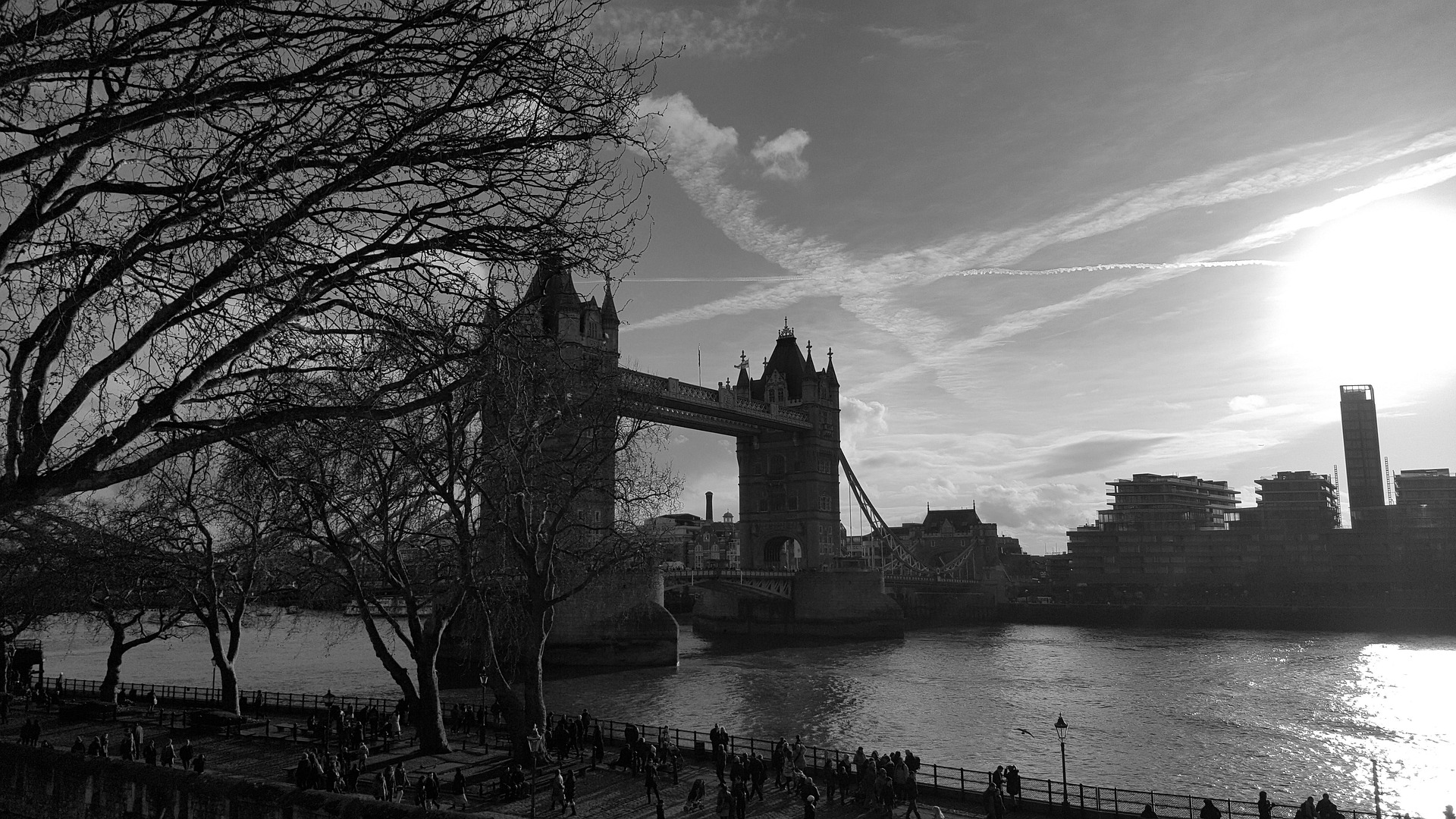
If one stands atop a high-rise in East London at dusk and looks out across the horizon, one can see the distant towers of Canary Wharf soaring into the skyline, where the HSBC logo flickers. In the opposite direction, the City of London presents a similarly dense constellation of contemporary structures, each packed tightly against the next. Surveying the surroundings, nearly every skyscraper erupting from the earth is a piece of haphazard modern architecture. As the gaze extends further, these modern developments appear so numerous that they seem to encircle and overwhelm almost every corner of London within sight. It feels as though only a few scattered spots beneath one's feet retain any remnants of the past, and even these have mostly succumbed to modern interventions. With only fragments of their original facades hastily preserved, calling them "historic buildings" has become a considerable stretch of the truth.
London is a historic city in the truest sense. The Romans began constructing what was known as Londinium in the first century C.E., giving it a history spanning nearly two thousand years. As early as the 1930s, old-school Britons began discussing the implementation of a "Green Belt" policy, aimed at preventing the city from sprawling outward indefinitely like "ink spreading across a sheet of paper". By 1935, the concept of a Metropolitan Green Belt was first proposed. This culminated in 1947 with the introduction of the landmark Town and Country Planning Act, which initiated the most stringent restrictions to date. Built upon urban policy foundations, this Act essentially revoked the rights of landowners to develop their property at will. Since then, any construction in London has required official planning permission. The right to develop land was effectively nationalized and has caused a chronic, "institutional shortage" in London's land supply.
Yet, can these urban management policies, once repeatedly lauded by academia, truly resolve the challenges of urban development, or do they instead breed further systemic malaise? These theoretical questions, which demand empirical validation, seem to have been overlooked for a long time, whether by design or through negligence. Consequently, modern London has undergone a form of distorted development that is largely ignored by the proud British planning and architectural establishment.
First of all, urban policy has begun to break through the constraints of conventional planning methods. Starting in late 2024, the British Labour government formally introduced the National Planning Policy Framework (NPPF), a "revolutionary concept" designed to create a "rational breach" within the Green Belt. According to preliminary estimates in early 2026 from the Ministry of Housing, Communities and Local Government alongside prominent British think tanks such as Knight Frank and the Centre for Cities, land classified as "Grey Belt" accounts for approximately 1.5% to 3% of the entire Metropolitan Green Belt surrounding London. While this percentage appears small, it is quite significant in practice. The figure was framed this way primarily to dampen political opposition. Given that the total area of London's Green Belt that encompasses London and its neighboring counties reaches roughly 515,000 hectares, designating about 2% as "Grey Belt" for urban regeneration means releasing 8,000 to 10,000 hectares of potential land for development. This provides a massive influx of land resources to facilitate the grand expansion of the city of London.
In theory, London appears to be a model of urban restraint, yet in reality, the city has never truly ceased its expansion. While Green Belt planning techniques have certainly had an impact, that influence is far less significant than commonly imagined and is by no means a paragon of scientific planning. Driven by the accumulation of urban population, the pressures of migration, and the urgent need for economic growth, London has long since employed various concepts and maneuvers to circumvent the restrictions of the Green Belt.
Secondly, the "London Green Belt" is, in practice, a flawed planning methodology. Constrained by Green Belt policies, the size of London should theoretically remain at approximately 1,572 square kilometers. However, the city's total architectural surface area, which is the combined area of all building facades and rooftops, as increased significantly alongside the proliferation of high-rises. When a low-rise building is demolished to make way for a skyscraper, such as "The Shard" or "The Cheesegrater" in the City, it is effectively converting horizontal urban sprawl into vertical surface expansion. This has intensified the city's upward growth, a phenomenon often deliberately ignored by the global architectural community and government sectors, yet it remains the critical factor fundamentally altering the urban landscape.
According to recent statistics from New London Architecture (NLA), the number of buildings over 20 stories tall currently in the planning or construction phases in London typically fluctuates between 500 and 600. Assuming that London has added 100 standard towers with an average height of 150 meters (approximately 40 to 50 stories) in recent years, the cumulative vertical surface area added by all mid-to-high-rise buildings (above 5 stories) constructed over the past two decades likely totals between 50 and 100 square kilometers. Consequently, accounting for both new constructions and redevelopments, it is reasonable to estimate that——the "London Green Belt" has already been breached by more than 10% in the vertical dimension.
Such a vertical urban expansion is almost entirely antithetical to the architectural style of historic London. These structures consist nearly exclusively of high-altitude configurations of glass and steel, which are the very characteristics of modern architecture. Furthermore, these spaces blend into the old city while simultaneously standing out prominently due to their modern forms, resulting in a sort of “modern invasion” of the London cityscape. The consequence of this approach has been a profound and fundamental transformation of London's original urban character.
Thirdly, the definition of the "Grey Belt" is unreasonable, and steers London’s urban regeneration down a path of crude mismanagement. Formally introduced by the British Labour government into the National Planning Policy Framework (NPPF) in 2024, the "Grey Belt" is a supposedly "revolutionary concept" whose objective effect is to create a "rational breach" within the previously “inviolable” Green Belt. This so-called "Grey Belt" development refers to land within the Green Belt that has fallen into disuse, overgrown with weeds or occupied by derelict petrol stations, and is deemed to possess no ecological value. Such land is now permitted to be reclassified for the construction of "affordable housing". Logically, this is clearly a form of "substantial encroachment”, yet in the context of Labour policy, it is euphemistically defined as "optimized utilization".
The Labour Party's urban policymakers argue that these sites have already been degraded by human activity, such as abandoned industrial land, and that transforming them into housing is not a matter of turning "greenery" into "concrete", but rather converting "ruins" into "residences" They contend that by establishing high-density, "Transit-Oriented Development (TOD)" communities on these scattered "Grey Belt" patches, they can theoretically prevent people from building homes further out in genuine, deep-green areas.
In fact, to satisfy "green" requirements, the Labour government’s new policy has even revised the definitions of "greenery" and the "Green Belt" itself. Now, any developer operating within the Grey Belt needs only to pledge a "Biodiversity Net Gain (BNG)". The logic follows that as long as a new building incorporates more environmental features, it meets regulatory standards, as doing so is considered a relative increase in "greenery".
In reality, London has been in a constant state of expansion. It is simply that this growth is typically met with the understanding of the public, including professionals and laypeople alike.
Beginning with Canary Wharf, the redevelopment of abandoned docks that commenced in the 1980s effectively marked the most significant breakthrough in the history of London’s planning. This was followed by King's Cross, a project that transformed former railway marshalling yards into a campus of TOD communities and corporate headquarters. There is also the Battersea Power Station; the urban regeneration of such massive industrial heritage sites has provided tens of thousands of square meters of new space, with each project contributing to the actual expansion of the city of London.
In contemporary London, the City has long since evolved into a high-density architectural cluster. By concentrating the construction of skyscrapers within an extremely small footprint, the urban plot ratio has reached a point of ultimate breakthrough. Furthermore, a plethora of "parasitic buildings" has emerged under various conceptual guises, adding modern stories atop existing historic structures. The approach circumvents the prohibitions against demolishing heritage buildings, yet in most cases, it severely compromises London's original urban character.
Frankly speaking, I have long shared a deep affinity with London, particularly through old friends in the field of urban research like Sir Peter Hall, who was involved in the design of King’s Cross. Out of this fondness for the city, London became one of the first places I sought out when I began traveling the world. In my case, one only truly critiques what one deeply loves.
As a world-class metropolis, London has long been regarded as a paragon of the modern city. During the initial surge of China's construction boom, London's urban architecture, particularly the financial cluster at Canary Wharf, delivered a profound shock to China. It exerted a tremendous influence on Chinese architectural and planning circles, serving for a time as the definitive blueprint for China’s own financial districts. Consequently, few in China have ever adopted a critical stance toward London; the prevailing attitude has been one of study and praise. However, as an honest critic, I am compelled to say frankly that contemporary London no longer offers much worth emulating. It is a failed city because, as a modern entity, London has effectively spiraled out of control. The city is trending toward an absolute failure rather than success.
In London today, architectural designs of every school and style permeate the city. These structures possess or are branded with various chic labels. Theoretically, they attempt to set the trend when, in reality, they are merely gimmicks for architectural marketing. The architectural design market is a fiercely competitive arena; without a distinctive label, how can one secure a project? The result of this cutthroat competition is an obsessive pursuit of unconventional design, which causes a proliferation of bizarrely shaped buildings across the city. More problematic still is the fact that these modern structures bear no relation to one another. The design and construction of such buildings often emphasize their differentiated existence rather than their integration with the surrounding environment.
Modern London has been rendered unrecognizable by rapid urban expansion and an irrational obsession with architectural design. While the preservation of the old city and its historic buildings continues in theory, these efforts have long been submerged by the sheer scale of the city's horizontal and vertical growth. Preservation ratios that once seemed reasonable and appropriate have dwindled, and it will certainly continue to shrink to the point where any sense of their presence is becoming almost impossible to find.
Regarding London’s urban fabric, what primarily remains are the constraints of the traditional street patterns, though the actual extent of their influence is difficult to ascertain. As the city sprawls and expands, the very scale of its streets follows suit. Once this horizontal expansion reaches a certain threshold, the encroachment of motorways becomes inevitable. In effect, the whole of contemporary London has evolved into an entirely new entity. Within this environment, the old city and its historic buildings are being continuously diluted, resulting in a state of perpetual relative contraction. The city's historical character is increasingly relegated to a mere decorative element of urban space, turning into a mere footnote to a massive influx of modern architecture.
I am uncertain how the British urban research community intends to confront this terrifying vision of London's future, but this is an industry that has always defined success and failures through results.
In the past, London enjoyed a prestigious reputation for allowing modern steel frames to pierce through Ancient Roman foundations, a practice that preserved its unique geographic continuity and kept the links to history relatively intact. Today’s London is filled with buildings that Londoners have vividly nicknamed "The Gherkin", "The Walkie-Talkie", and "The Cheesegrater". These modern structures, rising in a scramble for dominance, are dismantling the visual hierarchy and human scale that London cultivated over centuries. I wonder how the world will judge London when its cityscape becomes virtually indistinguishable from Tokyo, Hong Kong, Dubai, or Frankfurt? Once it has lost its historical imprint, can London still truly be called London?
It is profoundly saddening that the London which carried British history and memory is slipping away. The London people see now, and will see in the future, will probably be a "New London" maintained and molded by the mere "rhetoric" of architects. I have come to believe that this trajectory is virtually irreversible. This is because "modern Britons" bear no comparison to the heroic figures of British history; they live within a very confined dimensional space and have culturally adapted to such narrowness. They are quite content to let their city’s development become increasingly indistinguishable from the metropolises of other nations, a wish that is as pragmatic as it is mediocre.
Perhaps some will argue that this is the inevitable fate of every global metropolis, that with urbanization and population density, all cities must irrecoverably succumb to expansion and bloat, eventually reaching this same "modernity" through constant renewal. Others may contend that as long as a city preserves a certain number of old districts and streets, people will still be able to find traces of history and local character. In truth, answering these points is not difficult. The sheer proportion and scale of London's modern expansion have dictated a continuous erosion of its historical layers. This shift toward mediocrity ensures that, in the future competition among modern cities, London will have to rely solely on the manufactured concepts and "rhetoric" of planners and architects to sustain itself.
As twilight spread over London, the skyscrapers standing indistinctly around the city's perimeter resembled a cluster of tombstones. In the fading glow of the setting sun, it was as if someone was softly chanting an elegy for the city. In the days to come, London will no longer bring people excitement, but only a sense of sorrow.


