In India, “Tata” is everywhere. A typical Indian office worker’s day might look like this: waking up to a cup of Tata tea, commuting in a Tata-made car or taxi, crossing a steel bridge built by Tata, walking into a Tata company for work, using a Tata telco service to call clients, stopping by a Tata-owned supermarket after work to buy groceries, and finally heading home to rest.
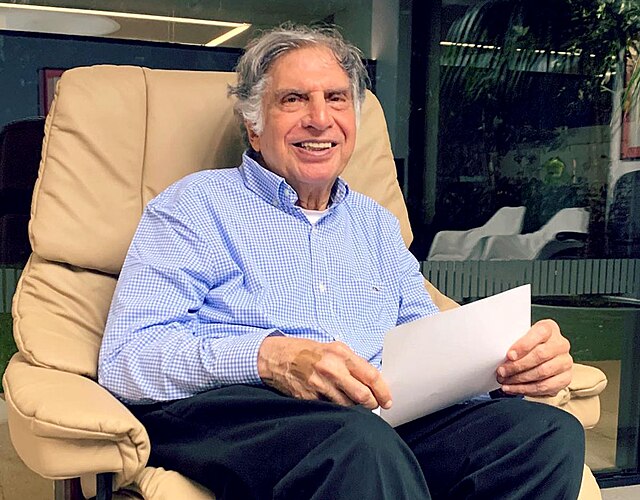
As of March 2024, the Tata Group reported annual revenues exceeding USD 168 billion and a market value of USD 365 billion, with operations spanning more than 100 countries and regions. It shifts from an inward-looking family business to a global multinational, and from a purely commercial conglomerate to a diversified group spanning education, healthcare, and technology. Behind all of this stands one name: Ratan Naval Tata.
Ratan Tata was born in 1937 in Mumbai into a Parsi family. Though small in number, the Parsi community has played a disproportionately influential role in modern India’s business, industrial, and intellectual spheres. The Tata family is among its most prominent names, having controlled India’s largest industrial group for generations. From birth, Ratan was surrounded by the weight of this legacy. Yet he was not simply a privileged heir destined for an easy life. At the age of seven, his parents divorced, an event that was rare and socially stigmatized in conservative Indian society at the time. A broken family often meant social marginalization and intense public scrutiny. It was in this environment that Ratan grew up.
During his university years, he rejected the path laid out by his family and chose instead to study at Cornell University in the United States. While there, he developed a passion for flying. On one occasion, while piloting a single-engine aircraft with classmates on board, the landing gear malfunctioned. The indicator light failed, and manual release did not respond. Faced with a life-or-death situation, he remained calm, focusing only on emergency procedures, adjusting the aircraft’s attitude and glide path, and ultimately executing a safe landing.
In 1962, Ratan returned to India and joined the Tata Group. Over the next two decades, he worked his way up from the shop floor at Tata Steel and Tata Consultancy Services, steadily building experience. His first major breakthrough came when he took over the struggling National Radio & Electronics Company (Nelco), then considered a “lost cause” within the group. Nelco’s market share stood at just 2%, while losses amounted to 40% of sales. Instead of choosing a conservative path, Ratan pushed the company toward high-tech product development. Within three years, Nelco’s market share rose to 20%, and the company turned profitable, marking his first major success.
In 1991, at the age of 54, Ratan Tata succeeded his uncle, J.R.D. Tata, to become the fourth-generation leader of the Tata Group. At the time, the group boasted over 100 subsidiaries, but management issues were becoming increasingly apparent. Most of these subsidiaries were controlled by executives aged 70 to 90. The most prominent figures among them were Russi Mody of Tata Steel, Darbari Seth of Tata Chemicals, and Ajit Kerkar of Indian Hotels. For years, these leaders had operated independently, treating their respective companies as personal fiefdoms and ignoring the strategic planning of the group headquarters. Ratan Tata realized that this fragmented, "each-to-their-own" management style could not survive in the face of global competition; he knew he had to change the landscape. In 1992, he implemented a mandatory retirement policy, decreeing that group directors must retire at 75, though he coupled this with generous financial compensation. Through this "carrot and stick" approach, he successfully pushed the septuagenarian leaders, including Mody and Seth, into retirement. He followed this with a series of moves to eliminate the biggest obstacle to reform: family nepotism. By requiring subsidiaries to report directly to the Group Office, he significantly consolidated and strengthened the authority of the headquarters.
With internal reforms underway, Ratan advanced the group’s global ambitions. In 2000, Tata acquired the UK-based Tetley Group, the world’s second-largest tea company, for USD 432 million. In 2007, it purchased the Biritsh-Dutch steelmaker Corus for USD 11.3 billion. In 2008, Tata acquired the British luxury car brands Jaguar and Land Rover from Ford for USD 2.3 billion. The Jaguar Land Rover deal, in particular, drew widespread skepticism amid the global financial crisis. Many doubted that an Indian company could successfully manage premium automotive brands. Contrary to expectations, Ratan chose not to interfere with operations, preserving the brands’ identity and positioning Tata as a strategic investor rather than an operator. He even assured that Jaguar Land Rover would remain a British enterprise rooted in the UK. Following the crisis, the brands rebounded strongly, especially Land Rover, whose luxury SUVs became highly popular in markets like China. During Ratan’s tenure from 1991 to 2012, group revenues grew from USD 6 billion to USD 100 billion, and market value increased 17-fold.
Even while pursuing global expansion, Ratan remained attentive to domestic needs. In 2008, Tata launched the world’s cheapest car, priced at around USD 2,500. The idea came from seeing a family of four riding precariously on a motorcycle during a rainy day. Determined to make four-wheeled transportation affordable, Ratan imposed strict cost targets, prompting engineers to simplify features, adopt modular design, and optimize supply chains. Although the product ultimately fell short commercially due to positioning challenges and public perception, it reflected his commitment to addressing the mobility needs of lower-income populations.
Like many business leaders, Ratan faced challenges in succession planning. In 2012, he appointed Cyrus Mistry as his successor. However, strategic differences soon emerged between Mistry and the group’s core leadership. After several years of tension, Ratan supported the board’s controversial decision to remove Mistry less than four years into his tenure. The move meant acknowledging a misjudgment and facing public criticism, but it ensured continuity in the group’s strategic direction.
After stepping down, Ratan devoted more time to investing in technology startups. He believed backing young entrepreneurs was more meaningful than investing in large corporations. In 2016 alone, he invested in 17 startups, including major Indian unicorns such as Snapdeal, Paytm, and Ola. In 2015, he also made a strategic investment in Xiaomi to support its expansion in India.
Through the Tata Trusts, he directed roughly two-thirds of the Tata Group’s shares toward charitable causes, supporting healthcare, education, and technological development in India. During the COVID-19 pandemic, he personally donated 5 billion rupees to relief efforts.
On October 9, 2024, in Mumbai, Ratan Tata passed away peacefully at the age of 86, marking the end of an era. The state of Maharashtra observed a day of mourning, and India’s Prime Minister Narendra Modi described him as "visionary business leader" and a "compassionate soul". Despite having overseen vast wealth, his personal net worth at the time of his death was estimated at only around USD 1 billion, having donated more than USD 102 billion to charitable causes over his lifetime.
Final analysis conclusion:
Ratan Tata’s life changed from a child marked by social stigma to a symbol of India’s entrepreneurial spirit. Over two decades at the helm of the Tata Group, he not only reshaped a traditional conglomerate into a global enterprise through decisive reforms, but also upheld the principle that wealth belongs to society. By directing roughly two-thirds of the group’s shares to philanthropy, he redefined what it means to be a business leader. At the time of his passing, this titan of industry who managed hundreds of billions in wealth left behind a relatively modest personal fortune, offering a powerful reminder that true leadership cannot be measured by wealth alone.
_________________________
Xiaofeng Li is a Economist of China Macro-Economy Research Center at ANBOUND, an independent think tank.


