Abstract
Socialism is an economic issue, not a political one. Economy pertains to wealth, while politics pertains to power; although socialism relates to both, relation is not equivalence. Only when economic growth reaches a certain stage does socialist theory become truly meaningful. The realization of politics and power can take many forms and does not necessarily rely on socialist theory. Therefore, examining the evolution of socialist theory through the lens of economics and wealth carries significant practical importance.
"Structural Socialism" is essentially a theory that examines and develops socialism from the perspective of economic growth and the implementation of related policies. Rooted in spatial theory, it introduces the concept of "key resources". Building upon this foundation and integrating relevant market theories, it constructs a social model to elucidate a fundamental path for policy practice. While the economy is not the absolute foundation of politics, it is undeniably the absolute foundation of power.
Naturally, any theoretical model is born of a specific social context; they are merely elective ideological frameworks proposed for a particular stage of development. When the social context undergoes fundamental change, these theories may become meaningless, retaining at most a degree of logical influence. Structural Socialism is no exception. ANBOUND consists of strategic policy researchers, which means their research orientation leans toward "prescriptionism" (1). In general, they are realists, eager to find a "prescription" within the whirlpool of complex theories that can solve not only current problems but, ideally, future ones as well.
Keywords: Structural Socialism, Space, Boundaries, Key Resources, Post-Industrial Society, Socialism, Capitalism, Prescriptionism, Double-Hull Structure
I. From "Dual-Hull Society" (2) to "Structural Socialism"
Looking at the development policy practice (3), it is apparent that socialism, including "planned socialism" (4) as well as classical socialist theory, has faced a major problem in its practical implementation, one that has essentially never been properly resolved. That problem concerns the practice of socialist development and the question of its effectiveness.
In general, socialism is a social theory and system that advocates that social production, distribution, and management should be jointly controlled by all members of society, with the goals of achieving social equality, justice, and common prosperity. In the developmental trajectory of Marxist theory, socialism is regarded as the primary stage in the transition from capitalism to communism. Its core lies in eliminating exploitation, liberating productive forces, and ensuring that the fruits of development are shared by all the people.
According to contemporary classical theory and the practices of various countries, including China, the realization and development path of a socialist society have generally focused on the following main aspects.
First, public ownership occupies a dominant position. (5) The means of production are held by society or the state in order to prevent excessive concentration of wealth. (6) Here, the definition of "means of production" is rather broad and has not been precisely, effectively, or practically defined on the basis of efficiency principles. As a result, in social practice, there have been situations in which the scope and boundaries shift without clear guidance. In addition, to what extent "dominance" should be exercised is likewise a major issue.
Second, distribution according to labor. (7) The emphasis here is that an individual's income should mainly depend on the quantity and quality of their labor, aiming to eliminate reaping without sowing. In reality, in today's society, the key issue is no longer about "money" itself, but about how money is obtained. Privilege, corruption, and "slacking off" types of inefficient labor all fall into the category of unearned gains, and to some extent, these have already been addressed.
Third, social equality and fairness. (8) This is extremely important, as it relates to eliminating class antagonism and to the level of social welfare provision. Clearly, the ideal goal is to provide equal access to education, healthcare, and social security. However, the real question lies in how to achieve and realize such a broad ideal. If even the most basic social medical security is difficult to sustain, this indicates that, from an overall perspective, the conditions for raising the level of social welfare provision are not yet present in reality. It then becomes necessary to consider alternative paths.
Fourth, planned and coordinated development. Classical theory seeks, through macro-level regulation, to ensure that economic development serves not only profit but also the fulfillment of social needs. However, when examined in substance, this ultimately comes down to questions of power and resources. How to deploy power and resources so as to generate the greatest economic benefits remains fraught with practical obstacles and challenges.
From the perspective of China's theory and practice, the integration of Marxism with China's concrete realities has given rise to socialism with Chinese characteristics. (10) In theory, this allows both the market to play a decisive role in resource allocation and, through state macroeconomic regulation, such as Five-Year Plans and national strategic emerging industry plans, to correct what is broadly defined as "market failure".
However, the difficulty lies in determining what actually constitutes "market failure" and what truly requires "correction". The policy distinctions involved here are extremely challenging in practice. The consequences may include periods of rapid and slow economic growth, along with industries that are sometimes encouraged and at other times restricted. This can lead to a loss of developmental direction and, ultimately, to financial constraints that make it increasingly difficult to improve the actual provision of social welfare.
In the theory of socialism with Chinese characteristics, great emphasis is placed on upholding the leadership of the Party. This serves as a fundamental guarantee in the relationship between power and resources. By the mid-2020s, China has placed even greater emphasis on "common prosperity", seeking to reduce wealth gaps through third-party redistribution (social philanthropy) and regionally coordinated development initiatives such as rural revitalization. The overall goal is to increase the level of social welfare provision. However, the development of this direction is clearly constrained by the broader economic environment and the country's overall economic capacity.
In addition, there is the concept of whole-process people's democracy, a high degree of technological independence, and institutional advantages, among others. In certain areas, the concentrated allocation of resources has allowed socialism with Chinese characteristics to exhibit its distinctive advantages such as nationwide governance. This is especially evident in strategic fields like AI, renewable energy, and deep space exploration, where the achievements have drawn global attention. However, the various sustainability issues present in practice should not be underestimated.
In fact, the immaturity and limitations of economic development also include disparities in income distribution. Although the goal of common prosperity is emphasized, the urban-rural gap and income inequality between industries remain focal points of social concern. Additionally, there are demographic pressures, such as aging and declining birth rates, which will become increasingly severe after 2026. These pose significant challenges to the sustainability of the social welfare system. Moreover, the external environment presents another major challenge. Geopolitical friction and international trade protectionism create immense competitive challenges, which are external in nature and will likely be both intense and prolonged.
Looking at the current socialist practice in China, the country is actively seeking policy solutions, attempting to address real-world issues by combining an "efficient market" with a "capable government". The problem, however, is that the government's "capability" might involve an amplification of power intervention, and an amplification of power intervention means a contraction of "market" space. This issue, which has essentially transformed into a question of space, remains a major unresolved challenge in practice, and there is still a lack of clear boundaries. From an epistemological perspective and in terms of the nature of the problem, I believe that this should be recognized and defined as a spatial issue rather than a policy planning issue. Thus, it will remain a core issue in the future practice of Chinese socialism.
When it comes to the practical policy implementation, China's socialist development path is still a dynamic model that is ongoing, exploratory, and experimental; it has not yet reached the stage of a classic, effective, and verifiable theory. In terms of the relationship between the principle of efficiency and wealth, it is clear that the socialist stage cannot ignore efficiency. In other words, capitalism, which emphasizes efficient modes of production, still requires more space for effectiveness to fully play out, in order to stimulate overall national economic growth and create the wealth base for common prosperity.
Taking China's land resources as an example, in decades of policy practice across various regions, land and other resources have almost always been allocated cheaply to production units through the development of industrial parks. Relatively speaking, this has caused the service industry in China to bear higher costs. This is essentially a planned allocation of resources, where power intervention has prioritized providing cheaper key resources to production and manufacturing units, while imposing higher costs on the service industry. This is, of course, a form of power intervention with socialist characteristics. To a large extent, it has encouraged production and contributed to China's economic rise. However, it has also, in one way or another, become an obstacle to the growth of China's service sector.
From real-world examples, it is clear that land is a critical resource. As China transitions from a production-oriented society to a consumption-driven one, and into the post-industrial era, it is essential to have the support of resources. The so-called transformation is basically the reallocation and adjustment of resources, which involves power intervention and tendency. Mobilizing such resources to achieve transformation requires the reconfiguration and redefinition of power. Without the factor of power, relying solely on market forces would make the task extremely difficult and may even make it impossible to achieve. This kind of power involvement, in essence, touches upon the core of socialism. Therefore, it can be said that it is precisely because China is a socialist country, able to mobilize and control key resources through power, that it is possible to efficiently enhance overall production efficiency at the resource level.
The problem lies in the fact that, at this level, we can also identify another issue, that in a socialist country, economic realization is actually layered. If the allocation of key resources is the primary expression of socialist nature, welfare distribution is not, because this level is still based on the expansion of wealth. Only when there is real wealth can distribution be discussed. Therefore, this still follows the principle of "more labor, more reward", emphasizing the efficiency principle, which, in simple terms, is "capitalist mode of production". On this issue, the perspective of structural socialism, which advocates for stratification, differs from the current mainstream socialist theory in policy practice. In other words, structural socialism asserts that the underlying logic is socialist, but only within the lower-tier space; beyond this lower tier, the more complex parts of social production must continue to use capitalist methods of production and follow capitalist efficiency principles. This is structural socialism.
"Structural socialism can be summarized as follows: the core is socialist, but the outer layer operates under capitalist principles. While the foundation remains socialist, the market functions on capitalist terms, and development follows capitalist models. Even welfare is achieved through capitalist modes of production. In this system, socialist and capitalist elements interact, creating a society with a 'dual-hull' structure".
The realization of this structural socialism is closely linked to the control of key resources. In reality, key resources are not limited to land (note: China's constitution has already defined this). In a post-industrial society, another key resource is the dominant market, namely the capital market (note: China's constitution does not define this). In discussions on post-industrial society, the capital market is the pivotal force and lever that drives everything. Market investors can utilize the capital market, and government finances and central banks can, and should, also make good use of the capital market. Both investors and government finances face significant opportunities in the development of productive finance and the capital market, and the government still holds dominant, core power in institutional interventions to reflect the basic nature of socialism. Therefore, in a post-industrial society, the capital market, as a key resource, is actually a fertile and untapped frontier waiting to be developed.
I believe that the key resources are fundamentally anchored in land and capital. Once these two core elements are addressed, the core of structural socialism is already firmly established at the foundational level. The broader social space should, however, be opened up and revitalized, following the capitalist mode of production, to seek and engage in high-efficiency production and development. There is no need to abandon large-scale production and competitive efficiency in other sectors of society simply for the sake of a theoretical concept.
In present-day China, the construction of a unified national market has been vigorously promoted. However, the development of this unified market is far more than just the construction of a technical market; it should also be viewed as an important theoretical development that needs to be expanded, developed, and enriched. The concept of "structural socialism" is, in fact, one possible theoretical experimental window within this process.
As a developing power, two key factors exist. First, the assumption of homogenized social classes and ideologies is invalid; second, capitalist competition originating from the outside is trans-border and global. These two trends dictate that socialist practices in various countries will remain in a "work-in-progress" state for the long term, perhaps even permanently. Any idealized socialist frameworks born from theoretical debate, even if they momentarily gain dominance, will eventually collide with massive practical obstacles. "Lack of monetary resources" cannot be solved by "ideological consciousness" alone; the improvement of welfare can only be achieved through the accumulation of wealth and a sufficiently abundant supply of resources. When the material foundation is not yet affluent, theoretical and policy practices that approach socialism from a holistic state or societal perspective, rather than from the perspective of individual competitiveness, are actually unrealistic. This realization highlights the necessity of implementing progress through structural layering and, consequently, establishing clear boundaries.
Furthermore, a unified national market must first and foremost be a market in order to be considered unified. As a market, it must emphasize efficiency, focusing on "the capitalist efficiency principles", rather than attempting to reverse the process and impose inefficiency in the name of socialism. Therefore, the invalidity of the assumption that social classes and ideologies are homogenized, combined with the reality of rising external competition, compels China to make more rational spatial decisions and define clearer policy boundaries. Only in this way can the unified national market be successfully formed and continually developed, thus laying a solid foundation for national governance and its internal connections.
Whether "key resources" are truly "key", and whether they sufficiently embody the core attributes and values of socialism, is a question that warrants specialized, in-depth research. It involves institutional construction techniques, experiences, and patterns. (17) However, it is a fundamental consensus of human societal development that land and capital markets serve as the foundational sectors for national growth. Even in the post-industrial era, the service industry remains a form of "production" in a broad sense, continuing to contribute to construction and development. Hence, as China gradually transitions into a post-industrial society, structural socialism still possesses the necessary conditions to persist and evolve. This is especially true given that the fundamental basis of the service industry is the capital market, which acts as a crucial resource for structural socialism.
If bold exploration in practice also encompasses theoretical inquiry, then "structural socialism" represents a theoretical field well worth exploring. It defines and clarifies numerous ambiguous boundaries within social reality, effectively opening a window for policy practice. By doing so, it creates the necessary conditions for the future of China's socio-economic development and the further unleashing of market economic vitality.
II. Modern Theories and Schools of Thought of Socialism
Socialist theory and schools of thought, after undergoing a long history and practice, have become rich and diverse. In addition to the long-standing and well-known classical theories, such as scientific socialism, there are actually a large number of theoretical systems and academic lineages that serve as the theoretical foundation for a significant group of left-wing scholars around the world. It should be noted that, in reality, right-wing scholars also rely on the existence of these socialist theories. The existence of right-wing scholars and their critical thinking is also dependent on left-wing theory. Otherwise, right-wing theory would lose its significance to some extent.
From the perspective of the modern intellectual evolution of socialist theory, the following are some of the more typical main schools and intellectual lineages:
1. Market Socialism (18)
Strictly speaking, this is not a single school of thought, but rather an intellectual lineage with significant internal differences spanning the 20th century. The main aim of this school is to address an age-old question: without the capitalist private ownership of resources, can the market be effectively utilized?
The core theoretical viewpoints of this school emphasize the importance of social ownership in socialism, rejecting private capital dominance. The insistence on social ownership creates rigidity and opposition, as power must ultimately be centralized to resolve ownership disputes. Market Socialism acknowledges the existence of individual businesses, cooperatives, and small private sectors, but inherently contradicts its own principles by allowing non-social ownership sectors that could eventually be eliminated. It advocates for market-based resource allocation rather than central command, a significant departure from classical socialism. Lastly, it defines the state's role as a rule-maker rather than a micro-manager, though this again contradicts the form of ownership it supports.
There are many representative figures of Market Socialism, with Oskar Lange (19) being one of the most prominent. He proposed the "Lange Model", which some describe as a theory of "Market-Simulated Socialism". Another key figure is Abba Lerner (20), who argued that the standard of socialism lies not in the form of ownership, but in whether it achieves the maximization of social welfare. He famously stated that an economic system is a tool, not a creed. This perspective has effectively been absorbed by Structural Socialism, which similarly maintains that the form of ownership is not the crux of the matter. Consequently, Structural Socialism repeatedly emphasizes the provision of public welfare. Furthermore, Fred M. Taylor (21) introduced the concept of Market Socialism by asserting that the market is merely a technical instrument and does not need to be exclusive to capitalism.
2. Pragmatic Market Socialism
In this regard, the theories of Edvard Kardelj (22), the primary theoretician of the Yugoslav socialist model, have exerted significant influence. His core arguments centered on worker self-management, whereby enterprises are controlled by worker collectives, and market forces determine prices and competition. From the perspective of Kardelj's theories, it is evident that modern market socialism has placed a clear emphasis on efficiency. In reality, this represents a theoretical shift driven by the practical deficiencies of previous socialist theories when put into actual practice.
Kardelj's theories were rooted in a powerful social context. Indeed, no theory can be understood or perceived in isolation from its background. His perspective emphasized a form of autonomy within production sectors, where the subjects of this autonomy were the workers of enterprises. By doing so, his model sought to break away from the rigid socialist bureaucracies that had bogged down socialist practices in other countries. While this represented a progressive step for its time, it clearly underestimated the difficulty and complexity of micro-level corporate governance and economic management.
As demonstrated by the later outcomes of Yugoslav socialist practices (23), there was an initial improvement in efficiency, but as time went on, particularly in the later stages, many problems emerged, such as investment imbalances, regional disparities, and soft budget constraints. In reality, wherever market competition exists, there will always be winners and losers. Socialism should not serve as a theoretical refuge for various types of failures, nor should it protect failures and idle beneficiaries under the guise of fairness. Socialism can only achieve sustainable wealth accumulation and provide high levels of public welfare by continuously rewarding genuine workers who create value at all levels. This is the key to achieving the goals of socialism.
3. Modern Socialist Theory (Post-1970s)
The defining characteristic of socialist theory during this stage is a stronger inclination toward institutional design and an emphasis on pragmatic policy. This orientation is clearly aligned with the characteristics of Structural Socialism. A primary representative of modern socialist theory is the British economist James Meade (24). For his pioneering research into international trade theory and international capital movements, he was co-awarded the Nobel Memorial Prize in Economic Sciences in 1977 alongside Swedish economist Bertil Ohlin (25). In his theoretical work, The Theory of International Economic Policy (Vol. II): Trade and Welfare, he provided a detailed analysis of how various trade restriction instruments, such as tariffs and quotas, impact national income and wealth distribution. He also explored how international capital flows act as either a substitute for or a supplement to commodity trade in regulating economic disparities between nations.
In the later stages of his career, Meade proposed avant-garde social reform schemes, suggesting the establishment of a national asset fund to distribute a "Social Dividend" to citizens. This was intended to address unemployment caused by automation and to narrow the wealth gap. Meade effectively delved into micro-level policy design, attempting to incorporate socialist ideals to enhance the provision of public welfare (26).
John Roemer (27), a professor at Yale University with a background in mathematics, developed and analyzed mathematical models of Marxian economics. He demonstrated the interdependence between the spheres of production and exchange. Roemer's view is that the exploitation rate is determined by a specific set of social relations and is also subject to the feedback effects of market prices. He maintains that a theory of surplus value remains valid even in the absence of the labor theory of value.
Roemer's models are highly modernized and closely mirror the structures of finance capital. His core idea involves achieving social shareholding through securitization and investment funds, utilizing institutional design to mitigate social inequality rather than abolishing the market. If one examines Structural Socialism even briefly, it becomes clear that Roemer's theoretical views are remarkably similar to it. However, because he approaches the issue from a holistic perspective rather than a layered one, his theory is essentially logical in principle yet remains potentially difficult to implement in practice.
Alec Nove (28) was an internationally renowned expert on the Soviet economy and socialist theory. His core concept, "Feasible Socialism," sought to explore an effective model that could achieve social equity and overcome the flaws of capitalism while avoiding the pitfalls of Soviet-style command economies, such as bureaucracy and inefficiency. He emphasized that socialism should be based on public ownership but must incorporate market mechanisms, advocating for a "mixed economy" model.
By proposing "Feasible Socialism", he effectively acknowledged that total planning is unworkable, that the market is indispensable, and that socialism must inherently be a mixed system. He was a realist who admitted truths that previous theorists were too embarrassed to face. However, the problem remains that he continued to view the issue from an unrealistic, holistic perspective, which led to his proposal of a "mixed system". In practice, the difficulty lies in the mechanics of the mix: what constitutes a rational or effective mixture? Ultimately, he failed to provide a satisfactory solution to this question.
4. Reformist Socialism
Reformist Socialism is a broad spectrum of thought rather than a singular school. Its core tenets are not overly complex: it advocates for the continuous reform within the existing institutional framework, breaking down and transforming socialist objectives into various operable and adjustable institutional arrangements.
Reformist Socialism is primarily concerned with sustainability, governability, and corrigibility, i.e., the capacity for self-correction. In this regard, Structural Socialism already carries a distinct "reformist" element. However, there are also clear and evident differences between the two.
The core starting points of Reformist Socialism primarily consist of the following five aspects:
(1) Not overthrowing the old system, but emphasizing gradual reform through a "pilot-and-expansion" approach. Reformist Socialism emphasizes identifying and correcting policy errors, bureaucratic rigidity, or unfair resource distribution through endogenous institutional arrangements, without overthrowing the existing political framework. China's reform and opening-up in the last century clearly exhibited these characteristics.
(2) All social governance tools must be tamed for socialist goals. Market, technology, capital, and management tools are no longer seen as neutral instruments. Instead, through institutional constraints and guidance, these tools are forced to align with core socialist objectives such as "social equity, common prosperity, and the all-round development of individuals".
(3) A mixed-ownership structure, but with an emphasis on public ownership as having a "foundational" and "safety-net" role. Multiple forms of ownership coexist, but the key issue is not who owns, but who controls, who benefits, and how it is regulated.
(4) "Strong state" and "self-restraint". A strong state refers to the ability to regulate and implement policies, but at the national level, it does not involve micromanaging every detail. Instead, it relies on self-restraint. In Reformist Socialist theory, "strong state" and "self-restraint" are viewed as a dialectical unity of core concepts. This combination aims to solve a historic dilemma: how to have a sufficiently powerful government to ensure fairness and order, while also preventing that government from becoming rigid or authoritarian due to excessive power.
(5) Result-oriented. The goal is not to pursue an ideal model, but rather to focus on whether income inequality has been reduced, whether public services have improved, and whether social mobility has increased.
Key figures of Reformist Socialism include Eduard Bernstein, a foundational thinker of Social Democracy who advocated for parliamentary democracy and social legislation while rejecting violent revolution. Karl Kautsky is also prominent; his perspective emphasized the evolutionary nature of social institutions. Furthermore, the Scandinavian Social Democrats have had a lasting global impact through their institutionalization of the universal welfare state and progressive tax-and-transfer systems.
5. Keynesianism and Socialist Schools
In the history of economic thought, Keynesianism and various Socialist Schools share similarities in their advocacy for "government intervention" (29), yet they differ significantly in their core philosophies, goals, and methods. Keynesianism is essentially a reformist theory proposed to "save" capitalism; its core objective is to resolve short-term economic fluctuations and unemployment. Keynes argued that when effective demand is insufficient, the cause of an economic depression is not a lack of productive capacity, but rather a lack of spending, in other words, a deficit in effective demand. Consequently, Keynes posited that the market is not omnipotent and is subject to "market failure". He maintained that when the economy is in a downturn, the government should stimulate demand through deficit spending, expanded public expenditure, and interest rate cuts. Conversely, it should take the opposite measures when the economy is overheating.
In the practical governance of various nations, Keynesianism and Reformist Socialism are frequently employed in tandem. For instance, Reformist Socialism often borrows Keynesian policy tools such as government investment to stimulate the economy, so as to achieve long-term socialist objectives, like common prosperity and high-quality development. On a theoretical level, while Keynesianism addresses the technical question of "how to keep the machine running", the socialist schools answer the fundamental question of "for whom the machine runs".
Among Keynesians, James Meade stands as a representative figure; in terms of his intellectual trajectory, he was essentially an architect of mixed economy systems. His lifelong advocacy for expansive welfare perhaps signals the fundamental trend in modern socialist thought. Ota Šik, the renowned designer of the economic reforms during the "Prague Spring", advocated for enterprise autonomy, emphasized the significance of market pricing, and championed national macro-control. Finally, Anthony Giddens proposed the so-called "Third Way". Although he de-emphasized the "socialist" label, his framework remains, in essence, a form of Reformist Socialism.
III. The Material Foundation of Key Resources
Can the realization of socialism rely on the control of key resources? This is a highly pragmatic issue that concerns immense operational realities. Whether Structural Socialism can actually be implemented depends, to a large extent, on this very factor.
Socialism places a profound emphasis on planning, as its universal significance is intrinsically linked to the pursuit of equity. Historically, however, the implementation of such planning has encountered significant systemic hurdles. Structural Socialism contends that the realization of planning should not be confined to a paradigm of comprehensive control. A critical flaw in prior socialist experiments was the overvaluation of total control, which neglected the reality that planning can be manifested through a diverse array of methods, mechanisms, and channels. Structural Socialism asserts that by securing control over key resources, the state can leverage resource radiation and dominant distributive relationships to facilitate the large-scale allocation and adjustment of interests. In doing so, it fulfills the "teleological significance of planning" and secures the universality of public welfare. The key resources prioritized by Structural Socialism, i.e., land and capital markets, are central because of their immense capacity for resource radiation and their role in defining distributive outcomes. As the foundational resources of social productivity, they are sufficient to embody the fundamental principles and social objectives of socialist planning.
In fact, we have already touched on the influence and scope of key resources in several articles (30). Here, we will further cite them and attempt to illustrate through examples that land and capital markets are indeed key resources in modern society.
Taking China's land resources as an example, in decades of policy practice across the country, land and other resources have almost always been allocated cheaply to production units through the construction of industrial parks, supporting China's rise as the "world's factory" and helping "Made in China" reach global markets. Naturally, by contrast, the service sector has borne higher costs due to the regulation of this key resource. Data show that from 2000 to 2025, the price gap between land for production and land for services has continued to widen, with core areas of first-tier cities seeing differences of several dozen times, while third- and fourth-tier cities typically experience gaps of several to over ten times.
Figure 1: Average Land Prices of Major Cities in China (31)
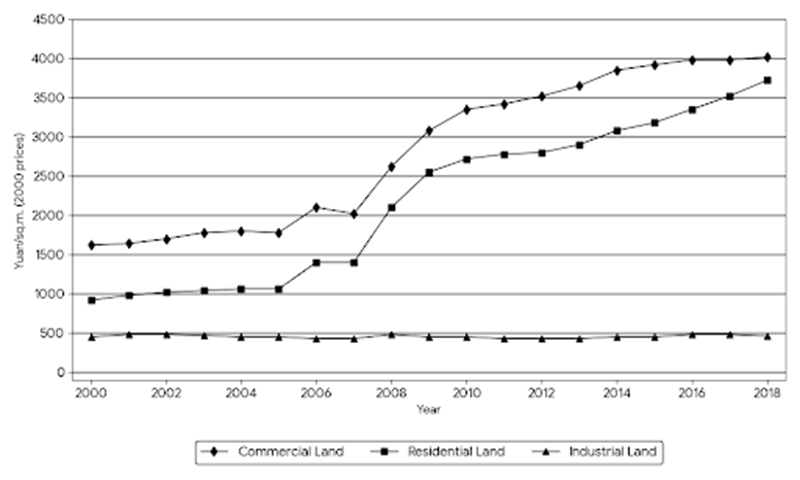
Data Source: National Major Cities Land Price Monitoring Report (2000–2018)
In the early stage of marketization, roughly between 2000 and 2005, land for production in China was transferred at extremely low prices, while land for commercial and service use began to be allocated through public bidding, auction, and listing, and the price gap began to emerge. According to data from the China Urban Land Price Dynamic Monitoring System, in 2005 the average price of industrial land nationwide was RMB 492 per square meter (RMB 328,000 per mu) (32), while the average price of commercial land during the same period was RMB 2,062 per square meter (RMB 1.375 million per mu), more than four times higher. In 2005, commercial land prices in Hangzhou had already reached the range of RMB 11,000–12,000 per square meter, while industrial land was only RMB 493 per square meter, resulting in a commercial-to-industrial land price gap of approximately 24 times.
During the period of widening land price differentials, roughly between 2007 and 2019, as China's urbanization accelerated, prices for commercial and service land surged, while industrial land prices remained relatively stable at low levels due to policy controls. A comprehensive study of 32 prefecture-level cities nationwide shows that the gap between commercial and industrial land prices was substantial and continued to widen; significant differences in growth rates further drove the expansion of the price differential (35). According to an academic survey covering 277 cities, the average price differential index between commercial/service land and industrial land from 2000 to 2018 was 9.293. In Guangzhou, for example, commercial land prices rose from RMB 5,356 per square meter in 2010 to RMB 15,351 per square meter in 2015, an increase of 187%. By contrast, the average industrial land price in the city's ten urban districts in 2015 was RMB 887 per square meter, far below commercial land prices (36).
During the period when the price gap remained at a high level, roughly from 2020 to 2025, amid urban renewal and industrial upgrading, premiums for commercial and service land in core urban areas remained elevated. Industrial land prices fluctuated only slightly due to policies promoting intensive land use, and the price differential continued to stay high. In 2020, the price of commercial and service land in Shenzhen was RMB 22,855 per square meter, while industrial land was priced at RMB 1,752 per square meter, a gap of about 13 times. In the same year, commercial and service land in Guangzhou was priced at RMB 13,073 per square meter, compared to RMB 1,463 per square meter for industrial land, a difference of approximately 8.9 times (37).
This implies that the "plannedness" of social development is clearly manifested in the state's command over a "key resource", i.e., land. By prioritizing the allocation of land to production and manufacturing units, the state effectively externalized higher operational costs onto the service industry. This dynamic represents a quintessential form of socialist regulatory intervention. By actively manipulating the distribution of this pivotal resource, the state incentivized industrial production and fueled China's rapid economic ascent. However, this strategy simultaneously created significant growth obstacles for the service sector, which faced inherently higher development costs as a direct byproduct of this land-based industrial bias.
Capital markets, as a key resource, possess this same nature. In 2025, the annual trading volume of China's capital markets, primarily the stock market, reached RMB 420 trillion, while the nation's total economic output stood at RMB 140 trillion. This places the ratio of market activity to total GDP at approximately 290%. The fact that capital market transactions are effectively 300% of the annual GDP clearly is an indication of their dominant position within the economy. In modern, and in fact, post-modern societies, the capital market is seen as an indispensable strategic resource. Even within traditional socialist theory, the perception of capital markets has undergone a clear evolution, moving from "total exclusion" to "instrumental utility", and finally to "strategic restructuring".
Figure 2: China – Shanghai Composite Index Trading Amount (Daily, RMB)

Data Source: Shanghai Stock Exchange
Chart Prepared by: ANBOUND Macroeconomic Research Center
Figure 3: China – Shanghai Composite Index Annual Trading Volume (Yearly, Trillion RMB)
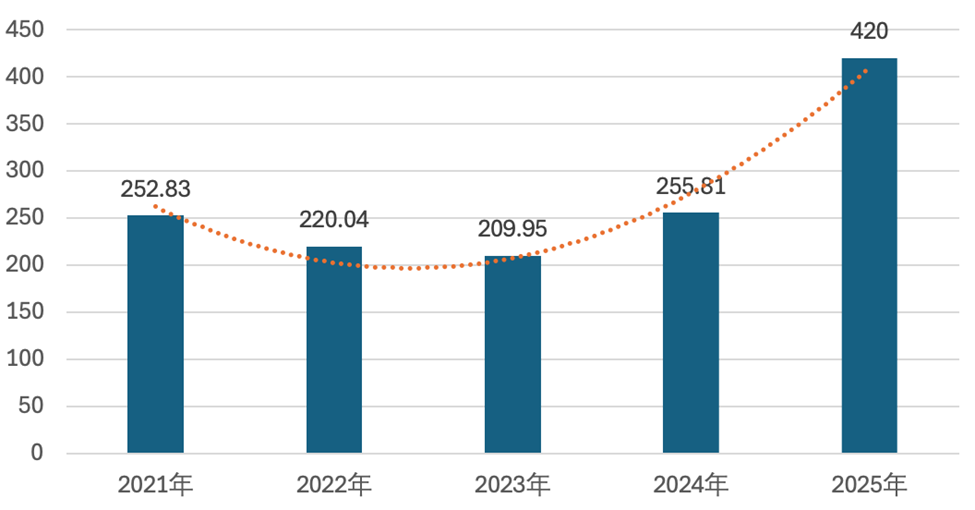
Data Source: Shanghai Stock Exchange
Chart Prepared by: ANBOUND Macroeconomic Research Center
In the past, capital markets were viewed simply as "efficient tools for resource allocation". However, modern socialist theory, like Socialism with Chinese Characteristics, posits that these markets function essentially as accelerators and amplifiers. They serve as a vital hub, mobilizing fragmented, idle social capital into long-term investments that fuel explosive growth in national strategic sectors, such as semiconductors, renewable energy, and quantum computing. Regarding risk mitigation, capital markets allow for the collective sharing of innovation risks, a distinct advantage compared to traditional bank loans. For a socialist state navigating the "uncharted waters of deep-tech" in 2026, this capacity is critical for achieving breakthroughs in core technologies.
Unlike capitalism, which views the capital market simply as a "profit-seeking venue", Structural Socialism places greater emphasis on its public nature and strategic significance. First, the capital market is a sovereign resource; a strong capital market is a pillar of national financial sovereignty. A socialist-oriented country can, by establishing its own capital market, reduce excessive dependence on Western financial systems. Second, the capital market should serve the real economy. Socialist-oriented countries firmly oppose the capital market's tendency to detach from the real economy. The logic is that the capital market must serve productive forces, and under this premise, it can become an effective tool to support the real economy.
On the surface, there appears to be a fundamental conflict between the nature of capital markets and socialist objectives. Capital is inherently profit-driven and short-sighted, whereas socialist goals are typically long-term and oriented toward the public good. However, from the perspective of Structural Socialism, capital markets must be evaluated as a collective whole rather than through the lens of individual investor behavior. While these markets naturally generate a wealth concentration effect, most modern reformist socialist theories argue that this can be managed. Through mechanisms such as capital gains taxes, property taxes, and secondary distribution systems, this can help to offset the wealth gap created by market activity.
In fact, reformist socialist theories around the world have already reached a clear consensus: without a developed capital market, it is impossible to build a modern socialist powerhouse. The capital market generates wealth, and having money is crucial. Only by expanding a large market space, including the capital market, can wealth be conditionally concentrated for welfare provision. Otherwise, the social production process may absorb most of the wealth.
Structural Socialism argues that wealth equilibrium and increased welfare provision cannot rely on subjective, top-down implementation. Instead, they should arise organically through the distribution of labor. Forced absolute egalitarianism creates systemic issues, which not only stifles production but also generates a form of "de facto" inequality. Ultimately, such an approach fails to raise social welfare levels and instead leads to collective poverty. Furthermore, by narrowing the focus of critical resources to land and capital markets, society can avoid the proliferation of massive, inefficient governance structures. most notably, bloated bureaucracies that erode welfare (38). The more areas that require direct management, the larger and more numerous these governing bodies become. These institutions themselves consume a significant portion of social resources, effectively reducing the very welfare they were meant to provide.
IV. Principal Theoretical Distinctions and Key Priorities of Structural Socialism
From a policy research perspective, the primary focus of Structural Socialism is solving the "spatial problem" of theoretical implementation. It seeks neither a breakthrough in abstract theory, nor a shift in the nation's path, direction, or even specific industrial policy. Instead, Structural Socialism places its core emphasis on policy execution, striving to find a grounded development theory that can truly penetrate the foundational layers of society and solidify its base. Historically, various socialist theories have faced deep-seated, recurring challenges in institutional realization and practical application, often resulting in a "one step forward, two steps back" cycle of inconsistency. The central dilemma of many socialist frameworks lies in the immense difficulty of putting them into practice. In certain environments, these challenges are so severe that they can only be temporarily resolved, shelved, or bypassed through political discourse. Consequently, the introduction of Structural Socialism represents a valuable and groundbreaking theoretical attempt to address these long-standing implementation gaps.
The fundamental issue of the theory lies in the coexistence of spaces.
Capitalism and socialism exist as two separate spaces, which in the past led to conflict and contradiction. In terms of development, the competition between these two spaces was quite evident, especially under conditions of unclear theories. Current policies and laws reflect an overall leftward shift, showing urgency in increasing welfare provision and achieving broad outcomes such as stringent labor regulations on enterprises and the difficulty of sustaining social healthcare. However, these theoretically desirable goals are incompatible with economic growth and therefore lack sustainable support under existing economic conditions.
Furthermore, some traditional, unreformed socialist sectors, such as higher education, struggle to coordinate effectively and generate societal innovation or contradictions. Nearly all universities in China are public institutions, and efforts to establish private universities have largely been unsuccessful and are increasingly declining, as evidenced by initiatives sponsored by Li Ka-shing and foreign cooperative programs that have been discontinued (39). Consequently, pursuing integrated development across both sectors remains a major structural challenge and an important task for social progress.
It is worth noting that, in terms of research methodology, Structural Socialism adopts a pragmatic, "prescription-based" approach. Its primary purpose is to open a window for solving the problem of policy effectiveness, creating the theoretical conditions necessary for a "capable government" to function. After all, a government's capability can only be realized through the execution of effective policy. Specifically, we believe the principal distinctions and priorities of Structural Socialism, compared to traditional socialist theories, include the following points:
1. Structural Socialism follows a theoretical path based on layers, space, and structure. Layers provide operability, facilitating adjustments and reforms in state governance. Space makes the social character clearly identifiable, and the value and significance of the market are highly evident. Structure aids social governance and its understanding, demonstrating the full compatibility and coexistence of socialism's underlying logic with the capitalist market.
2. Structural Socialism effectively resolves the historical issue of implementing theory on a holistic scale. By decomposing broad challenges into manageable, structured "spaces", it provides a spatial solution to long-standing theoretical bottlenecks. This allows for the resolution of "grandiose yet impractical" problems that have historically caused significant disruption in practice.
3. From the perspective of policy research, the focus of Structural Socialism is placed entirely on the "space of reality", rather than the questions of ownership that have been obsessed by and idealized in theoretical discourses for the past two centuries. By taking this approach, the theory breaks free from traditional ideological constraints, thereby unleashing market momentum, mobilizing the drive for wealth creation, and intensifying the overall motivation for economic development.
4. Structural Socialism places its primary emphasis on achieving wealth accumulation through development, a focus that aligns with historical practice over the past two centuries and China's own Reform and Opening-up process. The theoretical trajectory is clear: wealth accumulation is the vehicle used to realize and elevate the provision of public welfare. By raising these welfare levels, the ultimate objectives of socialism are achieved. Naturally, this path differs significantly from many other socialist theories.
5. From the perspective of socialist theoretical lineage, Structural Socialism addresses the long-standing contradictions, such as the conflict between ownership and wealth creation, by compressing them into specific layers. By narrowing the scope to "key resources" and exercising control through existing industrial and market influence, socialist principles and objectives are achieved indirectly. This approach substantially increases the ease of policy implementation.
6. In post-modern societies, capital markets are categorized as "key resources". However, this does not imply state control in a restrictive sense. Rather, it suggests that national governance, including fiscal policy, must fully utilize these markets. In this context, the state acts much like a powerful and influential institutional investor, directing market forces to serve socialist value objectives. This represents a role adaptation suited to the post-modern era. While the state's objectives for utilizing key resources differ from those of an average investor, the social significance defined by socialist theory is nonetheless achieved. Furthermore, the very rules and legal frameworks governing capital markets can be designed to embody and advance specific social goals.
7. Structural Socialism allows socialist theory to completely shed its long-standing utopian character, resolving the deep-seated contradictions between theory and reality. In doing so, it opens the door to a vast and enduring space for sustainable development.
8. Structural Socialism emphasizes that the essential significance of public ownership is not a question of "ownership" itself, but of "extent". This perspective allows the theory to enter critical domains of development, enabling problems to be addressed through the process of growth.
9. Structural Socialism asserts that both socialism and capitalism are institutional tools used to achieve specific social states. Rather than being mutually exclusive systems, the two can be unified. From this perspective, their coexistence is not inherently problematic. Indeed, it is a dimension that previous theories simply failed to address spatially.
10. Structural Socialism supports the view that capital activity is itself a form of accumulated labor. Consequently, it rejects the demonization of capitalism.
Structural socialism holds that, on one hand, the efficiency advantages of capitalism must be acknowledged, while on the other hand, the provision of social welfare under socialism is also a universal goal of human society (40). The integrated development of these two elements avoids extremes, allowing efficiency to generate maximum wealth accumulation and enabling that wealth to be transformed to the greatest extent into social welfare. This should be the key direction and theoretical foundation most conducive to social development.
In fact, the kind of reality we observe corresponds to the kind of theory we hold. Different theoretical approaches can be examined and validated through empirical observation.
Although China's long-term development has achieved remarkable results, its socialist theory has, in practice, experienced certain deviations and misinterpretations, giving rise to many "non-theoretical" realities at the grassroots level. For instance, a significant portion of China's entrepreneurial class is preoccupied with luxury consumption and indulgent lifestyles, a cultural phenomenon that has become increasingly mainstream in public discourse. By contrast, capitalist societies such as the United States have fostered technology entrepreneurs like Elon Musk who pursue ambitious visions for the future of humanity and approach enterprise with a broad, socially-oriented perspective.
The emergence of such entrepreneurial groups in the United States rather than in China is by no means accidental. Elon Musk's ability to grow in a capitalist environment like that of the U.S. and pursue his ambitions in space exploration is clearly linked to a highly efficient competitive environment. The conditions fostered by capitalism are conducive to wealth creation and the development of genuinely talented individuals. After all, a society can only realize true wealth creation if it effectively rewards those who pursue their ambitions and bring their visions to life.
Therefore, Structural Socialism implements social development theory through a layered approach, establishing a "welfare + capital" framework in terms of spatial organization. By providing this fresh characterization of the overall social environment, it offers a pragmatic and evidence-based theoretical advancement, one that merits serious consideration and implementation by all developing societies.
(End)
(1) Presriptionism was mentioned and interpreted by Kung Chan.
(2) The term Double Hull Structure originally refers to a design featuring both inner and outer shells, widely used in engineering for submarines and large oil tankers. In these designs, the inner hull provides structural pressure resistance, while the outer hull handles streamlining, collision protection, or explosion resistance. This specialized division of labor ensures superior overall performance. ANBOUND's founder Kung Chan first adapted this concept on January 18, 2026 to provide an innovative framework for describing social structures.
(3) "Structural Socialism in a Double-Hull Society", in Daily Economy, Issue No. 7583, Kung Chan, ANBOUND.
(4) After the founding of the People's Republic of China, leaders such as Mao Zedong and Liu Shaoqi asserted that the New Democratic Economy was a planned economy. Mao Zedong explicitly opposed the implementation of free trade and free competition. Furthermore, the Common Program of the Chinese People's Political Consultative Conference (the provisional constitution at the time) stipulated that China was to implement a planned economy.
(5) The socialist economy is a planned commodity economy based on public ownership. The plan must be implemented through the law of value, and the law of value must be utilized to serve the plan. See, "Decision of the Central Committee of the Communist Party of China on Reform of the Economic Structure", Third Plenary Session of the 12th Central Committee.
(6) Prior to 1953, China employed planning as the primary method of state economic management, categorized into directive plans and indicative plans.
(7) In 1958, Mao Zedong pointed out in the Resolution on Some Questions Concerning the People's Communes: "The principle of socialism is 'from each according to their ability, and to each according to their work".
(8) Equality is an essential requirement of socialism. The equality advocated by socialism not only demands the realization of equal rights for individuals at the political and legal levels but also requires the establishment of public ownership of the means of production within the economic sphere. The goal is to achieve substantive equality of outcome, ensuring that the people collectively share the fruits of social development. See, "Interpretation of the Basic Content of Socialist Core Values", 2014.
(9) The report of the 14th Party Congress pointed out: "By establishing such an economic structure we mean to let market forces, under the macroeconomic control of the state, serve as the basic means of regulating the allocation of resources, to subject economic activity to the law of value and to make it responsive to the changing relations between supply and demand… so that the efficient ones will prosper and the inefficient ones will be eliminated".
(10) Socialism with Chinese characteristics was explicitly proposed by Deng Xiaoping at the 12th National Congress of the Communist Party in 1982.
(11) Five-Year Plan (also called Five-Year Program): A national development plan. Its full name is the Outline of the Five-Year Plan for National Economic and Social Development of the People's Republic of China. It is a medium- to long-term development plan and an important guiding document for China's economic and social development. From the implementation of the first Five-Year Plan in 1953 after the founding of the People's Republic of China to the conclusion of the 14th Five-Year Plan in 2025, "planning to govern the country" has gradually emerged and become institutionalized in China's governance process, forming a new model of national governance. See, "Resolution of the Central Committee of the Communist Party of China on Further Deepening Reform Comprehensively to Advance Chinese Modernization".
(12) The 'Five-Year Plan' exemplifies the nationwide governance system. It sets forth the country's overall objectives, priority tasks, and policy directions over the next five years across the economy, society, science and technology, ecology, and public welfare, demonstrating the capacity of China's socialist system to mobilize resources for major initiatives.
(13) "In the context of the gradual establishment and improvement of China's market economic system, as well as the vigorous development of the urban land market and rapid urbanization and industrialization, the reform of the collective land-use system is the prevailing trend. Allowing the transfer of rural collective land is, first and foremost, a requirement for equity in urban and rural land rights; secondly, it is an inevitable choice for the efficient allocation of rural land resources; and thirdly, it is a basic requirement for the reasonable realization of the property of rural collectives and households. ... In the process of reform, it is essential to prevent the impact and shocks on the productive function of land caused by the excessive capitalization of land, the excessive rapid rise of land prices, and the excessive appreciation of land value". See, "A Century of Land System Change of the Communist Party of China", Zhu Daolin.
(14) A post-industrial society refers to a society in which industrialization has been largely completed, manufacturing is no longer the main economic driver, and the economy is dominated by the service sector, knowledge industries, and innovation. As early as 2018, ANBOUND foresaw this stage of change in China, pioneering the concept of POD to respond to the trends of the post-industrial era, and developed a systematic, "people-centered" principle for urban renewal.
(15)"Post-Industrial China and Productive Finance", in ANBOUND Geopolitical Review (AGR), Kung Chan.
(16) "China's Fiscal Efforts Need to Rely on Capital Markets" in Daily Finance, Issue No. 6918, Yang Xite, ANBOUND.
(17) I believe that this is a vast area worthy of continued discussion in the future, and there will certainly be many compelling cases and theoretical insights.
(18) Market Socialism: A form of socialism that advocates for the full implementation of a market economy. Its theoretical development was concentrated between the 1920s and 1990s. Its fundamental characteristic is the separation of the method of resource allocation from the social system.
(19) Oskar R. Lange (1904–1965) was a Polish economist and diplomat. He advocated for the use of market pricing tools within a socialist system and proposed the model of market socialism.
(20) Abba Lerner (1903–1982) proposed the "Lerner Index of Monopoly Power" in 1934. He introduced the concept of the "public debt illusion" and systematically elaborated on the "wealth effect of public debt", revealing how the issuance of public debt acts as a regulator for economic cycles.
(21) Fred M. Taylor (1855–1932) was one of the early scholars to advocate the introduction of market mechanisms within a socialist system to achieve more efficient economic operation.
(22) Edvard Kardelj (1910–1979) was a prominent political figure in the Socialist Federal Republic of Yugoslavia. Kardelj is regarded as the pioneer of the Yugoslav "Workers' Self-Management" model and the primary theorist of Titoism.
(23) Yugoslavia disintegrated in 1992.
(24) James Meade (1907–1995) is best known for his work An Introduction to Economic Analysis and Policy.
(25) Bertil Ohlin (1899–1979) authored the seminal Interregional and International Trade, a foundational text included in economics curricula worldwide.
(26) In fact, Meade's views are identical to those of ANBOUND. Over a decade ago, ANBOUND suggested using mutual funds to reform China's state-owned enterprises (SOEs) to improve the supply of public welfare.
(27) John Roemer (1945–) seeks to construct a theoretical framework for egalitarian justice, aimed at providing theory and direction for the emancipatory struggles of the Left. Roemer argues that the injustice of capitalism lies in its failure to provide equal opportunity; justice, therefore, requires equality of opportunity.
(28) Alec Nove (1915–1994) was a Professor of Economics at the University of Glasgow and is considered a renowned authority on the economic history of Russia and the Soviet Union. His representative work is The Economics of Feasible Socialism Revisited.
(29) In fact, the author is not alone in this view; many scholars share the same perspective. For instance, in The Road to Serfdom, Friedrich Hayek, while not explicitly labeling Keynes a Soviet-style socialist, argued that Keynesianism grants the government excessive planning power. Similarly, Joseph Schumpeter, in Capitalism, Socialism and Democracy, pointed out that Keynes's policies were effectively dismantling the pillars of capitalism. Murray Rothbard, the staunch libertarian, went as far as to characterize Keynes as an elitist whose economic system shared fundamental characteristics with fascism and socialism.
(30) Please refer to ANBOUND's related articles.
(31) "Why is the Price Gap Between Residential and Industrial Land Continuously Widening?", in "China Economic Quarterly (Jingjixue), Vol. 24, No. 3", Liao Mouhua et al., 2024.
(32) https://www.landvalue.com.cn/
(33) https://china.zjol.com.cn/05china/system/2007/02/02/008152458.shtml
(34) "Spatial Distribution of Urban Land Prices in China, 2007–2019", in "Geographical Research, 41(06): 1637-1651", Liu Xiaoyu and Xin Liangjie, 2022.
(35) "Between People and Land: Urban-Rural Land Reform Under China's Growth Model". Liaoning People's Publishing House, Tao Ran, 2023.
(36) https://www.guandian.cn/article/20150526/161127.html
(37) "Guangdong Provincial Urban Land Price Dynamic Monitoring Report (2020)", Department of Natural Resources of Guangdong Province. [2021-05-21].
https://nr.gd.gov.cn/zwgknew/sjfb/tjsj/content/post_3288359.html
(38) According to several in-depth research reports and public speeches by Li Xunlei between 2023 and 2024, the scale of the population in China whose livelihood is broadly supported by the state budget is approximately 80 million. Leading financial media outlets in the country have reported on his views in detail. Recent research by Professor Zhang Jun and others from the School of Economics at Fudan University (published in 2025) estimates that the proportion of personnel supported by public finance has reached 4.86% of the total population. Based on China's total population of 1.405 billion at the end of 2025, the broad number of supported individuals is approximately 68 million. This data includes staff within the official administrative establishment, personnel outside the formal establishment (contract workers such as auxiliary police and community supervisors), and retirees whose pensions are issued by the state treasury.
(39) Shantou University, which has received long-term sponsorship from Li Ka-shing, has been involved in numerous issues. The Li Ka-shing Foundation has confirmed its withdrawal from the campus, consolidating and relocating its offices to Shenzhen due to changes in mainland legal regulations. Furthermore, the termination of China's foreign cooperative educational programs has become increasingly common. Between 2018 and 2023, the Ministry of Education terminated 234 programs (in 2018) and 286 programs (in 2021). These closures involved prestigious universities in various regions, including Heilongjiang, Shanghai, and Beijing.
(40) In 2015, responding to discussions in American politics that viewed Denmark as a model for socialism, then-Danish Prime Minister Lars Løkke Rasmussen explicitly clarified during a speech at Harvard University: "I know that some people in the US associate the Nordic model with some sort of socialism. . . . I would like to make one thing clear. Denmark is far from a socialist planned economy. Denmark is a market economy". Furthermore, the so-called "Swedish lesson" is also well-known. Kjell-Olof Feldt, the former Social Democratic Minister of Finance in Sweden, once stated bluntly: "What we believed in as young socialists simply turned out to be impossible in practice (referring to the radical socialization schemes attempted in the 1970s)". Some leftist scholars (such as sociologists influenced by the Frankfurt School) argue that the Nordic model represents an intermediate stage toward "Democratic Socialism". They contend that when labor unions become powerful enough to determine the allocation of capital, the system takes on a "quasi-socialist" characteristic.


